
Written and clinically reviewed by Louise Yow, Principal Physiotherapist & Director, AHPC A1300363H.Last reviewed 6 October 2026.
Basketball breaks people in a very particular way.
It is not a contact sport on paper. But it is jumping, landing, cutting, stopping dead, and doing all of that on a hard surface, in a crowd, with somebody’s foot where yours is about to land. In Singapore most of it happens on concrete under a block or on an outdoor court in the afternoon heat, which makes every one of those forces slightly less forgiving.
Our physios at Phoenix Rehab see the same five injuries over and over. What follows is what each one actually is, where players get it wrong, and where the line sits between something you can play through and something that will still be affecting you at forty.
One of the five is a hand injury, which our hand therapists treat, and it is marked.
Every basketball injury, by body part
Start from where it hurts. Each linked row goes to the page that covers that injury in full. Rows marked “see a doctor first” are not ours to treat first.
| Where | Injury | How basketball usually causes it |
|---|---|---|
| Hand and finger | Jammed finger (volar plate injury) | The ball strikes the fingertip |
| Hand and finger | Mallet finger | The ball strikes the straight fingertip |
| Hand and finger | Finger dislocation | The ball or contact |
| Hand and finger | Skier’s thumb (thumb ligament tear) | The ball forces the thumb back |
| Hand and finger | Finger fracture | The ball or contact |
| Wrist | Scaphoid fracture | Fall on an outstretched hand |
| Wrist | Wrist fracture | Fall on an outstretched hand |
| Shoulder | Shoulder dislocation or instability | Contact while rebounding |
| Neck | Concussion (see a doctor first) | An elbow, or the floor |
| Lower back | Low back strain | Jumping and landing |
| Lower back | Spondylolysis (low back stress fracture) | Repeated arching in teenage players |
| Thigh | Dead leg (thigh bruise) | A knee to the thigh |
| Knee | Jumper’s knee (patellar tendon pain) | Repetitive jumping |
| Knee | Kneecap pain | Jumping and cutting volume |
| Knee | ACL tear | Landing or cutting without contact |
| Knee | Meniscus tear | Pivoting |
| Knee | MCL sprain | Contact to the outside of the knee |
| Knee | Osgood-Schlatter (teenagers) | Growth spurts in young players |
| Lower leg | Achilles rupture | Explosive push-off, more often in older recreational players |
| Lower leg | Achilles tendon pain | Jumping volume |
| Lower leg | Calf strain | Push-off |
| Lower leg | Shin stress fracture | Jumping load |
| Ankle | Ankle sprain | Landing on another player’s foot |
| Ankle | High ankle sprain | Rotating on a planted foot |
| Ankle | Ankle that keeps giving way | Repeated sprains |
| Foot | Fifth metatarsal (Jones) fracture | Cutting on the outside of the foot |
| Foot | Navicular stress fracture | Jump-landing load |
| Foot | Plantar heel pain (plantar fasciitis) | Court volume |
| Foot | Lisfranc (midfoot) injury | Landing with the foot pointed |
The Rolled Ankle
The most common basketball injury in the world, and the most badly managed.
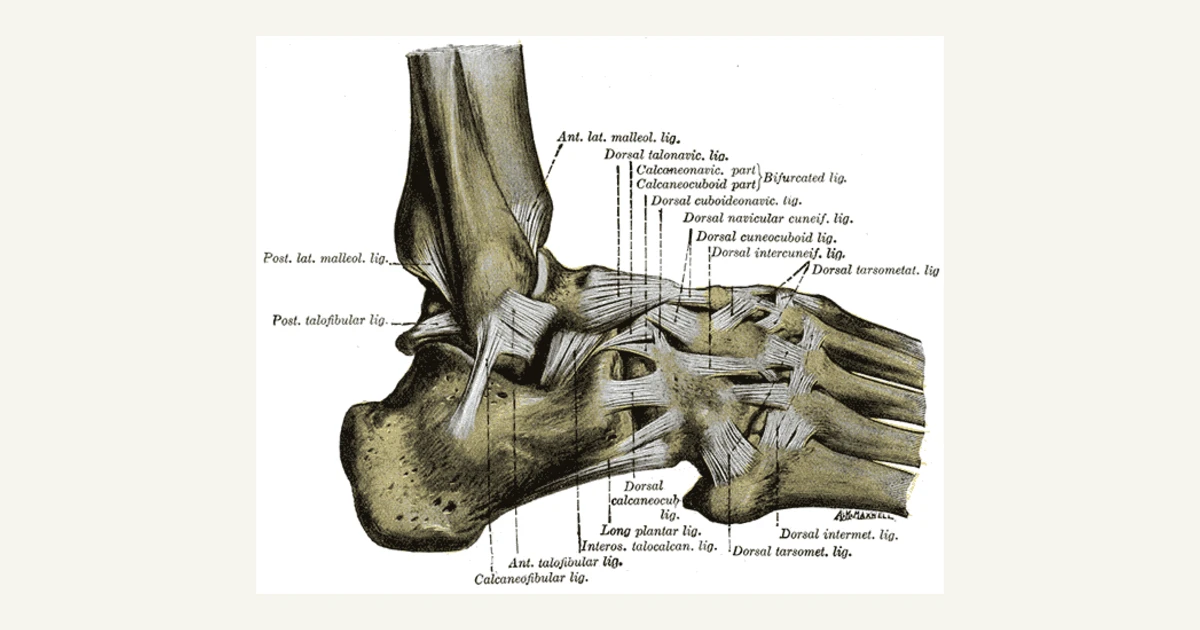
What it actually is. The ligaments on the outside of your ankle are strained or torn when the foot rolls inward, usually when you land on somebody else’s foot. There is often swelling within an hour, bruising over the following days, and pain on the bony bump on the outside.
Where players go wrong. They wait for the pain to stop, then go straight back.
Here is the problem with that. Ligaments do two jobs. They physically restrain the joint, and they feed your brain information about where your foot is in space. That second job is the one people forget. After a sprain, the sensing system is disrupted, and it does not repair itself just because the swelling went down.
So you return to court with an ankle that no longer reports its own position accurately. It does not react in time. You roll it again. That second sprain happens on weaker tissue, so it takes less force. Then a third. Within a couple of years you have an ankle that gives way on flat ground and a player who has quietly accepted that this is just how their ankle is now.
That is called chronic ankle instability, and it is almost always the consequence of a first sprain that was never properly rehabilitated. It also raises your risk of ankle arthritis decades later.
What treatment actually looks like. Settling the swelling early, then improving full ankle movement, then rebuilding the balance and reaction system deliberately. Single leg work, landing control, changes of direction. It is not complicated and it is not long. It is just almost never done, because by the time it would start, the pain has gone and the player has already gone back.
The rule that matters. Pain free does not mean ready. Being able to hop, land, and change direction on that leg with control is ready.
The Jammed Finger (A Hand Therapy Injury)
Every basketball player has jammed a finger. That is exactly why this injury does more long term damage than any other on this list. It is normalized.
What it actually is. The ball hits the end of an outstretched finger and drives the middle joint backwards or sideways. Several different things can happen, and they look almost identical from the outside.
The small plate of tough tissue at the front of the joint can tear. The ligaments on the sides can strain or rupture. The joint can dislocate and pop straight back in, which players often do themselves on court and then never mention to anyone. And a small piece of bone can be pulled off where a tendon attaches.
There is one variant that matters more than the rest. If the ball strikes the very tip and the fingertip then droops and will not straighten on its own, that is a mallet finger. The tendon that straightens the fingertip has been torn or has pulled bone off with it. That one has a treatment window, and it is measured in weeks. Miss the window and the finger stays bent permanently.
Where players go wrong. They tape it to the next finger and keep playing. Which is sometimes correct. But taping is a decision that should follow a diagnosis, not replace one.
The most common outcome our hand therapists see is the finger that was jammed two years ago and is still thicker than the others, still slightly bent, still stiff in the morning, and can no longer be fully straightened. The player has stopped thinking of it as an injury. It has become a feature of their hand. It did not have to be.
What treatment actually looks like. Working out which structure was damaged. Then, depending on the answer, a period in a specific splint position, controlled movement early to prevent the joint from stiffening, and swelling management. The finger joints stiffen faster than almost anything else in the body. Weeks of immobility in the wrong position produce permanent loss.
The rule that matters. If a finger will not fully straighten, will not fully bend, is still swollen after two weeks, or the fingertip droops, that is an appointment. Not tape.
Jumper’s Knee
What it actually is. Pain at the front of the knee, just below the kneecap, in the tendon that transmits all of your jumping force. It comes from load accumulating faster than the tendon can adapt. Hard courts make it worse. So do sudden increases in playing volume, which is why it shows up when someone starts playing three times a week after months of nothing.
How you will know. Pain right on that spot, sharpest when you jump, land, or come out of a deep squat. It often warms up during a game and hurts most afterwards and the next morning. In the early stages it does not stop you playing, which is precisely why it becomes chronic.
Where players go wrong. Rest and stretching. Both feel sensible and neither works well. A tendon that is under recovering from too much load does not need zero load. It needs the right load applied progressively over time. Full rest reduces pain quickly, weakens the tendon further, and the pain returns on the first game back.
What treatment actually looks like. Progressive, measured loading. Our physios build the tendon’s capacity back up in stages while managing how much you play. It is slow, it is repetitive, and it is the only thing with a reliable track record. Most players keep playing at reduced volume throughout.
The Knee Anterior Cruciate Ligament ACL Tear
The one that changes a season, and sometimes a career.
What it actually is. A ligament deep inside the knee that stops the shin sliding forward and controls rotation. Most basketball ACL injuries have no contact at all. The player plants, decelerates or lands, the knee collapses inward, and the ligament fails.
How you will know. Often a pop, felt more than heard. The knee swells dramatically within a few hours, which is a meaningful sign because it usually means bleeding inside the joint. It feels unstable, like it might give way, particularly on turning.
Where players go wrong. Two mistakes, in opposite directions.
The first is assuming any bad knee twist with swelling is just a sprain and waiting it out. Swelling settles in a few weeks and the knee feels usable in a straight line, so the player returns. Then it gives way, and each of those episodes can damage the cartilage discs and joint surfaces that were still intact. The knee that goes to surgery late is often in worse condition than the knee that goes early.
The second mistake is at the other end. Getting the surgery, doing three months of rehabilitation, feeling strong, and going back to competitive basketball too early. Return to sport after a reconstruction is decided by testing, not by the calendar. Going back before the leg passes those tests carries a genuinely high risk of tearing it again, or tearing the other side.
What treatment actually looks like. Assessment first, then a surgical opinion where indicated. Not everyone with an ACL tear needs a reconstruction, but people who want to play cutting and pivoting sports usually do. After surgery, the rehabilitation is long and staged, and the last stage, the return to jumping, cutting and unplanned movement, is the stage that actually decides whether you play again safely. It is also the stage most often skipped.
Our physios work with orthopedic surgeons across Singapore on exactly this pathway.
The Achilles
What it actually is. Two different problems that get confused.
The first is a gradual tendinopathy. Pain and stiffness in the tendon above the heel, worst on the first steps in the morning, warms up during play, aches afterwards. It builds over weeks.
The second is a rupture. Sudden, dramatic, usually in a recreational player over thirty pushing off hard. Almost everyone describes it the same way. They thought someone kicked them from behind. They turn around and nobody is there. Then they cannot push off that foot properly.
Where players go wrong. With the gradual version, they stretch it and rest it, and it comes back. With the rupture, a surprising number of people walk on it for days, because you can still walk with a fully ruptured Achilles using other muscles. That delay narrows the treatment options.
What treatment actually looks like. The gradual version responds to progressive calf loading over months, guided properly. The rupture needs urgent assessment and a decision between surgical and non surgical management, followed by a long, structured rehabilitation. Rushing the return is how people rupture it again.
The rule that matters. If you felt a sudden violent blow to the back of your ankle and cannot push off properly, that is same day medical attention.
The Traffic Light
| Green, manage it | Amber, get it assessed | Red, stop now |
|---|---|---|
| Mild soreness that clears within a day | Ankle that has rolled more than twice | A pop followed by rapid knee swelling |
| Stiffness that warms up and settles | Finger still swollen after two weeks | Fingertip that droops and will not straighten |
| No swelling, full movement both sides | Knee pain that has lasted a month | Sudden blow to the back of the ankle, cannot push off |
| Can hop and land on that leg with control | Ankle that gives way on flat ground | Knee that gives way or locks |
| Pain that is changing how you move | Any joint that will not fully bend or straighten |
The Pattern Underneath All Five
Look at what these injuries have in common.
None of them stop you immediately. The rolled ankle lets you play next week. The jammed finger lets you play the same day. Jumper’s knee lets you play for a year. Even a torn ACL lets you walk in a straight line without complaint.
Basketball injuries do not force a decision. They let you keep going while quietly changing what your body will be capable of later. That is why the players who end up with the worst long term outcomes are almost never the ones with the most dramatic injuries. They are the ones who never had a reason to stop.
What our patients say
Google reviews from our clinics in Singapore.



The window where these are simple to fix is short, and it is almost always open at exactly the moment you feel well enough to ignore it.
Getting Your Basketball Injury Looked At
Phoenix Rehab works with orthopedic and sports surgeons across Singapore, and our physiotherapy and hand therapy teams handle the whole pathway. Assessment, conservative treatment, preparation before surgery where surgery is needed, and the rehabilitation afterwards that decides how well you actually come back.
Every appointment is one to one. Nobody hands you a printed sheet of exercises and walks away.
Tell us what happened, which joint, and how long ago. We will tell you honestly whether this needs treatment, needs a surgical opinion, or needs nothing but a sensible plan for getting back on court.
Orchard, Tampines, Serangoon and Tanjong Pagar.
You want to still be playing pickup at forty five. Not describing the injury that ended it.
Frequently Asked Questions About Basketball Injuries
- Why does my ankle keep rolling when I play basketball? Because the first sprain was probably never fully rehabilitated. Ligaments carry position sensing information as well as physically restraining the joint, and that sensing system does not bring back itself when the swelling settles. An ankle that gives way repeatedly is a treatable problem, not a permanent trait.
- How long should I rest a sprained ankle before playing again? Time is the wrong measure. The test is whether you can hop, land and change direction on that leg with control and without pain. Returning on a pain free but poorly controlled ankle is the most common cause of the second sprain.
- My finger is still swollen months after jamming it. Is that normal? It is common but it is not normal. A finger joint that stays swollen and will not fully straighten usually means a structure was damaged and the joint has stiffened. Treatment is far easier early, but late cases are still worth assessing.
- When is a jammed finger serious? If the fingertip droops and cannot be straightened, if the finger is deformed or angled, if it will not fully bend or straighten, or if swelling has lasted beyond two weeks. Any of those should be assessed rather than taped.
- Can I play basketball with jumper’s knee? Usually yes, at a reduced and managed volume, alongside a progressive loading program. Complete rest tends to relieve pain in the short term and fail on the return to court, because the tendon has become weaker rather than stronger.
- Do I definitely need surgery for an ACL tear? Not everyone does. People who want to return to cutting and pivoting sports such as basketball usually do. The decision depends on the knee, the other structures involved, and what you want to get back to, which is why a proper assessment and a surgical opinion come first.
- How long after ACL surgery can I play basketball again? Return to a pivoting sport is generally measured in many months, and the decision should be based on strength and movement testing rather than the date. Returning before passing those tests carries a significantly higher risk of reinjury.
- I felt like someone kicked the back of my ankle. What happened? That description is the classic presentation of an Achilles rupture. It needs same day medical assessment, because treatment options narrow the longer it goes unrecognized, and it is possible to walk on a ruptured Achilles.
- Is playing on concrete worse for my knees? Harder surfaces give less and transmit more force through the tendons and joints on every landing. It does not directly cause injury on its own, but it raises the load, which matters when the playing volume increases suddenly.
- Should I see a physiotherapist or a hand therapist for a basketball finger injury? Hand and finger injuries are managed by a hand therapist. Ankle, knee, Achilles and shoulder injuries are managed by our physiotherapists. Phoenix Rehab has both, so the assessment sorts that out for you.
Basketball: what we focus on
Jammed finger, rolled ankle, and the knee on the landing.
The ball that hit the end of a straight finger. The ankle that rolled on someone’s foot. The landing that sent the knee one way and you the other. The finger is the one people leave, and it is the one that stays stiff.
- Fingers. A jammed finger needs the right splint early. A drooping fingertip is a mallet finger: the Mallet Finger Recovery Program. Stiffness weeks later: the Stiff Finger Joint Recovery Program.
- Ankle. Ankle sprains retrained with balance and hop work, not just rested.
- Knee. ACL injuries on landing: the ACL Reconstruction Recovery Program.
Tested, not dated. You go back when the measures say so: hop and landing control, and finger range in degrees. Pain is the first thing to leave. Strength is the last to train and recover.
WhatsApp us · Get Assessed & Treated · One 45-minute appointment, $230, nett, no GST.
Where are you with this right now?
1. It is settling on its own
Most injuries and most flare-ups settle over weeks with sensible load management and a return to normal movement. Improvement is judged over a month, not over a day, and good days and bad days inside that are usual. If you are doing more this month than last, and sleeping better, it is behaving the way it should. You do not need us for this, and we would rather say so.
2. It has stopped improving
You have adapted without noticing. The other side takes the load, you plan movements you used to make without thinking, and you have quietly dropped things you used to do.
Pain is the first thing to leave. Movement and strength are the last things trained back, and most people stop before that part is done. That is the gap worth measuring, and it is not measured by how you feel on the day.
The Stalled Recovery Review is three appointments over three weeks with the same therapist, because what a joint does under load cannot be read in one visit. The first finds what is limiting it. The next two measure how it responds. $690, nett, no GST, which is three appointments at $230.
3. You have had surgery, or you have a date
Recovery after an operation has a shape, and knowing which stage you are in tells you whether you are on it. See the recovery programs, hand and physiotherapy, or the four stages and what each one works on if you are not sure which applies to you.
All of it runs on the same four stages. The Phoenix Recovery Protocol explains what each stage works on and what you have to meet to move up. No referral needed to start.
Next step
Find out which stage you are in
Pain is the first thing to leave. Movement and strength are the last things trained back, and most people stop before that part is done. One Assessment and Treatment is a single 45-minute appointment at $230, nett, no GST. Your therapist finds what is actually limiting you, treats it in the same appointment, and you leave with your current stage and a written plan.
Prefer to phone? Each of our five clinics has its own number on the clinics page. No referral needed to book.
Related reading
- How Rehab-Led Strength and Conditioning Supports the Return to Competitive Sports
- Sports Physiotherapy Techniques Used by Singapore’s Elite Athletes
- How to Choose the Right Physiotherapy Clinic in Singapore for Your Needs
- The Phoenix Recovery Protocol, and the four stages
- All recovery programs, hand and physio
Where we are
Clinics across Singapore
ORCHARD
400 Orchard Road #12-12
Orchard Towers, S238875
NS22 Orchard MRT
Physiotherapy and hand therapy in Orchard →
WhatsApp 8800 1830TAMPINES
9 Tampines Grande #01-20
Asia Green, S528735
EW2DT32 Tampines MRT
Physiotherapy and hand therapy in Tampines →
WhatsApp 8780 9608SERANGOON
265 Serangoon Central Drive #04-269
S550265 · Lift C only
NE12CC13 Serangoon MRT
Physiotherapy and hand therapy in Serangoon →
WhatsApp 8892 4121TANJONG PAGAR
10 Anson Road #02-77A
International Plaza, S079903
EW15 Tanjong Pagar MRT
Physiotherapy and hand therapy in Tanjong Pagar →
WhatsApp 8227 7074JURONG EAST
2 Venture Drive #02-02
Vision Exchange, S608526
NS1EW24 Jurong East MRT
Opening 20 October 2026
Physiotherapy and hand therapy in Jurong East →
WhatsApp 8242 7340