
Written by the Phoenix Rehab physiotherapy team.Clinically reviewed by Louise Yow, Principal Physiotherapist & Director, AHPC A1300363H.Last reviewed 4 October 2026.
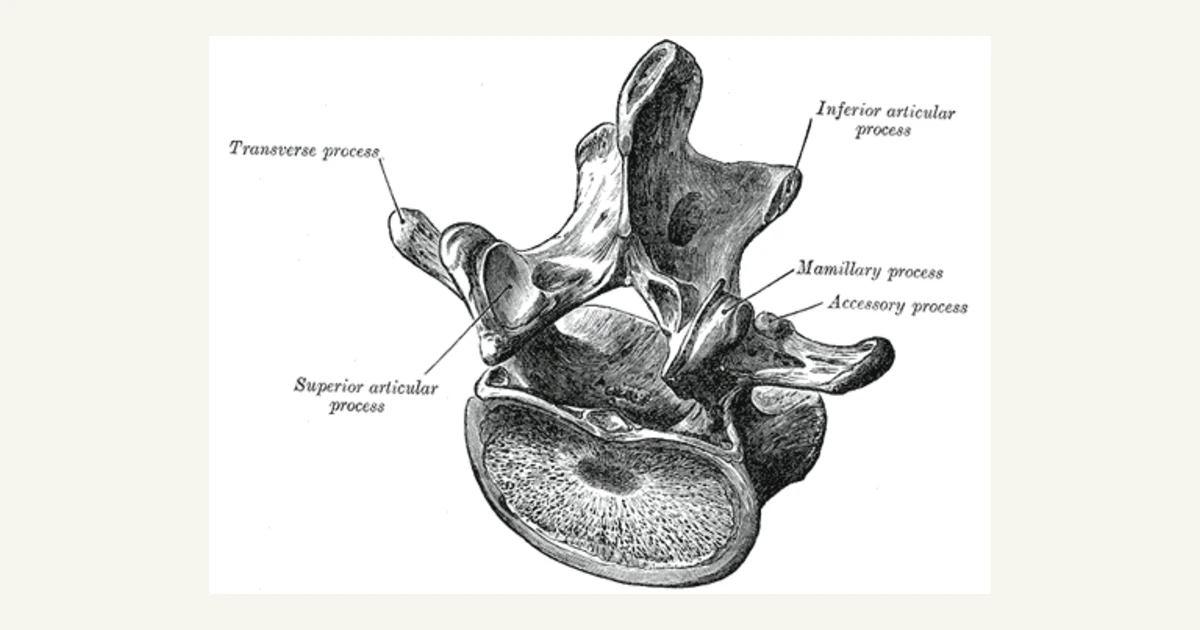
Spondylolysis is a stress fracture in a small bridge of bone at the back of a vertebra, the pars interarticularis, usually the lowest one in the back (L5). It is most common in active teenagers in sports that bend the back backward over and over: fast bowling, gymnastics, dance, diving, volleyball, weightlifting. It shows up as low back pain that is worse arching back and better with rest. Many people with a pars defect never feel it at all.
What does spondylolysis feel like?
- An ache low in the back, often to one side, that builds during training.
- Worse bending backward, standing on one leg and leaning back, or twisting and arching together: the bowling delivery, the back walkover, the spike.
- Better sitting or bending forward, and better with a few days off.
- Tight hamstrings are common alongside it.
No physical test confirms it. A doctor decides whether imaging is needed, and which kind. A young athlete with low back pain that is worse arching back and has lasted more than two to three weeks should see a doctor before training through it.1
Spondylolysis or spondylolisthesis?
| Spondylolysis | Spondylolisthesis | |
|---|---|---|
| What it is | A crack or defect in the pars | The vertebra has slipped forward on the one below |
| How they connect | A pars defect on both sides can let the vertebra slip. Most do not slip, or slip only a little | |
| Who monitors it | Your doctor, with physiotherapy for the loading plan | Your doctor or spine surgeon, especially in a growing child |
Spondylosis, one letter different, is something else again: age-related change in the spine.
Does spondylolysis pain go away?
In most young athletes, yes, with time away from the painful movements and a staged return. The usual plan is several weeks to a few months off the movements that arch the back, then a graded return over weeks. Some cracks heal with bone; others settle into a stable, painless defect. Either way, the goal is a back that tolerates the sport again. Your doctor decides whether a brace is needed. Surgery is uncommon and is a surgeon’s decision.
What we work on, stage by stage
- Stage 1, Calm & Protect: what to stop and what to keep. Walking, cycling and swimming are often fine; arching, bowling and back walkovers are not, for now.
- Stage 2, Move & Mobilize: hips and upper back that move well, so the low back is not doing their share of the arch. Hamstring length.
- Stage 3, Rebuild & Strengthen: trunk endurance timed in seconds, hip strength on each side, holding the low back still while the hips and arms work.
- Stage 4, Return & Perform: the sport movement brought back in steps: the bowling action in overs, the walkover in reps, the spike in sets, with the measures deciding each step.
Tested, not dated. You bowl, tumble or spike again when the measures say so. Pain is the first thing to leave. Strength is the last to train and recover.
When to see a doctor first
- Go to the emergency department now for numbness between the legs, new trouble passing urine or stool, or weakness in both legs.
- See a doctor the same day if one leg is going weak or the foot catches when you walk, or for back pain with a fever.
- See a doctor soon for low back pain in a child or teenager that is worse arching back and has not settled in two to three weeks, pain that wakes them at night, or back pain with weight loss.
Where are you with this right now?
1. It is settling on its own
If the back is quieter each week off the painful movements and your doctor has a plan, keep to it. Stay fit with what does not hurt. You are probably in Stage 1 or 2 of 4.
2. It has stopped improving
The scan was three months ago. Your son has been off bowling since, the back feels fine at school, and the first nets practice back brought the same ache by the fourth over. Now the season is close and there is no plan yet to get from rest to a full spell. Rest calmed it. The trunk endurance and hip control a fast bowler needs were never built back, and they can be measured.
WhatsApp us · Get Assessed & Treated · One 45-minute appointment, $230, nett, no GST.
3. You have had surgery, or you have a date
After a pars repair or a spinal fusion, the stages are set with your surgeon. See physiotherapy after surgery. All of it runs on the four stages of the Phoenix Recovery Protocol.
Related reading
Sources: 1. Standaert CJ, Herring SA. Spondylolysis: a critical review. Br J Sports Med. 2000;34(6):415-422.
Where we are
Clinics across Singapore
ORCHARD
400 Orchard Road #12-12
Orchard Towers, S238875
NS22 Orchard MRT
Physiotherapy and hand therapy in Orchard →
What our patients say
Google reviews from our clinics in Singapore.



TAMPINES
9 Tampines Grande #01-20
Asia Green, S528735
EW2DT32 Tampines MRT
Physiotherapy and hand therapy in Tampines →
WhatsApp 8780 9608SERANGOON
265 Serangoon Central Drive #04-269
S550265 · Lift C only
NE12CC13 Serangoon MRT
Physiotherapy and hand therapy in Serangoon →
WhatsApp 8892 4121TANJONG PAGAR
10 Anson Road #02-77A
International Plaza, S079903
EW15 Tanjong Pagar MRT
Physiotherapy and hand therapy in Tanjong Pagar →
WhatsApp 8227 7074JURONG EAST
2 Venture Drive #02-02
Vision Exchange, S608526
NS1EW24 Jurong East MRT
Opening 25 October 2026
Physiotherapy and hand therapy in Jurong East →
WhatsApp 8242 7340