
Written by Zita Sham, Fairuuz Saleh and Shiv Mohan Banka, Principal Physiotherapists at Phoenix Rehab.Clinically reviewed by Nigel Chua, Principal Hand Occupational Therapist & Director, AHPC A1300362Z.Last reviewed 16 October 2026.
Tennis elbow is pain on the outer side of the elbow from an overloaded tendon: the tendon that attaches the wrist-lifting muscles of your forearm to the bony point on the outside of the elbow. It hurts when you grip, lift with your palm down, turn a door handle or shake hands.
Most people with tennis elbow do not play tennis. Treatment centers on changing the load on the tendon and a progressive exercise program, which have the strongest long-term evidence. A tennis elbow band and taping can ease pain in the short term.
Tennis elbow often improves within 6 to 12 months, with or without treatment. Exercise is how you stay at work and in your sport while it does. Steroid injections ease pain for a few weeks, and in trials people who had one did worse at 6 to 12 months, with more recurrences, than people who exercised or waited.1,2,3 Whether that trade-off is worth it for you is a question for your doctor.
At Phoenix Rehab Group, our hand therapists treat the elbow as part of the upper limb. We test your grip strength, find the tasks that overload the tendon, and build an exercise plan that fits your work and sport. You do not need a doctor’s referral. If outer elbow pain is making gripping or lifting hard, WhatsApp us to Get Assessed & Treated.
Key takeaways
- Tennis elbow is an overloaded tendon on the outer elbow. Most people who get it do not play tennis.
- Changing the load on the tendon and a progressive exercise program have the strongest long-term evidence.
- Many cases improve within 6 to 12 months, with or without treatment.
- Steroid injections ease pain for a few weeks. In trials, people who had one did worse at 6 to 12 months than people who exercised or waited.
- Surgery is for the small group who have not improved after 6 to 12 months of good care.
Tennis elbow at a glance
| What it is | Overload of the wrist extensor tendon where it attaches to the outer elbow (the lateral epicondyle) |
| Also called | Lateral epicondylitis, lateral elbow tendinopathy, lateral epicondylalgia |
| Common in | Ages 35 to 55; mouse users, manual trades, badminton and pickleball players, new parents |
| Main symptoms | Outer elbow pain with gripping, lifting and twisting; weak grip |
| First-line care | Load changes, progressive exercise, a tennis elbow band for painful tasks |
| Typical recovery | Improvement within 6 to 12 weeks of consistent exercise; full resolution can take 6 to 12 months |
| See a doctor if | The elbow is hot and swollen, locks, or you have numbness or weakness in the hand |
What is tennis elbow?
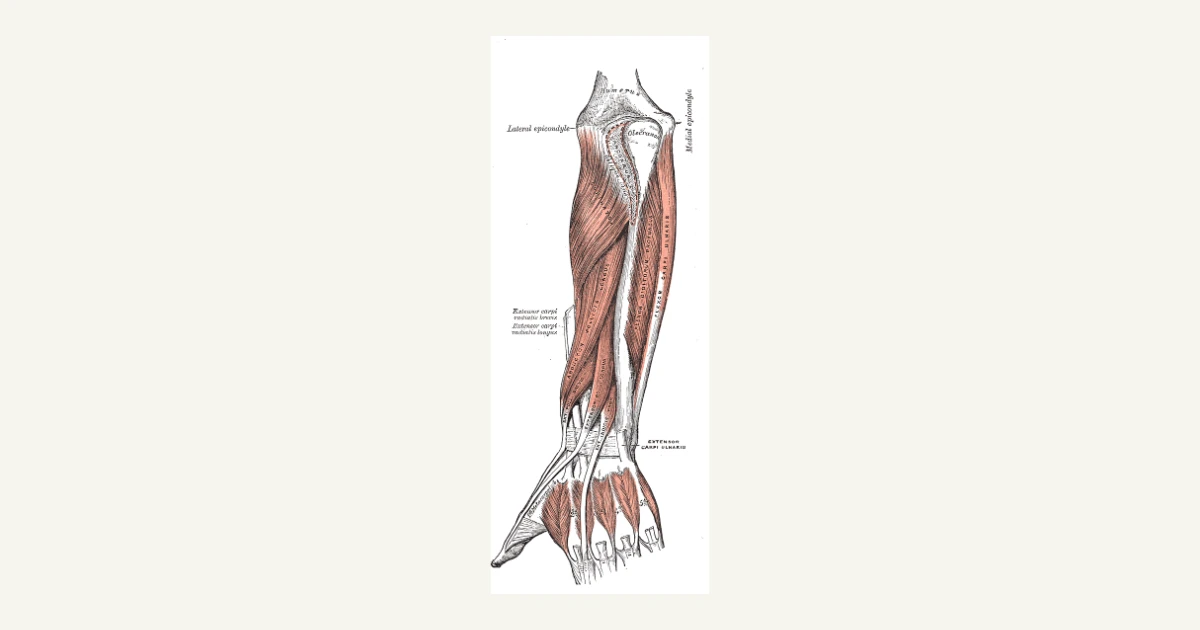
The muscles that lift your wrist and fingers start at a bony point on the outer side of your elbow, the lateral epicondyle. They join a shared tendon, the common extensor tendon. One of these muscles, the extensor carpi radialis brevis, takes most of the strain during gripping.
Repeated gripping with the wrist bent back overloads this tendon.
Under the microscope, the tendon shows wear and disorganized repair more than inflammation, which is why doctors now prefer the name lateral elbow tendinopathy to “epicondylitis”. The finding matters for treatment: tendons respond to the right dose of load, and rest and anti-inflammatory tablets on their own seldom fix them.
You may see tennis elbow called lateral epicondylitis, lateral epicondylalgia or lateral elbow tendinopathy.
Tennis elbow symptoms
- Pain on the outer elbow, often spreading down the back of the forearm.
- Pain with gripping. Holding a mug or kettle, a firm handshake, or turning a key or door handle.
- Pain lifting with the palm down, such as a bag of groceries, a laptop or a baby car seat.
- A weak grip. You drop things, or your grip gives way when the elbow is straight.
- Tenderness at, or a little below, the bony point on the outer elbow.
- Morning stiffness in the elbow and forearm.
How do you know if you have tennis elbow?
A hand therapist or doctor diagnoses tennis elbow with a few simple tests. Each test loads the tendon, and pain at the outer elbow supports the diagnosis:
- Resisted wrist lift (Cozen’s test). You lift your wrist against the clinician’s hand.
- Resisted middle finger lift (Maudsley’s test). You lift your middle finger against resistance.
- Stretch test (Mill’s test). The clinician straightens your elbow and bends your wrist down.
- Grip test. Your grip is weaker, and more painful, with the elbow straight than with it bent.
Tennis elbow vs golfer’s elbow
| Tennis elbow | Golfer’s elbow | |
| Where it hurts | Outer elbow | Inner elbow |
| Tendon | Wrist extensors, which lift the wrist back | Wrist flexors and forearm rotators, which bend the wrist forward |
| Painful movements | Gripping with the wrist bent back; lifting palm-down | Gripping with the wrist bent forward; lifting palm-up; throwing |
| Nerve link | Radial tunnel syndrome can mimic it | ulnar nerve / cubital tunnel |
| Common in | Racquet sports, mouse users, trades | Golf, throwing sports, climbing, gym pulling exercises |
Pain deep at the front of the elbow, worse bending it against load, is neither. It is often the brachialis. See brachialis pain and strain.
Both follow the same treatment principles, with exercises aimed at the muscle group involved.
Other causes of outer elbow pain
| Condition | Clues |
| Radial tunnel syndrome | Aching a few centimeters further down the forearm; a nerve problem that can coexist with tennis elbow |
| Neck-referred pain | Neck movement changes the pain; tingling in the arm |
| Elbow joint problems | Locking, catching, swelling, or losing the last part of straightening |
| Instability after an injury | A clunk or giving way after a fall or dislocation |
Swelling at the point of the elbow is a different problem; see olecranon bursitis. Tingling in the thumb and fingers points to a nerve problem, such as carpal tunnel syndrome.
What causes tennis elbow?
Tennis elbow develops when the load on the tendon outruns its ability to recover. In Singapore, the triggers we see most include:
- Mouse and keyboard work with the wrist bent back for long hours.
- Manual trades such as plumbing, painting, carpentry, electrical work and home renovation.
- Racquet sports. Badminton backhands and a tight grip, tennis, and pickleball, which has grown fast in Singapore.
- Gym training. Rows, pull-ups and heavy lifts with a tight grip.
- F&B work. Tossing woks, carrying trays and chopping.
- New parents, lifting car seats, prams and babies.
- A sudden jump in activity, such as moving house, a renovation or a new sport.
Most people develop tennis elbow between 35 and 55. Smoking and a sudden increase in gripping work also raise the risk. Our page on repetitive strain injury covers other work-related arm pain.
How is tennis elbow diagnosed?
A hand therapist or doctor diagnoses tennis elbow from your history and the tests above.
The examination also checks your neck, the nerves of the arm and the elbow joint, to rule out look-alikes. Your therapist measures grip strength with the elbow bent and straight, which gives a clear marker to track your progress.
Scans are seldom needed. A doctor may order an ultrasound or MRI if the diagnosis is unclear, or if pain persists after 3 to 6 months of good treatment.
Tennis elbow treatment in Singapore: your options
| Option | Who provides it | What the evidence shows | When it fits |
| Load management | Hand therapist | Core of treatment; keeps you active while the tendon settles | From the first appointment |
| Progressive loading exercise | Hand therapist | Strongest long-term support of the treatments studied | From the first week |
| Tennis elbow band (counterforce brace) | Hand therapist | Short-term pain relief during activity | For painful tasks and sport |
| Taping | Hand therapist | Limited evidence; short-term relief | Optional add-on |
| Manual therapy | Hand therapist | Short-term pain relief | Add-on to exercise |
| Steroid injection | Orthopedic doctor or hand surgeon | Relief for weeks; worse results and more recurrence at 6 to 12 months than exercise or waiting | A decision for your doctor, weighed against that trade-off |
| Shockwave therapy | Physiotherapist or hand therapist | Mixed evidence | Selected persistent cases |
| PRP injection | Orthopedic doctor or hand surgeon | Mixed evidence | Selected persistent cases |
| Surgery | Orthopedic doctor or hand surgeon | For the small group who do not improve | After 6 to 12 months of good conservative care; see below |
Change the load. Your therapist helps you cut the movements that strain the tendon and keep the rest of your life going. Lift with your palm up, use two hands, loosen your grip on the mouse, tools and racquet, and bring heavy items close to your body. Complete rest weakens the tendon, so the aim is less load while you stay active. Our occupational therapists can review a workstation or work task in more detail.
Progressive exercise. Tendons get stronger when you load them in stages. Your program starts with holds that ease pain, moves to slow lifting and lowering, and builds to heavier strength work over about 12 weeks. This is the treatment with the strongest long-term evidence.
Steroid injections. A steroid injection can ease pain within days, and the relief lasts a few weeks. In trials, people who had one took longer to recover and relapsed more often at 6 to 12 months than those who exercised or waited.1,2,3 If you are considering an injection, discuss the trade-off with your doctor.
Other injections and shockwave. Platelet-rich plasma (PRP) and shockwave therapy have mixed research results. Some doctors use them for tennis elbow that has lasted months despite exercise.
Surgery. An orthopedic or hand surgeon may operate on tennis elbow that has not improved after 6 to 12 months of good conservative care. Few people need it. What the operation involves, and the weeks after it.
Hand therapists do not give injections or prescribe medication; we coordinate your exercise plan with your doctor.
Hand therapy for tennis elbow at Phoenix Rehab Group
Tennis elbow is seen by our hand therapists and physiotherapists at Orchard, Serangoon, Tampines, Tanjong Pagar and Jurong East. All are AHPC-registered. The hand therapists are occupational therapists and physiotherapists with post-graduate training in hand therapy, and they treat the elbow as part of the upper limb. Every appointment is one to one with your therapist for the full 45 minutes.
At your first appointment, you can expect:
- A task and sport history. We ask about your work, tools, sport, gym routine and recent changes.
- An examination. We run the tendon tests and check your neck, nerves and elbow joint.
- Grip strength testing. We measure grip with a dynamometer, with the elbow bent and straight, to set a baseline.
- A load plan. Specific changes for work, sport and home.
- An exercise program, starting at a level your tendon tolerates now.
- Brace fitting and a technique review. We fit a tennis elbow band and look at your workstation, grip size and racquet.
We coordinate with your doctor if an injection or scan is being considered. Your therapist sets your plan at the first visit and reviews it at each stage.
Contact us for a tennis elbow assessment. WhatsApp us.
Tennis elbow band: how to use a counterforce brace
A tennis elbow band, or counterforce brace, is a strap worn around the upper forearm.
- The effect. It presses on the forearm muscles below the elbow and spreads their pull away from the sore tendon attachment. Many people feel less pain while gripping.
- Placement. Place it a couple of finger-widths below the painful point, over the muscle bulk of the forearm.
- Tightness. Snug, not tight. Loosen it if your hand tingles, swells or changes color.
- Timing. Wear it during gripping tasks, work and sport. Take it off at rest and at night.
- Its limits. The band eases pain in the short term and does not strengthen the tendon. Pair it with your exercise program.
For severe pain, some people wear a wrist splint at night for a short period to rest the extensor muscles. Your therapist can advise, and can make a custom splint if you need one.
KT tape for tennis elbow. Kinesiology tape has limited evidence and short-term effects. If it helps you move and exercise with less pain, it is a reasonable add-on. It does not replace strengthening.
Tennis elbow surgery, and the weeks after it
Surgery for tennis elbow is for the small group whose pain has not settled after 6 to 12 months of good conservative care. The surgeon removes or releases the worn part of the tendon where it attaches to the outer elbow. Hand therapy usually starts in the first two weeks and runs for about three months, with heavy work and sport at 3 to 6 months.
The operations used in Singapore fall into three groups:
- Open release or debridement. Through a cut of a few centimeters over the outer elbow, the surgeon removes the worn tissue at the start of the extensor carpi radialis brevis tendon.
- Arthroscopic release. The same tissue is released through small keyhole cuts, with a camera inside the elbow joint.
- Percutaneous tenotomy. A needle or small device, often guided by ultrasound, breaks up the worn tendon tissue through the skin.
Whether you need an operation, and which one, is your surgeon’s decision. What follows it is a tendon that has to be loaded back in stages, the same way it would have been without surgery, starting from a lower point.
| Weeks after surgery | Stage | What happens |
| 0 to 2 | Calm & Protect | A sling or splint for comfort in the first days, the wound kept dry, and the fingers, wrist and shoulder kept moving |
| 2 to 6 | Move & Mobilize | Stitches out at about 2 weeks; elbow and wrist movement back; light grip; scar care |
| 6 to 12 | Rebuild & Strengthen | Graded tendon loading, the same stages as the exercises below; grip strength measured each review |
| 12 to 26 | Return & Perform | Heavy lifting, tools and racquet sport, built up week by week |
When can I… These are typical ranges. Your surgeon’s instructions come first.
| Task | Typical timing after surgery |
| Type and do desk work | Often within 1 to 2 weeks |
| Drive | Usually 2 to 4 weeks, once you can grip and turn the wheel firmly and your surgeon has cleared it |
| Lift a kettle or a bag of groceries | Around 6 weeks |
| Manual work and heavy lifting | From about 3 months |
| Badminton, tennis, pickleball and golf | 3 to 6 months |
Is this normal after surgery? Usually expected: aching and swelling at the outer elbow for the first 2 to 3 weeks, a scar that stays tender for a few months, and a grip that is still weaker than the other side at 6 weeks.
- Go to the emergency department now if the whole forearm swells with severe pain that keeps rising, or the hand turns pale, cold or numb.
- Contact your surgeon the same day if the wound is red, hot or weeping, the redness is spreading, or you have a fever.
- Contact your surgeon soon if new tingling appears in the forearm or hand, or the elbow will not straighten further after 6 weeks.
Twelve weeks after the operation and the kettle still goes to the other hand? The wound has healed. The tendon has not yet been loaded back to work. That is what the Stalled Recovery Review is for, and hand therapy after surgery covers the other operations we rehabilitate. WhatsApp us with the date of your operation.
Tennis elbow recovery time
Recovery depends on how long you have had symptoms and how consistent you are with the load changes and exercise. Your therapist or doctor may give you different targets; use theirs.
| Situation | What happens | Typical timeframe |
| Recent, mild tennis elbow | Load changes and exercise | Improvement within 6 to 12 weeks |
| Established (over 3 months) | Longer strength program | 3 to 6 months |
| Natural course | Many cases settle with or without treatment | 6 to 12 months, sometimes up to 2 years |
| After a steroid injection | Short relief; higher risk of recurrence | Relief for a few weeks |
| After surgery | Protection, then strength | 3 to 6 months to return to heavy use |
You are on track if your pain-free grip strength (how hard you can grip before pain starts) goes up, mornings are less stiff, and you can lift a kettle or bag without a sharp pain. Contact your therapist if pain spreads, numbness appears, or pain rises despite the plan.
Tennis elbow exercises
These exercises form the core of tennis elbow treatment.
Stage 1: isometric holds for pain relief
- Wrist lift hold. Rest your forearm on a table, palm down, with the hand over the edge. Hold a light weight, or press the back of your hand up into your other hand, without moving. Hold 30 to 45 seconds, 5 times, at moderate effort, once or twice a day.
Stage 2: slow lifting and lowering
- Wrist extension lowering. Hold a light dumbbell or a water bottle, palm down. Use your other hand to help lift the wrist, then lower it on its own over 3 to 4 seconds. 3 sets of 15, once a day.
- Twist exercise with a flexible bar. Hold the bar upright in front of you and twist it with the sore hand while the other hand holds it steady. 3 sets of 15.
- Grip squeezes. Squeeze therapy putty or a soft ball. 3 sets of 10.
- Forearm rotation with a hammer. Hold a light hammer by the handle and turn the palm up and down. 3 sets of 10.
Stage 3: heavier strength and return to task
- Heavier wrist curls, lifting and lowering over 3 to 4 seconds each way. 3 sets of 8 to 12.
- Band rows for the shoulder blades. 3 sets of 12.
- Task and sport drills, such as shadow swings, light hitting or tool work, building up each week.
Pain rule. Pain up to 3 to 4 out of 10 during exercise is acceptable if it settles by the next morning. Scale back if pain is higher the next day.
One approach to drop: stretching the forearm hard into pain in the early weeks. Stretch within comfort, and let the strength work do the heavy lifting.
Returning to badminton, pickleball and golf

- Check your equipment. A grip that is too thin or too small makes you squeeze harder. Ask a coach or shop to check grip size, string tension and racquet weight.
- Build time on court in steps. Start with 20 to 30 minutes of drills, and add time each week if the elbow settles overnight.
- Work on technique. A coach can review your backhand in badminton and tennis, and your swing in golf.
- Wear your band for play during the return stage.
Mistakes that slow tennis elbow recovery
- Resting the arm for weeks. The tendon weakens and flares again when you return.
- Relying on the band alone. It eases pain but does not strengthen the tendon.
- Counting on injections alone. An injection quiets the pain. It does not strengthen the tendon.
- Stretching hard into pain. It can flare an irritated tendon.
- A tight grip on the mouse, racquet or tools. Loosen it, or change the tool.
- Heavy gripping lifts during a flare. Deadlifts and pull-ups with a tight grip load the tendon hard.
When to see a doctor
See a doctor on the same day if:
- the elbow is swollen and hot, or you have a fever
- you fell and the elbow looks deformed, or you cannot bend or straighten it
Make an appointment with a doctor soon if:
- the elbow locks or catches
- you have numbness or weakness in the hand
- pain is constant and wakes you each night
- the elbow clunks or gives way after an injury
- pain has not improved after 6 to 8 weeks of consistent exercise
Frequently asked questions about tennis elbow
What is the fastest way to heal tennis elbow?
There is no shortcut past the tendon’s own rebuilding. The approach with the strongest long-term evidence is cutting the tasks that provoke it and starting graded strengthening early, with a tennis elbow band for painful tasks. Steroid injections ease pain fastest, within days, but in trials people who had one did worse at 6 to 12 months, a trade-off to discuss with your doctor. Many people improve within 6 to 12 weeks of consistent exercise.
What triggers tennis elbow?
Repeated gripping with the wrist bent back triggers tennis elbow, along with lifting with the palm down and twisting. Common triggers include mouse work, manual trades such as plumbing and painting, badminton and pickleball, gym pulling exercises, carrying trays or car seats, and a sudden jump in activity such as a house move. Most people who develop it are aged 35 to 55.
What our patients say
Google reviews from our clinics in Singapore.



How do you know if you have a tennis elbow?
Tennis elbow causes pain on the outer elbow when you grip, lift with your palm down or turn a door handle, with tenderness at or a little below the bony point. A clinician confirms it with tests: pain when you lift your wrist or middle finger against resistance, and a weaker grip with the elbow straight. Numbness, locking or swelling point to another problem.
Does tennis elbow go away permanently?
Yes. Many people improve within 6 to 12 months, and some take up to 2 years without treatment. A progressive exercise program and changes to your grip and tasks keep you working and training while it settles, and leave the tendon stronger than rest alone. Steroid injections ease pain in the short term but make recurrence more likely. If pain has not improved after 6 to 8 weeks of consistent exercise, ask your therapist or doctor for a review.
Do tennis elbow bands work?
Tennis elbow bands ease pain during gripping for many people, by spreading the pull of the forearm muscles away from the sore tendon. Wear the band a couple of finger-widths below the painful point, snug but not tight, during work and sport, and take it off at rest. A band does not strengthen the tendon, so use it alongside an exercise program.
What exercises help tennis elbow?
Exercises that load the tendon in stages help most. Start with isometric holds, pressing the wrist up against resistance for 30 to 45 seconds. Progress to slow wrist lifting and lowering with a light weight, the twist exercise with a flexible bar, grip squeezes and forearm rotation. Build to heavier strength work over about 12 weeks. Pain up to 3 to 4 out of 10 is acceptable if it settles by the next morning.
Should I get a steroid injection for tennis elbow?
Weigh the trade-off first. A steroid injection eases pain within days, and the relief lasts a few weeks. Research shows people who have one take longer to recover and relapse more often at 6 to 12 months than people who exercise or wait. Some doctors still use an injection for severe pain that blocks exercise. Discuss the trade-off with your doctor, and keep up your exercise program either way.
What is the difference between golfer’s elbow and tennis elbow?
Tennis elbow causes pain on the outer elbow and involves the tendon of the muscles that lift the wrist. Golfer’s elbow causes pain on the inner elbow and involves the tendon of the muscles that bend the wrist forward and turn the forearm. Gripping with the wrist bent back aggravates tennis elbow, and gripping with the wrist bent forward aggravates golfer’s elbow. Treatment follows the same principles.
Can tennis elbow heal in 2 weeks?
Rarely. Two weeks is long enough for a flare to settle once you stop the task that set it off, but not for the tendon itself to change. Tendons adapt to load over months. Most people need 6 to 12 weeks of consistent exercise to see a clear change, and longer if the pain has been there for more than three months.
What kind of doctor should I see for tennis elbow?
Start with a GP, a sports doctor, or a hand therapist or physiotherapist, who can confirm the diagnosis from an examination and start treatment without a scan. An orthopedic or hand surgeon is the right referral if pain persists after 6 to 12 months of good care, the diagnosis is unclear, or you are weighing an injection or surgery. You do not need a referral to see a hand therapist in Singapore.
How long is recovery after tennis elbow surgery?
Most people return to desk work within 1 to 2 weeks and to light lifting at around 6 weeks after tennis elbow surgery. Heavy lifting, manual work and racquet sport usually take 3 to 6 months. Hand therapy starts in the first two weeks and builds through four stages, from protecting the operated tendon to full strength. Your surgeon’s protocol takes precedence.
Do I need a referral to see a hand therapist for tennis elbow in Singapore?
No. You can see a hand therapist at Phoenix Rehab Group without a doctor’s referral. If you need a scan, an injection or a surgical opinion, we refer you to a doctor and share our findings. Some insurers ask for a doctor’s referral before they reimburse therapy, so check your policy first.
Contact us for a tennis elbow assessment
If outer elbow pain is making gripping, lifting or your sport hard, a hand therapist can find the tasks that overload the tendon and start your exercise plan in the first appointment.
- WhatsApp: Message us. Your message opens with “Hi, I’d like to schedule a hand therapy assessment for tennis elbow.”
- Clinics: Orchard, Serangoon, Tampines, Tanjong Pagar at International Plaza and Jurong East at Vision Exchange, opening 25 October 2026.
- Referral: not required. Some insurers need one for claims, so check your policy.
- Insurance: we provide itemised invoices, and a clinical report if your insurer asks for one.
Had an injection?
The elbow went quiet for six weeks. Then you lifted the kettle.
An injection dulls the pain at the outer elbow. It does not strengthen the tendon. In a randomized trial, people given a steroid injection for tennis elbow were doing worse at one year, with more recurrences, than people given a placebo injection (Coombes and colleagues, JAMA, 2013).
Progressive tendon loading and grip and forearm strength are what change a tendon. If you are weighing another injection, that trial is a fair thing to raise with your doctor.
Also on this site: the page on a lateral collateral ligament injury of the elbow covers the ligament on the outer side of the elbow, and the page on an annular ligament tear covers the ligament that holds the top of the forearm bone.
Where are you with this right now?
1. It is settling on its own
Elbow tendon problems settle slowly, over months rather than weeks, and they respond to graded loading rather than to rest alone. If you can grip for longer than you could a month ago, it is responding. You do not need us for this, and we would rather say so.
2. It has stopped improving
You pour the kettle with the other hand. A full mug is a two-handed job. You have stopped carrying the shopping on that side.
A tendon that stops being provoked is not the same as a tendon that got stronger. One is avoidance, the other is capacity. That is the gap worth measuring, and it is not measured by how you feel on the day.
The Stalled Recovery Review is three appointments over three weeks with the same therapist, because what a tendon does under load cannot be read in one visit. The first finds what is limiting it. The next two measure how it responds. $690, nett, no GST, which is three appointments at $230.
3. You have had surgery, or you have a date
Recovery after an operation has a shape, and knowing which stage you are in tells you whether you are on it. See tennis elbow surgery and the weeks after it, hand therapy after surgery, or elbow physiotherapy if you are not sure which applies to you.
All of it runs on the same four stages. The Phoenix Recovery Protocol explains what each stage works on and what you have to meet to move up. No referral needed to start.
Next step
Find out which stage you are in
Pain is the first thing to leave. Movement and strength are the last things trained back, and most people stop before that part is done. One Assessment and Treatment is a single 45-minute appointment at $230, nett, no GST. Your therapist finds what is actually limiting you, treats it in the same appointment, and you leave with your current stage and a written plan.
Prefer to phone? Each of our five clinics has its own number on the clinics page. No referral needed to book.
Related reading
Sources: 1. Smidt N, van der Windt DA, Assendelft WJ, et al. Corticosteroid injections, physiotherapy, or a wait-and-see policy for lateral epicondylitis: a randomised controlled trial. Lancet. 2002;359(9307):657-662. 2. Bisset L, Beller E, Jull G, Brooks P, Darnell R, Vicenzino B. Mobilisation with movement and exercise, corticosteroid injection, or wait and see for tennis elbow: randomised trial. BMJ. 2006;333(7575):939. 3. Coombes BK, Bisset L, Brooks P, Khan A, Vicenzino B. Effect of corticosteroid injection, physiotherapy, or both on clinical outcomes in patients with unilateral lateral epicondylalgia: a randomized controlled trial. JAMA. 2013;309(5):461-469.
Where we are
Clinics across Singapore
ORCHARD
400 Orchard Road #12-12
Orchard Towers, S238875
NS22 Orchard MRT
Physiotherapy and hand therapy in Orchard →
WhatsApp 8800 1830TAMPINES
9 Tampines Grande #01-20
Asia Green, S528735
EW2DT32 Tampines MRT
Physiotherapy and hand therapy in Tampines →
WhatsApp 8780 9608SERANGOON
265 Serangoon Central Drive #04-269
S550265 · Lift C only
NE12CC13 Serangoon MRT
Physiotherapy and hand therapy in Serangoon →
WhatsApp 8892 4121TANJONG PAGAR
10 Anson Road #02-77A
International Plaza, S079903
EW15 Tanjong Pagar MRT
Physiotherapy and hand therapy in Tanjong Pagar →
WhatsApp 8227 7074JURONG EAST
2 Venture Drive #02-02
Vision Exchange, S608526
NS1EW24 Jurong East MRT
Opening 25 October 2026
Physiotherapy and hand therapy in Jurong East →
WhatsApp 8242 7340