
Written by Yuna Zhuang, Principal Hand Occupational Therapist at Phoenix Rehab, AHPC A1700999G.Clinically reviewed by Nigel Chua, Principal Hand Occupational Therapist & Director, AHPC A1300362Z.Last reviewed 11 October 2026.
Looking for the LCL in the knee? That is a different ligament, on the outer side of the knee, covered in lateral knee pain. This page is about the elbow.
An elbow LCL tear is a stretch or tear of the lateral collateral ligament complex, the bands on the outer elbow that stop it bending inward and stop the forearm rolling off the upper arm bone. Most tears happen when the elbow dislocates in a fall onto an outstretched hand. The usual sign is clicking or giving way, more than pain.
Key takeaways
- The LCL is on the outer side of the elbow. It starts on the bony bump on the outer elbow and runs down to the forearm bones.
- Most LCL tears happen when the elbow dislocates in a fall onto an outstretched hand. Throwing loads the ligament on the inner side, the UCL, not this one.
- The usual signs are clicking, catching or a feeling of the elbow giving way when you push up from a chair with your palm turned up.
- Tennis elbow, a radial head fracture, a plica and an inner elbow ligament sprain can all cause pain near the same area. How it started is the first clue.
- A doctor confirms the injury and decides on a scan or an operation. A hand therapist protects the elbow, brings back range and strength, and tests it under load before you return to sport.
Is the LCL on the outside or the inside of the elbow?
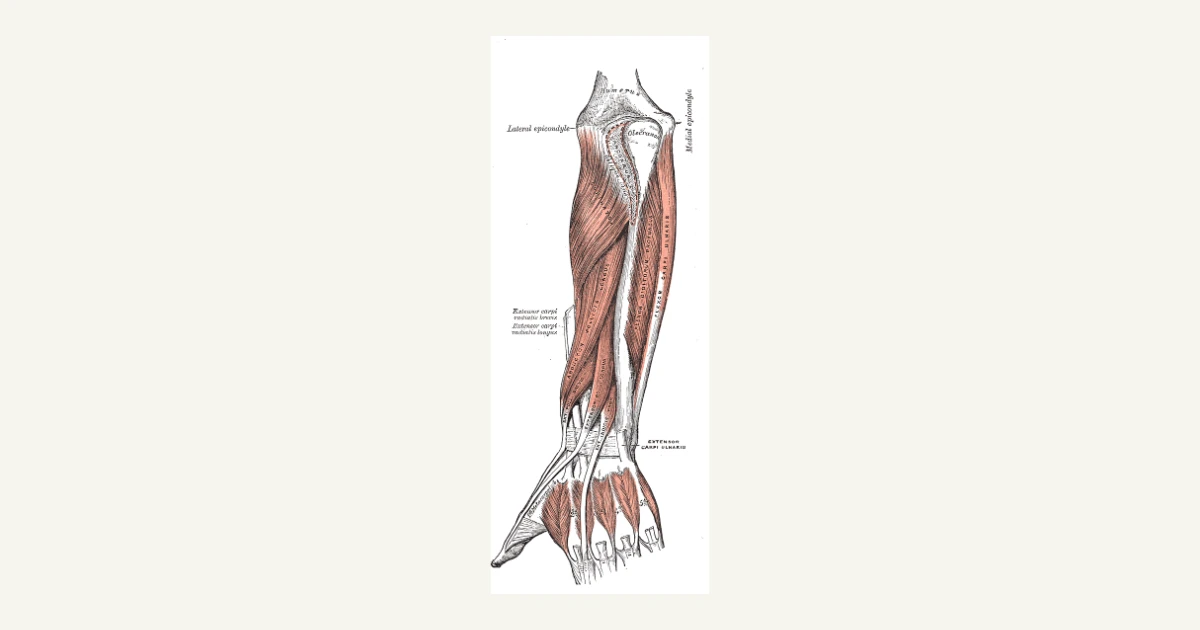
The outside. Bend your elbow and feel the bony bump on the outer side, the thumb side when your palm faces up. That bump is the lateral epicondyle. The lateral collateral ligament complex starts there and fans down to the two forearm bones. The ligament on the inner side is a different structure, the ulnar collateral ligament, or UCL.
The complex has four parts:
- The radial collateral ligament runs from the outer bump down to the ring of ligament around the top of the radius.
- The lateral ulnar collateral ligament (LUCL) runs from the same bump, past the radius, to a ridge on the ulna. It is the part that holds the elbow in joint.1
- The annular ligament wraps around the head of the radius so it can turn when you turn your palm up and down.
- The accessory lateral collateral ligament reinforces the annular ligament.
The complex has two jobs. It stops the elbow bending inward, which doctors call varus. And it stops the forearm bones rotating and sliding off the back of the upper arm bone when you push through a straightening arm with the palm turned up. When that second job fails, the condition is called posterolateral rotatory instability, or PLRI.1
Sprain, partial tear, complete tear
In a sprain the fibers are stretched and the ligament still holds. In a partial tear some fibers have gone. In a complete tear, often pulled off the bone at the outer bump, the elbow can slip partly out of joint under load. Your doctor grades it, and the grade decides the plan.
How it happens, in the order to check
1. A fall onto an outstretched hand
This is the usual story. You come off the bike at East Coast Park, slip on a wet floor, or fall in futsal, and land on the hand with the elbow nearly straight. The forearm twists outward and the elbow is forced out of joint. When an elbow dislocates this way, the tear usually starts on the outer side, so the LCL is often the first structure to go.2 See elbow dislocation.
Some elbows go out and back in by themselves. People describe a clunk, a moment where the arm looked wrong, then pain and swelling on the outer elbow. That elbow needs a doctor the same day, even if it now moves.
2. A fall with a fracture
The same fall can break the head of the radius at the outer elbow, or a piece of the ulna at the front of the joint. A dislocation with both fractures is the injury doctors call the terrible triad. Fractures change the plan, and that plan belongs to an orthopedic or hand surgeon. See fractured elbow.
3. After an operation on the outer elbow
Now and then the ligament is loosened by an earlier operation on the outer elbow, such as a release for tennis elbow, because the tendon that is released lies right over it. If clicking or giving way started after an operation, tell the surgeon who did it.
Repeated throwing is not the usual cause. The throw pushes the elbow outward and loads the ligament on the inner side, which is the elbow UCL sprain page.
How do you know if your elbow LCL is torn?
The pattern points to it: a fall, sometimes with the elbow out of joint, then pain and swelling on the outer elbow. Once the swelling settles, the clue is instability more than pain. The elbow clicks, catches or clunks. It feels as if it is about to give way when you push up from a chair with your palm turned up, push open a heavy door, do a push-up, or lower yourself with the arm straight. Many people quietly start pushing up with the other hand.
Can you bend your elbow with an LCL tear? Usually yes. After a dislocation, the last few degrees of straightening are often what goes missing.
The tests a doctor or hand therapist may use
- The chair push-up test. You push up from a chair with the elbows bent and the forearms turned palm up. Apprehension or the elbow slipping as you push up points to the ligament.3
- The push-up test. A push-up from the floor, first with the forearms turned palm up and the hands turned out, then with the hands turned in. Apprehension the first way that eases the second way points the same way.3
- The lateral pivot-shift test. The examiner turns the forearm palm up and bends the elbow while pressing it inward, and feels the joint slip and then clunk back into place.1 It is hard to do on an awake, guarded patient, so surgeons sometimes do it under anesthesia.
None of these is a home test. Testing a loose elbow again and again tells you nothing new. Whether you need an X-ray, an ultrasound or an MRI is a decision for your doctor. An X-ray looks for a fracture first.
LCL tear, tennis elbow, radial head fracture, plica, dislocation or UCL sprain?
Ask three things: how it started, where it hurts, and what brings it on.
| Condition | How it started | Where you feel it | What gives it away | What it needs first |
|---|---|---|---|---|
| LCL sprain or tear | A fall onto an outstretched hand, often with the elbow out of joint | Outer elbow | Clicking, catching or giving way pushing up from a chair, palm turned up | A doctor the same day after a fall. Otherwise assessment |
| Tennis elbow | No injury. Builds over weeks of gripping, typing, lifting or a racquet | On the outer bump itself, spreading into the forearm | Gripping and lifting with the palm down hurt. The elbow does not slip | Assessment and graded loading |
| Radial head fracture. See fractured elbow | A fall onto an outstretched hand | Outer elbow, just below the bump, with swelling | Turning the palm up and down hurts and is blocked. Pressing on the spot hurts | A doctor the same day, for an X-ray |
| Synovial plica | No injury, or a minor one. Builds over time | Outer elbow, at the back of the joint | A painful click or catch at the same point as the elbow straightens. The elbow does not give way | Assessment |
| Elbow dislocation | A fall onto an outstretched hand | The whole elbow | The elbow looks out of place, or you cannot move it at all | The emergency department now |
| UCL sprain | Weeks of throwing, one throw with a pop, or a fall forcing the elbow outward | Inner elbow, just below the bump | Pain as the arm comes through to throw. The ball falls short or wide | A doctor the same day after a pop or a fall |
Can an elbow LCL tear heal without surgery?
Often, yes. After a dislocation with no fracture, most elbows are put back and managed without an operation: a short time in a sling or splint, then early, protected movement. Keeping the elbow still for longer than about three weeks has been linked to more stiffness and pain afterward.4 How long yours stays protected is your doctor’s call.
An operation is a decision for your orthopedic or hand surgeon. It comes up when the elbow will not stay in joint, when there are fractures that need fixing, or months later when the elbow keeps giving way. The surgeon either repairs the ligament back to the bone or rebuilds it with a tendon graft, which is called LUCL reconstruction.
Either way, the route to that decision is your GP, a polyclinic, a sports physician, or the emergency department after a fall. Hand therapy cannot reattach a ligament, and nothing on this page replaces that visit. Ask the doctor one question: is the ligament stretched, torn in part, or torn through?
How long does an elbow LCL tear take to heal?
These are typical ranges after a dislocation with no fracture, managed without an operation. Your doctor’s or surgeon’s protocol takes precedence over every one of them.
| Milestone | Typical range |
|---|---|
| Sling or splint | A few days to about a week, as your doctor sets |
| Hinged brace, if your doctor wants one | About 3 to 6 weeks |
| Enough bend and straightening for daily life | Often by about 6 weeks |
| Pushing up from a chair without the elbow slipping | Around 2 to 3 months |
| Push-ups, racquet sport, gym, contact sport | Around 3 to 6 months, when the Stage 4 tests are met |
| The last few degrees of straightening | Can keep improving for 6 to 12 months |
| After a repair or reconstruction | Longer, often 6 months or more before heavy loading, on your surgeon’s timetable |
Elbow LCL tear treatment: who does what
- A doctor (your GP, a polyclinic doctor, a sports physician or the emergency department) examines the elbow, decides on an X-ray, an ultrasound or an MRI, and refers you to a surgeon when it is needed.
- An orthopedic or hand surgeon decides whether the ligament needs an operation, and repairs or rebuilds it.
- A hand therapist assesses the elbow, makes or fits a splint or brace when your doctor wants one, brings back range and strength in the positions that protect the ligament, and tests the elbow under load before you go back to sport. At Phoenix, elbows are seen by our hand therapy team.
Protecting the ligament while the elbow moves
Two positions matter. With the forearm turned palm down, the outer ligament is protected while the elbow bends and straightens.5 And with the arm lifted out to the side, gravity bends the elbow inward and loads the very ligament that is healing. So the early exercises are often done lying on your back with the arm pointing up at the ceiling, where gravity helps hold the elbow in joint.6 When your doctor wants the elbow held, a custom thermoplastic splint is molded at the visit, or we set a hinged brace to the range your doctor writes down.
The four stages
In the Phoenix Recovery Protocol the work starts at Calm & Protect: the splint or brace if your doctor wants one, swelling controlled, and the fingers, wrist and shoulder kept moving. Move & Mobilize brings back bending, straightening and forearm turning inside the range that keeps the elbow in joint, then beyond it. Rebuild & Strengthen loads the muscles that cross the elbow, because muscles that are working help hold an elbow with a loose ligament in place.5 Then grip, the shoulder and the shoulder blade. Return & Perform puts weight through the hand: pushing up from a chair, then a wall push-up, then a push-up on the floor, then your racquet, the gym or your sport. The criteria decide when it builds, and your surgeon’s protocol comes first.
What we measure
- Elbow range. How far the elbow bends and straightens, and how far the forearm turns, in degrees, against the other arm.
- The chair push-up test, written down. With the forearms turned palm up and palm down, whether it slips, and whether it hurts. If it points to an unstable elbow that a doctor has not seen, we write to your doctor that day.
- Grip. In kilograms on both hands.
- Strength across the elbow. Bending, straightening and forearm turning against the other arm.
- The shoulder. How far it rotates in and out on both sides, because a stiff shoulder pushes more load into the elbow.
- The push-up ladder. Chair, wall, knees, floor: which rung you reach before the elbow complains.
- A short questionnaire about daily tasks, the QuickDASH, at the first visit and at the end.
Tested, not dated. The plan moves on when the measures say so.
What you can do this week
- Wear the sling, splint or brace exactly as your doctor set it.
- Keep the fingers, wrist and shoulder moving within comfort, so the rest of the arm does not stiffen.
- Push up from chairs with the other hand, or with the palm of the injured side turned down.
- Do not test the elbow by pushing on it to see whether it slips.
- Use a cold pack wrapped in a cloth on the outer elbow for 10 to 15 minutes at a time.
- Write down the date, how you fell, and whether the elbow looked out of place, and take that to the doctor.
- Pain relief and anti-inflammatory medication are a decision for your doctor or pharmacist.
- After an operation: follow your surgeon’s protocol for the brace and the range, and do not push up on that arm until it allows.
Is this normal?
Usually expected: after a dislocation, an elbow that does not fully straighten for weeks. Bruising that spreads down the forearm and fades yellow. An ache after the exercises that settles within a few hours. A click without pain or slipping.
Worth getting checked: clicking or giving way pushing up from a chair that comes more often each week. Straightening that has not improved over 3 to 4 weeks of rehabilitation. An elbow you have stopped trusting with your weight.
When to see a doctor first
- Call 995 for arm pain with chest pain, breathlessness or sweating, or a wound that is bleeding heavily and firm pressure does not slow it, or bone showing through the skin.
- Go to the emergency department now if the elbow looks out of place after a fall, or you cannot bend or straighten it at all. Also if the hand turns cold, pale or blue, the whole hand goes numb, or the forearm is swelling fast and feels tight with pain far out of proportion to the injury. Also for a child or teenager who fell onto the arm and has a swollen elbow or will not use the arm.
- See a doctor the same day for an elbow that went out and back in by itself, pain and swelling on the outer elbow after a fall even if it still moves, or turning the palm up and down that is painful and blocked after a fall. After an operation, contact your surgeon the same day if the wound is red, leaking or more painful, you have a fever, a part of the hand goes numb for the first time or the hand weakens, the brace breaks, or the elbow feels as if it has shifted again.
- See a doctor soon for clicking, catching or giving way when you push up from a chair that keeps coming back, an elbow that has never been examined since a fall, or straightening that has stopped improving over 3 to 4 weeks of rehabilitation.
Where are you with this right now?
1. It was a fall, and it is settling
You landed on the hand, the elbow never looked out of place, and a doctor has checked it. Each week it bends and straightens a little further, and pushing up from a chair feels steady, if sore. That is more likely a sprain settling as expected. If the ache is on the bony bump itself and gripping is what hurts, tennis elbow covers it. Bring the push-ups back slowly, wall before floor. You do not need us for this, and we would rather say so.
2. It has been weeks, and it still gives way
Eight weeks since you came off the bike. The sling went back to the cupboard in week one. The bruise faded yellow and went.
Now you get up from the office chair with the other hand. You push the toilet door open with your hip. At the gym you skip the push-ups and hope no one notices. And once, leaning on the counter at the hawker centre, the elbow clunked and you stood very still.
You were told to give it time, so you did. In your own weeks since, it has clicked on the same push every time.
The pain is mostly gone. Has anyone tested it with your weight through the hand and the palm turned up?
Your IPPT window, the next league game, or the first day back on shift. Whichever is yours, it is a date when that elbow has to take your weight.
What our patients say
Google reviews from our clinics in Singapore.



If the elbow has never been examined since the fall, that question goes to a doctor first, through your GP, a polyclinic or a sports physician. If a doctor has seen it and it still gives way, one Assessment & Treatment with a hand therapist runs the chair push-up test, measures range, grip and the shoulder against the other side, treats what is limiting you in the same visit, and tells you which stage you are in. If the elbow looks unstable, we write to your doctor that day.
3. You have had the repair or reconstruction, or you have a date
The surgeon repairs or rebuilds the ligament. The months after decide how the elbow moves, how the muscles around it hold it, and when you can put weight through the hand again. See hand therapy after surgery. Your surgeon’s protocol takes precedence.
If it is months on and the elbow still stops short of straight, the grip is still well short of the other hand, or the push-up ladder keeps stalling at the same rung, the Stalled Recovery Review is three weeks with the same hand therapist. The first visit measures range, strength and the push-up test. The next two measure how they respond.
All of it runs on the same four stages. The Phoenix Recovery Protocol explains what each stage works on and what you have to meet to move up. No referral needed to start.
Next step
Find out which stage you are in
Weeks after the fall and you still push up from the chair with the other hand. One Assessment and Treatment is a single 45-minute appointment at $230, nett, no GST. Your therapist finds what is actually limiting you, treats it in the same appointment, and you leave with your current stage and a written plan.
Phoebe replies with a clinic and two times. Bring the doctor’s letter, any X-ray or MRI report, and the splint or brace if you have one. Prefer to phone? Each of our five clinics has its own number on the clinics page. No referral needed to book.
Related reading
Sources: 1. O’Driscoll SW, Bell DF, Morrey BF. Posterolateral rotatory instability of the elbow. J Bone Joint Surg Am. 1991;73(3):440-446. 2. O’Driscoll SW, Morrey BF, Korinek S, An KN. Elbow subluxation and dislocation: a spectrum of instability. Clin Orthop Relat Res. 1992;(280):186-197. 3. Regan W, Lapner PC. Prospective evaluation of two diagnostic apprehension signs for posterolateral instability of the elbow. J Shoulder Elbow Surg. 2006;15(3):344-346. 4. Mehlhoff TL, Noble PC, Bennett JB, Tullos HS. Simple dislocation of the elbow in the adult: results after closed treatment. J Bone Joint Surg Am. 1988;70(2):244-249. 5. Dunning CE, Zarzour ZD, Patterson SD, Johnson JA, King GJ. Muscle forces and pronation stabilize the lateral ligament deficient elbow. Clin Orthop Relat Res. 2001;(388):118-124. 6. Wolff AL, Hotchkiss RN. Lateral elbow instability: nonoperative, operative, and postoperative management. J Hand Ther. 2006;19(2):238-243.
Where we are
Clinics across Singapore
ORCHARD
400 Orchard Road #12-12
Orchard Towers, S238875
NS22 Orchard MRT
Physiotherapy and hand therapy in Orchard →
WhatsApp 8800 1830TAMPINES
9 Tampines Grande #01-20
Asia Green, S528735
EW2DT32 Tampines MRT
Physiotherapy and hand therapy in Tampines →
WhatsApp 8780 9608SERANGOON
265 Serangoon Central Drive #04-269
S550265 · Lift C only
NE12CC13 Serangoon MRT
Physiotherapy and hand therapy in Serangoon →
WhatsApp 8892 4121TANJONG PAGAR
10 Anson Road #02-77A
International Plaza, S079903
EW15 Tanjong Pagar MRT
Physiotherapy and hand therapy in Tanjong Pagar →
WhatsApp 8227 7074JURONG EAST
2 Venture Drive #02-02
Vision Exchange, S608526
NS1EW24 Jurong East MRT
Opening 25 October 2026
Physiotherapy and hand therapy in Jurong East →
WhatsApp 8242 7340