
Written by Mavis Tham, Shamaine Soh and Yuna Zhuang, Principal Hand Occupational Therapists at Phoenix Rehab.Clinically reviewed by Nigel Chua, Principal Hand Occupational Therapist & Director, AHPC A1300362Z.Last reviewed 7 October 2026.
Carpal Tunnel Syndrome Hand Treatment Singapore | Phoenix Rehab
Carpal tunnel syndrome happens when the median nerve, one of the main nerves to your hand, gets squeezed in a narrow tunnel at the front of your wrist. You feel it as tingling or numbness in the thumb, index and middle fingers, often bad enough to wake you at night.
Most people with mild to moderate symptoms improve without surgery. Effective carpal tunnel syndrome treatment starts with a night splint that holds your wrist straight and changes to the grip and tasks that press on the nerve. It also needs a clear plan for when to see a surgeon.
Constant numbness, a weak pinch or a flattened muscle at the base of your thumb means the nerve is under more pressure. See a doctor soon if you notice these signs, because long-standing severe compression can leave permanent numbness and weakness.
At Phoenix Rehab Group, our hand therapists test the feeling and strength in your hand and rule out neck and elbow problems that mimic carpal tunnel. We then mold a custom night splint that holds your wrist in neutral.
You do not need a doctor’s referral. If tingling fingers wake you at night or make you drop things, WhatsApp us to Get Assessed & Treated.
Carpal tunnel syndrome at a glance
| What it is | Pressure on the median nerve as it passes through the carpal tunnel at the wrist |
| Where you feel it | Thumb, index, middle and the thumb-side half of the ring finger; the little finger feels normal |
| Common in | Adults aged 40 to 60, women, pregnancy, diabetes, jobs with forceful gripping or vibrating tools |
| Key tests | Tinel’s, Phalen’s and carpal compression tests; nerve conduction studies, arranged by a doctor, grade severity |
| First-line care | Night splint in neutral, grip and task changes, nerve gliding as part of a program |
| Typical response to splinting | Night symptoms often ease within 2 to 4 weeks; review progress at 6 to 8 weeks |
| See a doctor soon if | Numbness is constant, your pinch is weak, or the base of your thumb looks flattened |
Hand therapy, with or without surgery
Carpal Tunnel Program
The numbness is the symptom everyone notices. The muscle at the base of the thumb is the one that matters.
For carpal tunnel syndrome managed with splinting and hand therapy, and for recovery after carpal tunnel release. A staged hand therapy program at five Singapore clinics.
No referral needed to start. Bring your nerve conduction report if you have one.
Start here
Where are you right now?
Carpal tunnel is a different problem depending on where you are with it. Pick the one that matches.
How the program runs
4-Stage Structured Recovery
You move up a stage when you meet the criteria for it, not when a number of weeks has passed. That is Criteria Before Clearance, and it is why the last appointment is a graduation rather than a discharge.
The shape of it
What happens, week by week
Without surgery, most people know within six to eight weeks of night splinting and load changes whether it is settling. The weeks below are the usual shape after a release. Your surgeon’s protocol takes precedence over anything on this page, every time.
- Weeks 0 to 2Stage 1 · Calm & ProtectDressing on, stitches in. Fingers moving freely from day one. Hand up when it swells.
- Weeks 2 to 4Stage 2 · Move & MobilizeStitches out. Scar work and desensitizing a tender palm. Light use of the hand for everyday things.
- Weeks 4 to 8Stage 3 · Rebuild & StrengthenGrip and pinch strengthening. The ache at the base of the palm, called pillar pain, usually eases through this stretch.
- Week 8 onwardStage 4 · Return & PerformFull use for work and tools. Numbness that was there before surgery can keep improving for months.
After a release
Is this normal?
Usually expected
- Tingling that takes weeks to settle.
- A tender, thickened scar.
- Pillar pain: an ache either side of the base of the palm when you lean on it.
- Grip that is weaker than before for a couple of months.
- Night symptoms that stop within days of the operation, while daytime numbness takes longer.
- Swelling by evening in the first weeks.
Contact your doctor
- Doctor the same day: fever, or a wound that is red, hot, opening or leaking.
- Surgeon soon: numbness that is worse than before the operation, or new weakness of the thumb.
- Doctor soon, without surgery: numbness that has become constant rather than coming and going, dropping things, or a flatter base of the thumb than on the other side.
- Review soon: no change in grip or symptoms over 3 to 4 weeks of therapy.
We would rather send you back to your surgeon early than be the reason you went late.
What does not reverse on its own
What does not come back
This is the part patients are rarely told plainly. In carpal tunnel syndrome that has gone on long enough with severe compression, the thenar muscles at the base of the thumb waste, and that wasting does not reliably come back after the nerve is released. Sensation after prolonged severe compression may also not fully return. Decompression stops further damage. It does not bring back what has already been lost.
If your numbness is now constant rather than coming and going, if you are dropping things, or if the base of your thumb looks flatter than the other side, the right next step is your GP or a hand surgeon, not a therapist. Your GP can refer you for nerve conduction studies, which is what tells you how severe the compression actually is. We would rather you did that first and came to us afterwards than spent three months on exercises while a nerve was being compressed.
If it is not going to plan
Months after the release, and the hand still is not right
The night numbness stopped the week of the operation. That was the good part. Three months on, you still cannot lean on the heel of your hand.
You push up from the table on your fist. Opening a jar, the grip gives before the lid does. The scar still catches on your trouser pocket.
A hand that is slow after a release is usually a scar and strength problem, and both are measured: grip in kilograms, pinch in kilograms, and the scar’s tenderness mapped. If it is the nerve that is slow, that is your surgeon’s question, and we will say so.
The Stalled Recovery Review is three appointments, one a week for three weeks, with the same therapist. The first finds what is holding you back. The next two measure how it responds, because what a joint does under load cannot be read in one visit. $690, nett, no GST.
More on what the three appointments cover: the Stalled Recovery Review.
Logistics
When can I…
Your surgeon decides, based on healing and what your job demands. These are typical points, not permissions.
| Activity | Typical point | What has to be true first |
|---|---|---|
| Typing, light use | 1 to 2 weeks | Wound comfortable. Short spells first. |
| Driving | 1 to 2 weeks | A grip on the wheel you trust, and off strong painkillers. Check with your surgeon and insurer. |
| Getting the hand wet | When the wound has healed | Usually once the stitches are out. Your surgeon says when. |
| Heavy grip, tools, gym | 6 weeks or later | Grip tested against the other hand. |
| Leaning on the palm: push-ups, yoga | 6 to 12 weeks | Pillar pain settled enough to load. |
| Medical certificate | Your doctor issues it | Hand therapists do not issue MCs. We can write a report on your functional limits for your doctor or employer. |
The program
What it costs and what is in it
Carpal Tunnel Program, Stages 1 to 4
Per 45-minute appointment, nett, no GST. The Carpal Tunnel Program is 12 appointments, $2,760 in all. You pay for each appointment as you attend it. If you need more, your therapist shows you which stage criteria are still open, and each extra appointment is $230.
- An Assessment & Treatment first, at $230: which stage you are in, what is limiting you, and a written plan you walk out holding
- A night splint shaped during the appointment, where one is needed
- Nerve and tendon gliding, scar care and graded strength work
- Grip and pinch in kilograms, measured against the other hand
- A home program, written down
- A one-page report to your surgeon at weeks 2, 6 and 12 if you were referred
- Your next stage review dated into the diary, with the same therapist
Graduation, Not Discharge. The program ends when you meet the Stage 4 criteria for your work and the tasks you named at the start.
Who you will see
Managed by our hand therapy team
Carpal tunnel sits with the hand therapy team. All five of our hand therapists treat it, so you can start at the clinic nearest you. You stay with the same therapist through the program, and every appointment is one to one for the whole 45 minutes.

Principal Hand Occupational Therapist. Wrist fractures, TFCC and wrist ligament injuries, custom splinting.
Tanjong Pagar

Principal Hand Occupational Therapist. Stiffness and scar tightness after hand or wrist surgery.
Orchard, Sundays

Principal Hand Occupational Therapist. Carpal and cubital tunnel, sports wrist and finger injuries, tennis elbow.
Orchard, Serangoon, Tampines

Principal Hand Occupational Therapist. Finger and wrist fractures, De Quervain’s, wrist ligament injuries.
Orchard

Principal Hand Occupational Therapist. TFCC and wrist ligament injuries, trigger finger, thumb and wrist pain after pregnancy.
Jurong East, from 25 October
This program runs Stages 1 to 4 of the Phoenix Recovery Protocol. It sits under hand therapy after surgery, alongside the other recovery programs.
Timings on this page are typical ranges, not predictions for any individual recovery, and your surgeon’s protocol takes precedence. Hand therapists assess, splint, exercise, educate and refer; doctors diagnose, inject, prescribe and order imaging. If we find something that needs medical review we refer you back to your doctor.
What is carpal tunnel syndrome?
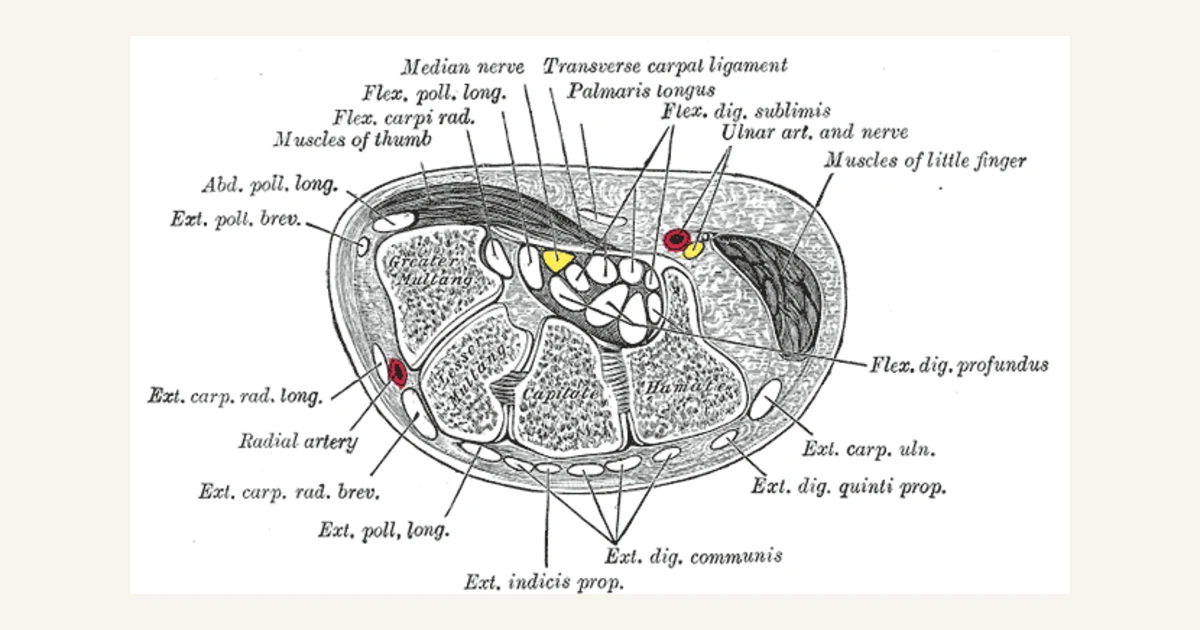
The carpal tunnel is a narrow passage at the front of your wrist. The small wrist bones (carpal bones) form its floor and sides, and a tough band called the transverse carpal ligament forms its roof. Ten structures share this tight space: the median nerve and nine tendons that bend your fingers and thumb.
The median nerve carries feeling from your thumb, index finger, middle finger and the thumb-side half of your ring finger. It also powers the thenar muscles, the pad of muscle at the base of your thumb that turns and lifts the thumb for pinch.
Anything that raises pressure inside the tunnel squeezes the nerve and reduces its blood supply. Swollen tendon linings, fluid retention and a wrist held bent for long periods all do this. The nerve responds first with tingling, then numbness and, if the pressure lasts, weakness.
You may see the condition called median nerve compression at the wrist or median neuropathy at the wrist. Both names describe the same problem. Singapore General Hospital’s hand surgery department calls it the most frequent entrapment neuropathy of the upper limb: the nerve squeeze we see more than any other in the arm.
Carpal tunnel symptoms
- Tingling and numbness in the thumb, index, middle and half of the ring finger. The little finger feels normal, a useful clue that points to the median nerve.
- Symptoms that wake you at night. Many people curl their wrists in their sleep, which raises pressure in the tunnel. Night waking is often the first sign.
- Shaking or flicking the hand for relief. Clinicians call this the flick sign.
- Tingling with gripping tasks. Holding a phone, a steering wheel, a hairdryer or a newspaper can bring it on.
- Clumsiness and dropping things. Buttons, earrings and coins get harder to handle as feeling fades.
- An ache in the forearm. Some people feel an ache that spreads up from the wrist.
- Later signs. Numbness that stays all day, a weak pinch, and wasting of the thenar muscles, seen as a flattened pad at the base of the thumb. These signs need a doctor’s review soon.
Symptoms come and go at first. Both hands are often affected, with one worse than the other.
How to tell carpal tunnel apart from other causes of hand numbness
| Condition | Where you feel it | Clues |
| Carpal tunnel syndrome | Thumb, index, middle and the thumb-side half of the ring finger; the little finger feels normal | Worse at night and with gripping; skin of the palm near the wrist often feels normal |
| Neck nerve root irritation (cervical radiculopathy) | Follows one nerve root from the neck down the arm | Neck pain; symptoms change with neck movement and can spread from the shoulder |
| Cubital tunnel syndrome | Ring and little fingers | Worse with the elbow bent for long periods, such as holding a phone to your ear |
| Guyon’s canal (ulnar tunnel) syndrome | Ring and little fingers on the palm side; the back of the hand on that side feels normal | Pressure on the heel of the hand on the little-finger side: long or downhill rides on the handlebars, a tool handle, a walking stick or crutch. Can weaken grip with little tingling |
| Pronator syndrome | Same fingers as carpal tunnel, plus the palm at the base of the thumb | Aching in the front of the forearm; night waking is less common |
| Diabetic peripheral neuropathy | Both hands and both feet | Often starts in the feet; needs a doctor’s check for diabetes |
| Thoracic outlet syndrome | Whole arm, often the little-finger side of the hand | Worse with arms overhead or with a heavy bag on the shoulder |
| Base of thumb arthritis | Base of the thumb | Pain with pinch and twisting, without tingling; can coexist with carpal tunnel |
| De Quervain’s tenosynovitis | Thumb side of the wrist | Pain with thumb and wrist movement; no numbness in the fingers |
Numb little finger after a long ride? Guyon’s canal
The nerve to the little finger runs through two tunnels: one at the elbow (the cubital tunnel) and one at the wrist, beside the small bones on the little-finger side of the palm (Guyon’s canal). Cyclists know it as handlebar palsy: weight through the heel of the hand on the handlebars, sometimes even on short rides.b
The clue that tells the two apart: when the nerve is pressed at the wrist, the back of the hand on the little-finger side usually feels normal. When it is pressed at the elbow, that patch is often numb too.c
- What usually helps first: taking the pressure off. Changing hand position every few minutes on the bike, padded gloves, a bike fit that puts less weight through the hands, a softer grip on the tool.
- What we measure: sensation on each side of the ring and little fingers, grip and pinch strength in kilograms, and the strength of the small muscles that spread the fingers, both hands.
- See a doctor soon if the hand is getting weaker, you are dropping things, or the muscle between the thumb and index finger looks hollow. Your GP can refer you for nerve conduction studies. A lump at the wrist needs a doctor’s look as well.
When the pressure is removed early, symptoms usually settle over weeks to a few months. For the elbow, see the Cubital Tunnel Recovery Program.
Sources: b. Capitani D, Beer S. Handlebar palsy: a compression syndrome of the deep terminal (motor) branch of the ulnar nerve in biking. J Neurol. 2002;249(10):1441-1445. c. Earp BE, Floyd WE, Louie D, Koris M, Protomastro P. Ulnar nerve entrapment at the wrist. J Am Acad Orthop Surg. 2014;22(11):699-706.
But what causes carpal tunnel syndrome?
Anything that crowds the tunnel or swells the tissues inside it presses on the median nerve. For most people, several small factors add up:
- Pregnancy. Fluid retention in the third trimester swells the tissues in the tunnel.
- Diabetes and thyroid problems. Diabetes is common in Singapore and makes nerves more sensitive to pressure. An underactive thyroid can cause swelling in the tunnel.
- Rheumatoid arthritis and other inflammatory conditions. These thicken the linings around the tendons.
- Age and sex. Carpal tunnel syndrome is most common between 40 and 60, and in women.
- Higher body weight. Studies link it with a higher risk.
- A previous wrist fracture. A healed break can change the shape of the tunnel.
- Forceful, repeated gripping and vibrating tools. Drills, grinders, floor polishers and heavy kitchen work all load the tunnel.
Keyboards and mouse use. Research has not shown a clear link between office computer work and carpal tunnel syndrome, and the studies disagree. Desk set-up still matters once you have symptoms, because a bent wrist and a hard edge under the palm raise pressure in the tunnel.
In Singapore, we see carpal tunnel symptoms in CBD desk workers, pregnant women and new mothers, F&B, cleaning and construction workers who grip hard or use vibrating tools, people with diabetes, and older adults.
How is carpal tunnel syndrome diagnosed?
A doctor diagnoses carpal tunnel syndrome from your symptoms and an examination, and a hand therapist runs the same examination at assessment. The pattern of tingling, the night waking and a little finger that feels normal carry the most weight.
- Symptom map. You shade the areas of tingling on a hand diagram. A median nerve pattern supports the diagnosis.
- Tinel’s test. Tapping over the nerve at the wrist sends tingling into the fingers.
- Phalen’s test. Holding both wrists bent for up to 60 seconds brings on the tingling.
- Carpal compression (Durkan) test. Firm thumb pressure over the tunnel for up to 30 seconds brings on the tingling.
- Sensation and strength. Your clinician tests light touch in the fingertips and measures pinch and grip strength.
- Neck and elbow checks. These rule out a nerve problem higher up the arm.
Nerve conduction studies. A doctor arranges these tests, which measure how fast signals travel along the median nerve. They confirm the diagnosis and grade it as mild, moderate or severe. Surgeons need them before an operation, and they help when the diagnosis is unclear. Some doctors add an ultrasound scan, which can show a swollen nerve.
Carpal tunnel syndrome treatment in Singapore: your options
The right treatment depends on severity. Mild to moderate carpal tunnel syndrome often responds to non-surgical care. Severe or long-standing cases need a surgeon’s opinion.
| Option | Who provides it | Evidence | When it fits |
| Night splint in neutral | Hand therapist | Strongest non-surgical evidence for mild to moderate cases, together with steroid injection | First line, worn at night for 6 to 8 weeks or longer |
| Grip, task and desk changes | Hand therapist | Eases daytime symptoms | From day one |
| Nerve and tendon gliding exercises | Hand therapist | Limited, mixed evidence; useful as part of a program | Alongside splinting |
| Anti-inflammatory tablets or diuretics | Doctor or pharmacist | Little benefit over placebo in trials | Not a treatment on their own |
| Short course of oral steroids | Doctor or pharmacist | Short-term relief | Selected cases |
| Steroid injection | Doctor or pharmacist | Relief for months in many people; symptoms can return | Mild to moderate cases, or while waiting for surgery |
| Carpal tunnel release surgery | Hand or orthopedic surgeon | Relieves symptoms for most people with severe or persistent disease | Constant numbness, weakness, muscle wasting, severe nerve test results, or failed conservative care |
Night splints: the wrist angle matters. Pressure inside the carpal tunnel is lowest with the wrist near straight. Many ready-made pharmacy braces tilt the wrist back 20 to 30 degrees, an angle that suits sprains and raises pressure on the median nerve. A splint for carpal tunnel holds the wrist in neutral and leaves the fingers free. Wear it at night, when wrists curl during sleep, and during tasks that bring on tingling. Your hand therapist can mold a custom splint at the right angle, or check and adjust a ready-made one.
Changing grip and tasks. Your therapist looks at the grips and positions that bring on symptoms: a tight grip on a steering wheel, a phone held with a bent wrist, a hairdryer, a heavy wok. Thicker handles, two-handed lifts, breaks from vibrating tools and a straighter wrist during long tasks all reduce pressure on the nerve.
Medication. No tablet frees a squeezed nerve. In trials, anti-inflammatory tablets and diuretics have done little better than placebo for carpal tunnel syndrome. A doctor may prescribe a short course of oral steroids or inject a steroid into the tunnel. An injection often brings relief for months, and symptoms return for some people. Hand therapists do not prescribe medication or give injections; we coordinate your splint and exercise plan with your doctor.
Surgery. A hand or orthopedic surgeon cuts the transverse carpal ligament to give the nerve more room. The operation is a day procedure under local anesthetic, through a small cut in the palm (open release) or with a camera (endoscopic release). Surgeons recommend it for constant numbness, weakness or muscle wasting, severe nerve test results, or symptoms that persist despite good conservative care. Numbness that has lasted for years may not recover in full, so constant numbness deserves an early surgical opinion.
Hand therapy for carpal tunnel at Phoenix Rehab Group
Our hand therapy team was built by Nigel Chua, founder of Phoenix Rehab and a hand therapist by training. You are seen by our hand therapists: AHPC-registered occupational therapists and physiotherapists with post-graduate training in hand therapy.
At your first appointment, you can expect:
- A symptom and task history. We map your tingling and ask about sleep, work, phone use and pregnancy.
- An examination of both hands. We test sensation and measure grip and pinch strength with calibrated gauges, run the provocation tests, and check your neck and elbow.
- A custom night splint. We mold a thermoplastic splint that holds your wrist in neutral in the same appointment, or check the angle of your current brace.
- A grip and desk plan. Specific changes for the tasks that bring on your symptoms.
- A nerve and tendon gliding program. We set the dose so the glides do not stir up tingling.
Constant numbness, weakness or wasting needs a doctor’s review, and so do symptoms that have not improved after 6 to 8 weeks of splinting. In those cases, we write to your GP or a hand surgeon with our findings and recommend nerve conduction studies. Most people need 3 to 5 appointments over 6 to 8 weeks.
Contact us for a carpal tunnel assessment. WhatsApp us.
Carpal tunnel in pregnancy and after the birth
Carpal tunnel syndrome is common in pregnancy, most often in the third trimester, when fluid retention raises pressure on the median nerve at the wrist. It often affects both hands and wakes you at night. Many women improve after the birth, and some still have symptoms through breastfeeding and beyond. A neutral night splint is the usual first step.
Why it happens in pregnancy
Pregnancy adds fluid to every tissue in the body, and the carpal tunnel has no room to give. The median nerve and nine tendons now share the space with swollen tissue, so the pressure on the nerve rises. Symptoms most often start in the third trimester.f Night is worst: the hands have been still for hours and the wrists curl under the pillow. In one study, three quarters of pregnant women with symptoms had them in both hands.d Reported rates in pregnancy run from 31% to 62% when the diagnosis is made on symptoms.e
Does carpal tunnel go away after pregnancy?
Often it eases after delivery, as the extra fluid leaves. Not always. A systematic review found symptoms still present in more than half of women one year after delivery, and in about 30% at three years.e Symptoms can also carry on through breastfeeding.f Baby care keeps the wrists bent for hours a day, and that adds pressure on a nerve that is already irritated.
What is safe to do while you are pregnant
- A night splint that holds the wrist straight. Neutral, with the fingers and thumb free, worn every night, and for night feeds after the birth. A splint involves no medication, so you can wear it through pregnancy and breastfeeding. Many pharmacy braces tilt the wrist back, which is the angle that raises pressure on the nerve.
- Sleep with your wrists out of the curl. Lie on your side with the top arm resting on a pillow in front of you, and keep your hands out from under your cheek and the pillow.
- Move the fluid. Raise your hands above your heart and open and close them 10 times, a few times a day and when you wake.
- Glide, gently. The nerve and tendon glides in the exercises section further down can be done in pregnancy, at a dose that does not stir up tingling.
- Take the baby’s weight off your wrists. During feeds, a nursing pillow carries the baby and your forearm rests along it, wrist straight. At night, prop the phone on a stand instead of holding it.
- Leave medication to your doctor. Pain relief and any other medication in pregnancy or while breastfeeding is a decision for your doctor or pharmacist. An injection is something your doctor may discuss with you.
Carpal tunnel or mummy wrist?
Both turn up in the months around a birth, and they can share a wrist. Carpal tunnel is tingling and numbness in the thumb, index and middle fingers, worst at night. Mummy wrist, De Quervain’s tenosynovitis, is a sharp pain on the thumb side of the wrist when you lift the baby under the arms, with no numbness in the fingers. The splints differ as well. Carpal tunnel needs the wrist held straight with the thumb free. De Quervain’s needs a splint that holds the thumb too, and a wrist-only brace does little for it.
What we do
Your hand therapist maps where the tingling is, tests light touch in your fingertips, and measures grip and pinch in kilograms on both hands. We run the carpal tunnel tests, check your neck, and check the thumb side of the wrist for De Quervain’s. Then we mold a thermoplastic night splint to your hand on the first visit: wrist in neutral, fingers and thumb free. Swelling in pregnancy changes from week to week, so we reshape the splint when it starts to press. Thermoplastic wipes clean after a feed. At each review we measure again, so you see whether the numbers are moving instead of judging by last night. This is Stage 1, Calm & Protect, of The Phoenix Recovery Protocol.
When to see a doctor first
Tingling fingers in pregnancy are most often carpal tunnel. Sudden swelling is a different matter.g
- Call 995 if you have a fit, or sudden numbness or weakness down one side of the body with a drooping face or slurred speech.
- Go to the emergency department now, or your delivery hospital’s 24-hour obstetric emergency service, if your face, hands or feet swell suddenly together with a severe headache, blurred vision or flashing lights. These can be signs of pre-eclampsia.
- See a doctor the same day if your hands, face or feet swell suddenly, even without a headache. After the birth, the same applies to a hot, red, swollen wrist or a fever.
- See a doctor soon if the numbness becomes constant, your pinch weakens, the base of your thumb looks flatter than the other side, or the tingling is still there three months after the birth. Your GP can refer you for nerve conduction studies.
The baby is here, and the hands are not better
Three in the morning, halfway through the feed, and the phone has gone numb in your hand. The snaps on the onesie take so long that you pass the baby over to be changed. The car seat buckle takes two goes, because your thumb will not press hard enough.
Your partner does the snaps now. You carry the baby on your forearms because you no longer trust your grip. Maternity leave ends at 16 weeks, and the keyboard is waiting.
Everyone said it would go once the baby came. The baby is ten weeks old.
The tingling comes and goes, so it is easy to call it better. Has anyone measured your pinch against the other hand, or tested the feeling in your fingertips?
An Assessment & Treatment answers both on the first visit, and you leave with your stage, a splint if you need one, and a written plan. The WhatsApp button at the end of this page reaches the hand therapy team.
Sources for the section on pregnancy: d. Voitk AJ, Mueller JC, Farlinger DE, Johnston RU. Carpal tunnel syndrome in pregnancy. CMAJ. 1983;128(3):277-281. e. Padua L, Di Pasquale A, Pazzaglia C, Liotta G, Librante A, Mondelli M. Systematic review of pregnancy-related carpal tunnel syndrome. Muscle Nerve. 2010;42(5):697-702. f. Georgiew F, Florek J, Bębenek A, Florek P, Sobanski G. Pregnancy-related carpal tunnel syndrome. Cureus. 2025;17(10):e94652. g. NHS. Pregnancy symptoms you need to get help for. nhs.uk.
Desk and phone set-up that eases carpal tunnel symptoms
- Keep the wrist straight. Adjust your chair so the keyboard sits at elbow height and your wrists stay level.
- Take the pressure off the palm. Avoid resting the heel of your hand on a hard desk edge or the edge of a laptop while you type.
- Bring the mouse close. Keep it beside the keyboard, and try a vertical mouse if your wrist bends to reach it.
- Break up long tasks. Change position or task every 30 to 45 minutes.
- Change how you hold the phone. Use a stand for videos, switch hands, and use voice typing for long messages.
- Loosen your grip. Thicker pens, cushioned tool handles and a lighter hold on the steering wheel reduce pressure.
- Give the laptop a keyboard. On a laptop for more than an hour, plug in a separate keyboard and mouse and raise the screen, so your wrists stay level while your eyes stay up.
For a full workstation checklist, see repetitive strain injury.
Carpal tunnel recovery time
Timeframes depend on severity and on how long you have had symptoms. Your therapist or surgeon may give you different targets; use theirs.
| Situation | What happens | Typical timeframe |
| Mild to moderate, with night splint and task changes | Night waking eases first, then daytime tingling | Improvement within 2 to 4 weeks; review at 6 to 8 weeks |
| After a steroid injection | Tingling and night waking ease | Relief within 1 to 2 weeks, lasting months for many people |
| Pregnancy-related | Often eases after delivery; can persist through breastfeeding and beyond | Weeks to months; still present at one year in more than half of women in one systematic review |
| After release surgery: night symptoms | Night waking stops | Often within days |
| After release surgery: grip and pillar pain | Scar settles and strength returns | Grip recovers over about 3 months; pillar pain can last weeks to months |
| Long-standing severe cases | Numbness and wasting recover at a slow pace, sometimes in part | Up to 12 months or longer |
You are on track if you wake less often, shake your hand less and drop things less. Contact your therapist if numbness becomes constant, your pinch weakens, or the splint causes new tingling or pressure marks.
Carpal tunnel exercises: nerve and tendon glides
Glides move the median nerve and the finger tendons through the tunnel. On their own, they have limited evidence; they help as part of a program with splinting and task changes.
Tendon glides. Start with a straight hand, then make a hook fist, a full fist, a flat fist and a straight fist. Hold each for 3 seconds. 5 to 10 rounds, 2 to 3 times a day.
Median nerve glide. Move through these six positions:
- Make a fist with your wrist straight and your thumb outside your fingers.
- Straighten your fingers and thumb, keeping the thumb beside the index finger.
- Bend the wrist back.
- Move the thumb out to the side.
- Turn the palm up to face the ceiling.
- Use your other hand to ease the thumb a little further out.
Hold each position for 3 to 5 seconds. 5 rounds, 2 to 3 times a day.
Stop or scale back if tingling starts during a glide and lasts more than a few minutes afterwards, or numbness is worse the next day. A glide should feel like a mild stretch; pins and needles mean you went too far.
One habit to drop: long, forceful wrist stretches in either direction, including the prayer stretch that most exercise lists open with. Holding the wrist bent raises pressure in the tunnel.
Rehab & hand therapy after carpal tunnel release surgery
Most people go home the same day with a bulky dressing. Hand therapy after release surgery focuses on the scar, swelling and strength.
- First 2 weeks. Keep the hand raised, make full fists several times an hour while awake, and keep the dressing dry. Stitches come out at about 10 to 14 days.
- Weeks 2 to 6. Scar massage once the wound has healed, desensitization for a tender scar, tendon and nerve glides, and light daily use.
- Weeks 6 to 12. Grip and pinch strengthening, and a return to heavier tasks.
Pillar pain, a tender ache at the base of the palm on either side of the scar, is common and can last weeks to months. It does not mean the operation failed. Desk workers often return to work within 1 to 2 weeks, and manual workers after 4 to 6 weeks or longer, as the surgeon advises.
See post-surgery rehabilitation.
Open or keyhole release: does it change the rehab?
Not much. In open release the surgeon divides the ligament through a short cut in the palm. In endoscopic, or keyhole, release it is done through one or two smaller cuts, guided by a camera. A Cochrane review comparing the two found similar improvement in numbness and tingling, with keyhole release getting some people back to work a little sooner. Which one you have is your surgeon’s call, based on your hand and their experience.
The rehab runs the same four stages either way. What differs is the first few weeks of scar work: a longer palm scar usually needs more desensitization and more time before firm grip feels comfortable.
When can I drive after carpal tunnel release?
When you can grip the wheel firmly with the operated hand, turn it quickly and make an emergency stop without pain or the hand giving way. For many people that is within the first two weeks, sometimes sooner after keyhole release. Your surgeon has the final say, and some insurers set their own rules after surgery, so check your policy.
Mistakes that slow carpal tunnel syndrome recovery
- Wearing a brace that tilts the wrist back. It raises pressure on the nerve. Check the angle, or ask a hand therapist.
- Splinting on bad nights alone. Consistent night wear gives the nerve a steady break.
- Pushing through tingling. Tingling during a task is a signal to change grip, position or tool.
- Relying on painkillers. Tablets do not relieve pressure on the nerve.
- Waiting out constant numbness. Constant numbness or muscle wasting needs a doctor’s review soon, because long-standing compression can leave permanent numbness.
- Stretching hard. Long, forceful wrist stretches raise pressure in the tunnel.
When to see a doctor
Call 995 or go to A&E if:
- you have sudden weakness or numbness of the face, arm or leg, slurred speech or a drooping face (possible stroke)
See a doctor on the same day if:
- numbness starts after a wrist fracture or inside a tight cast
- your hand swells fast with numbness after an injury
- after release surgery, the wound is red, hot or weeping, blood soaks through the dressing, or you have a fever of 38°C or above
Make an appointment with a doctor soon if:
- numbness is constant, your pinch is weak, or the base of the thumb looks flattened
- both hands and both feet feel numb (a check for diabetes or neuropathy)
- neck pain spreads down the arm with tingling
- symptoms have not improved after 6 to 8 weeks of splinting
- numbness improved after surgery and is now getting worse again
Frequently asked questions about carpal tunnel syndrome
What is the best medication for carpal tunnel pain?
No tablet frees the squeezed median nerve. In trials, anti-inflammatory tablets and diuretics have given little more benefit than placebo for carpal tunnel syndrome. A doctor may prescribe a short course of oral steroids, or inject a steroid into the tunnel, which relieves symptoms for months in many people. A neutral night splint shares the strongest non-surgical evidence with injection, so start there and speak to your doctor about medication.
What is the best way to treat carpal tunnel syndrome?
Treatment depends on severity. Mild to moderate carpal tunnel syndrome responds to a night splint that keeps the wrist straight, changes to grip and tasks, and a nerve and tendon gliding program. A doctor can add a steroid injection if needed. Constant numbness, weakness, wasting at the base of the thumb or severe nerve test results need a surgeon’s opinion, because release surgery relieves symptoms for most people with severe disease.
Can carpal tunnel heal on its own?
Mild carpal tunnel syndrome can settle on its own once the cause eases, for example after pregnancy or a change of job. Many cases come and go for months, and some worsen over time. Constant numbness or weakness points to more pressure on the nerve and needs a doctor’s review soon, because long-standing severe compression can leave permanent numbness. A night splint and task changes improve the odds for mild cases.
What are 5 symptoms of carpal tunnel?
Five common symptoms are tingling or numbness in the thumb, index, middle and half of the ring finger; night waking; shaking or flicking the hand for relief; dropping small objects; and an ache from the wrist into the forearm. Later signs include constant numbness, a weak pinch and a flattened muscle at the base of the thumb, which need a doctor’s review.
How long should I wear a carpal tunnel splint?
Wear a neutral night splint each night for 6 to 8 weeks, and during tasks that bring on tingling. Many people notice fewer night symptoms within 2 to 4 weeks. If symptoms have not improved after 6 to 8 weeks, see your hand therapist or doctor to discuss the next step. Some people go back to the splint during flare-ups or busy work periods.
Can a physiotherapist or hand therapist treat carpal tunnel syndrome?
Yes. A hand therapist, a physiotherapist or occupational therapist with post-graduate hand training, treats mild to moderate carpal tunnel syndrome with a night splint, grip and task changes, and nerve and tendon glides. Your therapist also spots the signs that need a doctor, such as constant numbness or muscle wasting, and works with your surgeon on rehab after release surgery. In Singapore, you can see a hand therapist without a referral.
Does carpal tunnel go away after pregnancy?
Often it eases after delivery, as the extra fluid leaves, but not always. A systematic review found symptoms still present in more than half of women one year after delivery, and in about 30% at three years. Symptoms can also carry on through breastfeeding. See a doctor if numbness persists three months after the birth or becomes constant.
When should I worry about carpal tunnel in pregnancy?
See a doctor soon if numbness becomes constant, your pinch weakens, or the base of your thumb looks flatter than the other side. Sudden swelling of the face, hands or feet needs a doctor the same day. With a severe headache, blurred vision or flashing lights, go to the emergency department now, as these can be signs of pre-eclampsia.
Is a wrist splint safe for carpal tunnel during pregnancy?
Yes. A night splint that holds the wrist straight, with the fingers and thumb free, involves no medication, so you can wear it through pregnancy and breastfeeding. It is the usual first step. Many pharmacy braces tilt the wrist back, which raises pressure on the nerve, so check the angle or ask a hand therapist to mold one.
Can I take medication for carpal tunnel while pregnant or breastfeeding?
Pain relief and any other medication in pregnancy or while breastfeeding is a decision for your doctor or pharmacist. An injection is something your doctor may discuss with you. A hand therapist does not advise on medication, and works on what involves none: a neutral night splint, sleeping and feeding positions, and gentle nerve and tendon glides.
Do I need surgery for carpal tunnel?
Many people avoid surgery. Mild to moderate cases often improve with splinting, task changes and, if needed, a steroid injection. Surgeons recommend carpal tunnel release for constant numbness, weakness or muscle wasting, severe nerve conduction results, or symptoms that persist despite good conservative care. Release surgery is a day procedure under local anesthetic, and hand therapy afterwards helps with the scar, pillar pain and grip strength.
Do I need a doctor’s referral to see a hand therapist for carpal tunnel in Singapore?
No. You can see a hand therapist at Phoenix Rehab Group without a doctor’s referral. If you need nerve conduction studies, an injection or a surgical opinion, we refer you to a doctor and share our findings. Some insurers ask for a doctor’s referral before they reimburse therapy, so check your policy first.
Is it normal to still have numbness after carpal tunnel surgery?
Yes, for a while. Night waking usually stops within days. Numbness in the fingertips can take weeks to months to settle, because the nerve recovers slowly once the pressure is off, and the longer and harder it was squeezed, the slower and less complete that recovery tends to be. Numbness that gets better and then worse again is different: tell your surgeon.
Can carpal tunnel come back after surgery?
It is uncommon after a complete release. When symptoms stay after surgery, it is more often because the nerve was compressed for a long time beforehand and has not fully recovered. When symptoms come back after months of being clear, see your surgeon. A repeat nerve conduction study helps tell the two apart.
Should carpal tunnel exercises hurt?
No. A nerve or tendon glide should feel like a mild stretch. Tingling that starts during a glide and fades within a few minutes means ease off. Tingling that lasts longer, or numbness that is worse the next morning, means you went too far. The same logic is why we leave out the prayer stretch: holding the wrist bent back under load raises pressure inside the tunnel, which is the opposite of what the nerve needs.
Contact us for a carpal tunnel assessment
If numb or tingling fingers are waking you or making you drop things, a hand therapist can assess what is driving it and start treatment in the first appointment.
- WhatsApp: Message us. Your message opens with “Hi, I’d like to schedule a hand therapy assessment for carpal tunnel syndrome.”
- Clinics: Orchard, Serangoon, Tampines, Tanjong Pagar at International Plaza and Jurong East at Vision Exchange, opening 25 October 2026.
- Referral: not required. Some insurers need one for claims, so check your policy.
- Insurance: we provide itemized invoices, and a clinical report if your insurer asks for one.
The nine flexor tendons that bend your fingers and thumb share the carpal tunnel with the median nerve, and they run on into the fingers. When their lining thickens at the base of a finger instead of at the wrist, the finger catches or locks rather than going numb. That is trigger finger, and the two often turn up in the same hand.
If the pain builds over a day at the desk, office syndrome covers the neck, back and wrist problems behind it. If you play an instrument, musician injuries covers hand, wrist and arm pain from playing.
If the numbness is in the ring and little fingers rather than the thumb, index and middle, the nerve being compressed is at the elbow rather than the wrist. The Cubital Tunnel Recovery Program sets out the four stages and the criteria to move up.
Had an injection?
The numbness eased after the injection. Your wrist still sleeps bent.
A steroid injection reduces swelling inside the tunnel and takes pressure off the median nerve. It does not change the wrist curled under the pillow at night, or the angle at the keyboard all day.
A night splint holding the wrist straight, nerve and tendon gliding, and the workstation are the work. If the numbness is constant, or the muscle at the base of the thumb has started to thin, that needs your doctor first, whatever happened with the injection.
Where are you with this right now?
1. It is settling on its own
Many hand problems settle with a well fitted splint, changes to what provokes them, and tendon gliding. A tender scar and weak grip for a few weeks after surgery are usual. If the numbness still comes and goes rather than staying constant, and grip is improving month on month, it is behaving as expected. You do not need us for this, and we would rather say so.
2. It has stopped improving
You hand the jar to someone else. You button the shirt one-handed. You have stopped using that hand for anything that matters and barely noticed when it started.
The hand is the part of the body where stiffness sets in fastest, because a hand that hurts gets used less within days rather than weeks. That is the gap worth measuring, and it is not measured by how you feel on the day.
The Stalled Recovery Review is three appointments over three weeks with the same therapist, because what a joint does under load cannot be read in one visit. The first finds what is limiting it. The next two measure how it responds. $690, nett, no GST, which is three appointments at $230.
3. You have had surgery, or you have a date
Recovery after an operation has a shape, and knowing which stage you are in tells you whether you are on it. The Carpal Tunnel Program above sets it out, or see hand therapy after surgery if you are not sure which applies to you.
All of it runs on the same four stages. The Phoenix Recovery Protocol explains what each stage works on and what you have to meet to move up. No referral needed to start.
Next step
Find out which stage you are in
Pain is the first thing to leave. Movement and strength are the last things trained back, and most people stop before that part is done. One Assessment and Treatment is a single 45-minute appointment at $230, nett, no GST. Your therapist finds what is actually limiting you, treats it in the same appointment, and you leave with your current stage and a written plan.
Prefer to phone? Each of our five clinics has its own number on the clinics page. No referral needed to book.
Related reading
- hand therapy after surgery
- Trigger finger
- Cubital Tunnel Recovery Program
- Hand Occupational Therapist Singapore | Phoenix Rehab Group
- Wrist Fracture Recovery Program | Hand Therapy Singapore
- Thumb Joint Pain and Thumb Arthritis Singapore | Phoenix
- The Phoenix Recovery Protocol, and the four stages
- All recovery programs, hand and physio
- Rheumatoid arthritis in the hands
Where we are
Clinics across Singapore
ORCHARD
400 Orchard Road #12-12
Orchard Towers, S238875
NS22 Orchard MRT
Physiotherapy and hand therapy in Orchard →
WhatsApp 8800 1830TAMPINES
9 Tampines Grande #01-20
Asia Green, S528735
EW2DT32 Tampines MRT
Physiotherapy and hand therapy in Tampines →
WhatsApp 8780 9608SERANGOON
265 Serangoon Central Drive #04-269
S550265 · Lift C only
NE12CC13 Serangoon MRT
Physiotherapy and hand therapy in Serangoon →
WhatsApp 8892 4121TANJONG PAGAR
10 Anson Road #02-77A
International Plaza, S079903
EW15 Tanjong Pagar MRT
Physiotherapy and hand therapy in Tanjong Pagar →
WhatsApp 8227 7074JURONG EAST
2 Venture Drive #02-02
Vision Exchange, S608526
NS1EW24 Jurong East MRT
Opening 25 October 2026
Physiotherapy and hand therapy in Jurong East →
WhatsApp 8242 7340What our patients say
Google reviews from our clinics in Singapore.



