
Written by Zita Sham, Fairuuz Saleh and Shiv Mohan Banka, Principal Physiotherapists at Phoenix Rehab.Clinically reviewed by Louise Yow, Principal Physiotherapist & Director, AHPC A1300363H; biceps tendon section by Nigel Chua, Principal Hand Occupational Therapist & Director, AHPC A1300362Z.Last reviewed 4 October 2026.
Brachialis pain is an ache at the front of the elbow and the lower upper arm, under the biceps, that hurts when you bend the elbow against load: pull-ups, rows, reverse curls, carrying shopping with the palm down. Most are mild strains or an overloaded tendon and settle with the load adjusted. A mild strain usually settles in two to three weeks. A sudden pop with bruising is different: see a doctor the same day.
Key takeaways
- Brachialis pain is an ache at the front of the elbow and lower upper arm, under the biceps, that hurts when you bend the elbow against load, especially with the palm down.
- A mild brachialis strain usually takes about two to three weeks to get back to full pulling, and a moderate strain about four to eight weeks.
- Soreness after a hard pulling day peaks at one to three days and fades within about a week, on both arms. A strain is usually one arm and is still there a week later.
- Pain turning the palm up against resistance points to the biceps tendon. Pain along the thumb side of the forearm points to the brachioradialis.
- A pop at the front of the elbow with bruising, or a change in the shape of the arm, needs a doctor the same day.
Brachialis, biceps or brachioradialis?
Three muscles bend the elbow. Which one hurts changes the plan.
| What you notice | More likely |
|---|---|
| Deep ache at the front of the elbow, worse bending against load with the palm down, biceps itself not tender | Brachialis |
| Pain worse when you turn the palm up against resistance (turning a key, turning a screwdriver), or a pop with bruising at the elbow crease | Biceps tendon. See the section further down |
| Pain along the top of the forearm on the thumb side, worse with hammer curls or gripping and lifting with the thumb up | Brachioradialis |
| Pain on the outside of the elbow when gripping, worse lifting a kettle or a cup | Tennis elbow |
Sore after pull-ups, or strained?
Muscle soreness after a hard pulling day peaks at one to three days and fades within about a week, on both arms. A strain is usually one arm, starts during the set, hurts on a specific movement, and is still there a week later. If it is the second, the arm needs its load changed, not more of the same.
How long does a brachialis strain take?
| What it is | What it feels like | Usually back to full pulling |
|---|---|---|
| Mild strain | Sore to bend against load, full movement | About two to three weeks |
| Moderate strain | Weak to bend the elbow, sometimes some bruising | About four to eight weeks |
| Overloaded tendon (months of aching) | Ache during and after training, stiff first thing | Often three months of graded loading |
| Pop, bruising, a change in the shape of the arm | Possible tendon tear | See a doctor the same day |
What we measure before you pull again
- Strength. Elbow bending strength on both sides, with the palm up, palm down and thumb up, to see which position is weakest.
- Range. Full straightening and bending of the elbow, against the other side.
- Load tolerance. Which pulling movement, at what weight, brings the pain on, and whether it is worse the next day.
- Return. Rows, then pull-ups, then hanging and climbing, in steps, with the measures deciding each one.
Tested, not dated. You pull again when the measures say so.
What is the brachialis muscle and what does it do?
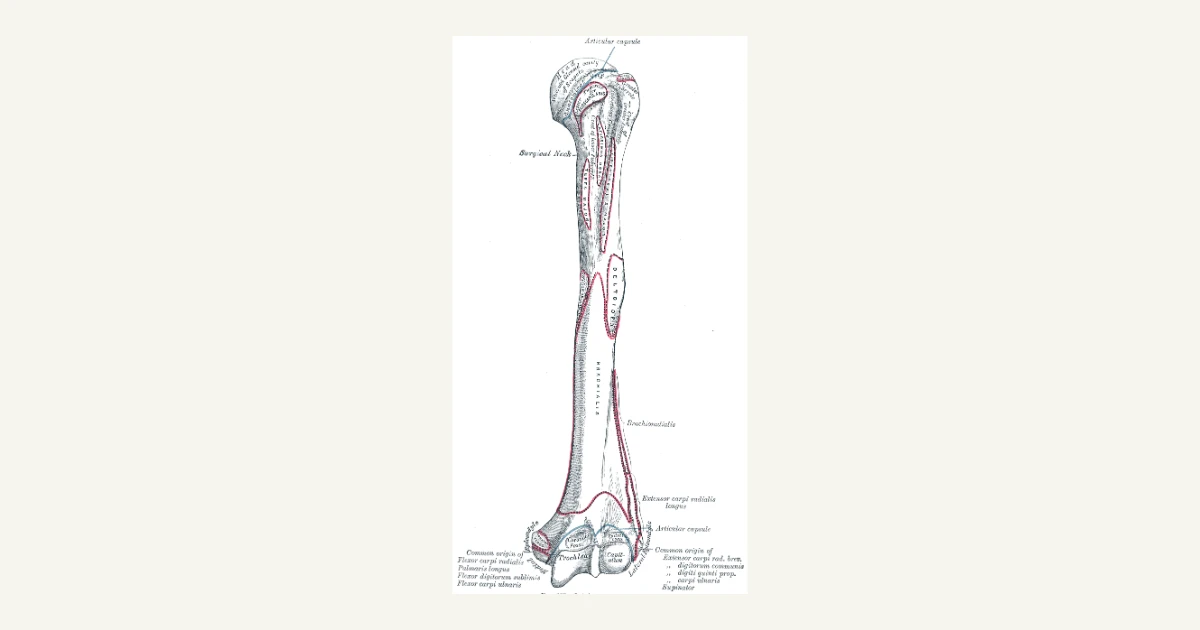
The brachialis lies under the biceps, on the front of the lower half of the upper arm bone. It crosses the front of the elbow and attaches to the ulna, the forearm bone on the little-finger side, just below the elbow joint. Its only job is bending the elbow, and it does that whichever way the palm faces. That is why it carries so much of the load in pulling work: rows, pull-ups, rope climbs, carrying. The biceps bends the elbow too, but it is strongest with the palm up, and it also turns the palm up.
What causes brachialis strain?
- A jump in pulling volume: more pull-ups, a new rowing or climbing block, a CrossFit or HYROX block heavy on rope and sled work.
- Heavy lowering: controlling a heavy weight down, or catching something that falls.
- Repeated carrying with the elbow bent: trays, toolboxes, a child on the hip.
- Climbing: long days on steep walls and holds that lock the elbow bent.
Symptoms of a brachialis strain
- A deep ache at the front of the elbow or the lower front of the upper arm.
- Pain bending the elbow against load, especially palm down.
- Pain or stiffness straightening the elbow fully after training.
- Tenderness just above the elbow crease, under the biceps.
Who is at risk?
Climbers, rowers, people who train pull-ups and rope work, and anyone whose job means lifting and carrying with the elbows bent. A brachialis that is weak relative to the training load is more likely to ache.
Treatment options for brachialis strain
- Change the load, don’t stop it. Cut the pulling volume and the heaviest lowering for a week or two, and keep the arm moving.
- Graded loading. Elbow bending against light, then heavier load, in the palm-down position first, built up over weeks.
- Range. Gentle full straightening and bending each day, so the elbow does not stiffen in a bent position.
- Medication and injections are a doctor’s decision.
When to see a doctor first
- Go to the emergency department now if the elbow or forearm is deformed after a fall, or the forearm is swelling fast and feels tight and very painful.
- See a doctor the same day for a pop at the front of the elbow with bruising, or a change in the shape of the arm.
- See a doctor soon for numbness or tingling in the forearm or hand, or a hard lump in the muscle with loss of bending after a blow or a dislocation. Deep massage on that lump should wait until a doctor has seen it.
Brachialis strain or a torn biceps tendon?
Both hurt at the front of the elbow after lifting. They are different injuries, and the second one needs a doctor first.
| Brachialis strain | Distal biceps tendon tear | |
|---|---|---|
| How it started | Usually built up over days or weeks of pulling, curls, rope work or climbing, or a sharp twinge with no pop | One moment under a heavy load, often lowering it: a heavy curl, a failed muscle-up, catching something falling. Often a pop |
| Bruising | Uncommon | Common at the front of the elbow and forearm within a few days |
| Shape of the arm | Unchanged | The biceps may bunch up toward the shoulder |
| Turning the palm up | Usually comfortable. Bending the elbow against resistance with the palm down is what aches | Weak and painful |
| What happens next | Physiotherapy, loading the muscle back in stages | A doctor the same day. Whether and when to repair it is the surgeon’s decision |
Distal biceps tendon tears happen mostly in men in their 30s to 50s, usually when the elbow is forced straight while the biceps is working hard. A tear higher up, at the shoulder end of the biceps, tends to happen in older adults, leaves a bulge low in the upper arm, and is usually managed without surgery.
After a repair, rehabilitation runs through the four stages of the Phoenix Recovery Protocol: Calm & Protect, Move & Mobilize, Rebuild & Strengthen, and Return & Perform. Strengthening usually starts from around 8 to 12 weeks, and heavy lifting is usually not before 4 to 6 months, on your surgeon’s protocol. See hand therapy after surgery.
Also on this site: the page on a lateral collateral ligament injury of the elbow covers the ligament on the outer side of the elbow, and the page on an annular ligament tear covers the ligament that holds the top of the forearm bone.
Where are you with this right now?
1. It is settling on its own
Most injuries and most flare-ups settle over weeks with sensible load management and a return to normal movement. Improvement is judged over a month, not over a day, and good days and bad days inside that are usual. If you are doing more this month than last, and sleeping better, it is behaving the way it should. You do not need us for this, and we would rather say so.
2. It has stopped improving
You have adapted without noticing. The other side takes the load, you plan movements you used to make without thinking, and you have quietly dropped things you used to do.
Pain is the first thing to leave. Movement and strength are the last things trained back, and most people stop before that part is done. That is the gap worth measuring, and it is not measured by how you feel on the day.
The Stalled Recovery Review is three appointments over three weeks with the same therapist, because what a joint does under load cannot be read in one visit. The first finds what is limiting it. The next two measure how it responds. $690, nett, no GST, which is three appointments at $230.
3. You have had surgery, or you have a date
Recovery after an operation has a shape, and knowing which stage you are in tells you whether you are on it. See the recovery programs, hand and physiotherapy, or the four stages and what each one works on if you are not sure which applies to you.
All of it runs on the same four stages. The Phoenix Recovery Protocol explains what each stage works on and what you have to meet to move up. No referral needed to start.
Next step
Find out which stage you are in
Pain is the first thing to leave. Movement and strength are the last things trained back, and most people stop before that part is done. One Assessment and Treatment is a single 45-minute appointment at $230, nett, no GST. Your therapist finds what is actually limiting you, treats it in the same appointment, and you leave with your current stage and a written plan.
What our patients say
Google reviews from our clinics in Singapore.



Prefer to phone? Each of our five clinics has its own number on the clinics page. No referral needed to book.
Related reading
Where we are
Clinics across Singapore
ORCHARD
400 Orchard Road #12-12
Orchard Towers, S238875
NS22 Orchard MRT
Physiotherapy and hand therapy in Orchard →
WhatsApp 8800 1830TAMPINES
9 Tampines Grande #01-20
Asia Green, S528735
EW2DT32 Tampines MRT
Physiotherapy and hand therapy in Tampines →
WhatsApp 8780 9608SERANGOON
265 Serangoon Central Drive #04-269
S550265 · Lift C only
NE12CC13 Serangoon MRT
Physiotherapy and hand therapy in Serangoon →
WhatsApp 8892 4121TANJONG PAGAR
10 Anson Road #02-77A
International Plaza, S079903
EW15 Tanjong Pagar MRT
Physiotherapy and hand therapy in Tanjong Pagar →
WhatsApp 8227 7074JURONG EAST
2 Venture Drive #02-02
Vision Exchange, S608526
NS1EW24 Jurong East MRT
Opening 25 October 2026
Physiotherapy and hand therapy in Jurong East →
WhatsApp 8242 7340