
Written by Zita Sham, Fairuuz Saleh and Shiv Mohan Banka, Principal Physiotherapists at Phoenix Rehab.Clinically reviewed by Louise Yow, Principal Physiotherapist & Director, AHPC A1300363H.Last reviewed 8 October 2026.
You turned your head to check the blind spot and something caught. Or you woke up, went to look left, and your neck simply would not go. Or the neck ache pain has been there for months, low and grumbling, sitting at the base of your skull, worst by four in the afternoon, gone on holiday, back by Tuesday.
Most people do not book anything for this. They roll the shoulders. They buy a new pillow. They get someone to press on it. For a lot of them it settles, because most neck pain does.
Some of it does not. The people who reach us nine months later, still sore and quietly worried about a disc, almost never had something terrible. They never found out which kind of neck pain they had, so everything they tried was a guess.
The neck is not one problem. It is at least six, and from the inside they all feel similar. This page helps you work out which one sounds like yours, what needs a doctor, and what to start doing this week.
What neck pain actually is
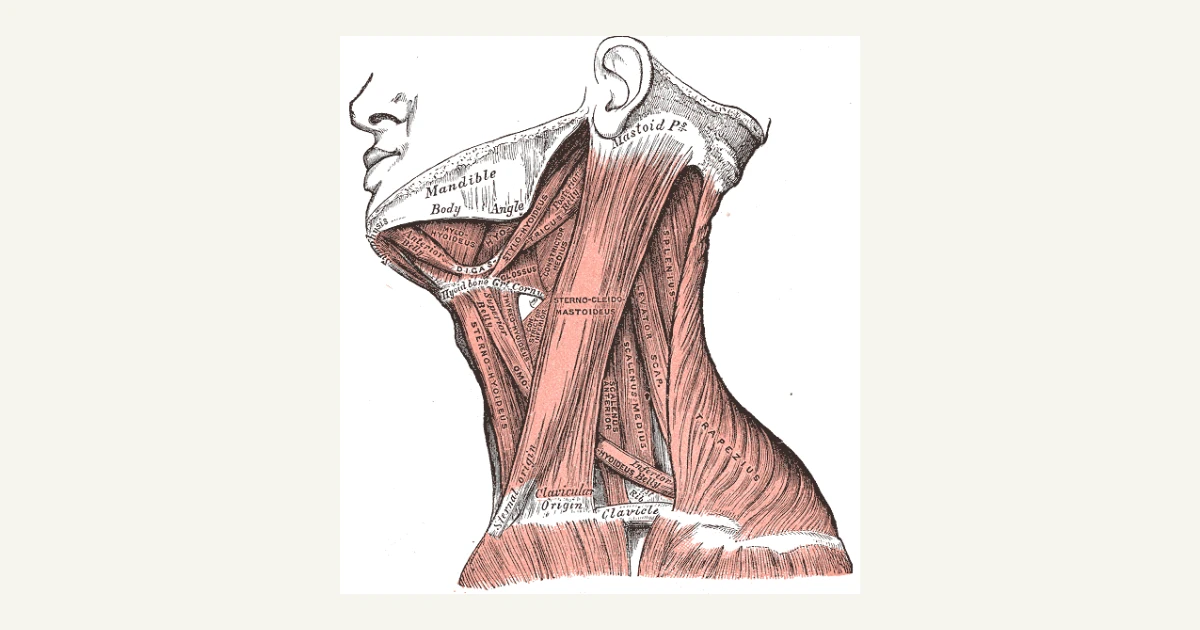
Seven small bones stacked on top of one another. That is your neck.
Between them at the front sit discs, soft cushions with a tougher rim. At the back of each level sit a pair of small joints called facet joints, which guide how far you turn and tilt. Around all of it are muscles. Threading out between the bones are the nerves that run into your shoulder, arm and hand.
Pain can come from any of those. They all report through roughly the same nerves, so your brain is poor at telling you which one is complaining. That is why neck pain feels so vague. It aches. It sits between the shoulder blades. It creeps up behind one ear. People point with a whole hand, not a finger.
So our physios at Phoenix Rehab think in patterns rather than single villains. Neck pain usually falls into one of these groups.
- Mechanical or postural neck ache. Tissue held in one position too long, now sensitive to being held there.
- Facet joint irritation. One of those small guiding joints becomes painful and stiff, usually on one side.
- Muscular and myofascial pain. Tender, guarded muscle that refers pain across the shoulder blade or into the head.
- Disc and nerve related pain. Pain travels down the arm, often with numbness, pins and needles or weakness.
- Whiplash. Neck pain starting after a car accident or sudden jolt, usually a day or two later.
- The rarer serious causes. Infection, fracture, inflammatory disease, tumor, or pressure on the spinal cord. Uncommon. Real. Recognizable by the warning signs below.
How to tell if this is what you have
See which one you recognize. Plenty have two at once.
The slow ache that builds through the day
You wake up fine. By lunchtime there is a dull band across the top of the shoulders. By evening it is heavy and you keep reaching up to squeeze it. Moving helps for twenty minutes. Sitting still lets it creep back. The most common pattern we see, and not damage. Tissue that has stopped tolerating being held still.
The neck that locked overnight
You went to bed fine. You woke up with your head stuck, usually turned away from the painful side, and turning back produces a sharp catch that stops you dead.
This is a wry neck, an acute locked neck, or a crick in the neck. It is frightening out of all proportion to how serious it is. One of those small facet joints has become acutely irritated and the muscles around it have clamped down to stop you moving that way. The clamping is protection, not damage.
The honest news is good. Most acute wry necks settle substantially within a few days and are largely resolved inside one to two weeks. Short regular bouts of gentle movement inside the pain free range speed it up. Staying frozen drags it out.
The headache that is actually coming from your neck
This one is genuinely hard to spot. The pain lands in your head, so the neck is rarely the first place anyone looks, and there is nobody to blame for that. Read it even if you came here for something else. A cervicogenic headache is generated by the structures in your neck, and the pattern is recognizable once you know it.
- Usually one sided, and it stays on that side attack after attack.
- Starts at the base of the skull and spreads forward, often behind the eye or temple.
- Brought on by sustained neck positions. Long meetings. Long drives. Two hours on a laptop.
- The neck on that side is stiff, and turning towards the sore side is limited.
- Pressing at the top of the neck on that side can reproduce the head pain.
People live with this for years believing it is migraine, tension headache or eye strain. If your headaches follow that pattern and your neck is stiff on the matching side, have it looked at. These usually respond well to treating the neck.
The pain that goes into the arm
Here is the one rule worth memorising. If pain, numbness, pins and needles or weakness travel below your elbow, the picture changes.** Aching into the shoulder or across the shoulder blade is very common with ordinary neck pain and does not mean nerve trouble. Symptoms running past the elbow into the forearm, hand or fingers suggest a nerve in the neck is involved.
That is a different condition with a different plan. If that is you, read our page on cervical radiculopathy. If there is real weakness, meaning you are dropping things or cannot lift your arm, get medical review sooner rather than later.
Neck pain after a car accident
Whiplash pain usually shows up twelve to forty eight hours after the crash, not in the moment. Stiffness, headache, sore jaw, sometimes dizziness. Returning to gentle normal movement early helps more than protecting the neck for weeks. Anyone with neck pain after a significant impact should be medically assessed first to rule out a fracture.
What causes it
The story most people have been told is posture. Sit up straight. Stop looking at your phone. Your text neck is destroying your spine.
Our physios will be straight with you. The evidence that one perfect posture prevents neck pain is weak.
Plenty of people who sit beautifully get neck pain, and plenty who slouch never do. The more accurate version is simpler. Sustained static positions of any kind are the problem. Movement variety is the answer. A perfect upright posture held rigidly for three hours makes a neck sore just as reliably as a slumped one. Your neck wants change, and working life here gives it very little.
Look at an ordinary Singapore weekday.
- A laptop with no separate monitor, so the screen sits low and the head tips forward all day.
- Hot desking, so the setup changes daily and nobody adjusts a chair they will not use tomorrow.
- Forty minutes on the MRT each way, head down, phone up, neck flexed throughout.
- Evenings on the phone in bed, propped on one elbow, at an angle nobody accepts at a desk.
Then the things people do not connect to their neck. Poor sleep. High stress, which raises resting muscle tension and lowers pain tolerance at once. A sudden jump in load, like a new gym program with overhead pressing, a weekend of badminton smashes after months off, or field pack work in camp. A heavy laptop bag on one shoulder.
Patients here blame the office aircon constantly. There is no good evidence that cold air damages a neck. A cold draught on guarded muscle can make it feel worse, and cold people hold themselves stiffly. Do not build the whole explanation around it.
When you need to get this looked at
Most neck pain needs no imaging and no specialist. Some does. Get prompt medical review if any of these apply.
- Neck pain after significant trauma, such as a car accident, a fall from height, or a blow to the head.
- Fever with neck stiffness, especially if you feel unwell or cannot bring your chin to your chest.
- Unexplained weight loss, night sweats, or a history of cancer.
- Progressive weakness or clumsiness in the hands. Buttons, coins and chopsticks becoming difficult is a real warning sign.
- Unsteadiness when walking, or legs that are not doing what you tell them.
- Dizziness, fainting or visual changes brought on by neck movement.
- A sudden severe headache unlike any you have had before.
- Pain that wakes you every night and eases in no position.
None of that means something terrible is happening. It means the question needs a doctor, not a search engine at eleven at night.
For everything else, use the trajectory rule. Pain that is present is not the signal. Pain that is not improving is. No better after two to three weeks of sensible self-management, or clearly worse week on week, is the point to get it assessed.
If you are unsure which side of that line you sit on, WhatsApp us on 8336 6009. We would rather talk you out of an appointment than have you sit on something for six months.
What happens if you leave it
The honest answer differs by pattern. Simple mechanical neck ache and acute wry neck usually settle on their own, and leaving them alone is not dangerous.
What it costs you is recurrence. The first episode settles in a week, the next takes three, the one after hangs around for two months. Nothing is damaged, but the neck becomes easier to provoke and you build a list of things you avoid. Turning to reverse the car. Overhead pressing. Long meetings. That shrinking list is the real cost, and it happens quietly.
Neck driven headaches left alone tend to stay, often mislabelled for years when the neck was treatable all along.
Nerve related pain is the one not to sit on. Many cases settle, but persistent pressure on a nerve with real weakness deserves earlier review, because strength lags behind pain.
The serious causes above do not improve with waiting.
How it gets treated
Self-management. For a large share of people this is the whole treatment. Movement variety through the day, gentle range work, a few exercises, and time.
Physiotherapy. The most valuable part is the assessment. Which pattern you have is most of the job, because a locked facet joint, a nerve under pressure and a sensitised muscular neck need three different plans. The wrong plan is why so much neck treatment underdelivers.
After that, it improves movement at the stiff segments, settles the guarding around them, and rebuilds the deep neck muscles and the ones controlling the shoulder blade, so the neck stops doing work it was never meant to do alone. Hands on treatment has a real place early, particularly for a locked neck, because it opens a window where you can move again. The exercise makes it stick. Louise, who works with backs and necks, will spend as long on what your Tuesday looks like as on the couch.
Medication. Your GP may suggest simple pain relief or a short course of anti-inflammatory medication to bring things down enough to move. Muscle relaxants are sometimes used for a severely locked neck. A doctor’s call, not ours.
Injections. For persistent facet joint or nerve root pain, a specialist may offer a targeted injection under imaging. These open a window for rehabilitation rather than fixing anything on their own.
Surgery. Rare for neck pain. Considered mainly for pressure on the spinal cord, progressive neurological loss, or nerve root pain that has failed everything else. If a surgeon recommends it, our job is the recovery afterwards.
Exercises and what to do at home
These suit most people with ordinary mechanical or muscular neck pain. If you have symptoms below the elbow, real weakness, dizziness with neck movement, or any red flag above, get assessed before starting. Nothing here should cause sharp pain or push symptoms further down your arm. Mild soreness that settles is fine.
Movement snacks. The highest value habit here. Every thirty to forty five minutes, stand up for sixty seconds. Roll the shoulders, turn the head, look at the ceiling. Not because your posture was wrong. Because the position was long.
1. Chin nods. Sit or lie. Make a small nod, as if saying a quiet yes, drawing the chin gently back and down without lifting the head. You should feel the front of your neck switch on. Hold 5 seconds, 10 repetitions, two to three times daily.
2. Cervical rotation range work. Slowly turn your head towards one shoulder as far as it comfortably goes, pause, return, repeat the other way. 10 each way, every couple of hours, especially in the first days of a locked neck.
3. Scapular setting. Gently draw both shoulder blades down and together. Not a hard squeeze. Hold 5 seconds, 10 repetitions, two to three sets.
4. Upper trapezius stretch. Sit on your hand on the tight side. Tilt the opposite ear towards the opposite shoulder until you feel a stretch down the side of the neck. Hold 30 seconds, three times each side.
5. Levator scapulae stretch. Same start, but turn your nose down towards your armpit. This targets the muscle running from the neck to the inner corner of the shoulder blade, usually the sorer one. Hold 30 seconds, three times each side.
6. Thoracic extension. Sit in a firm backed chair, hands behind your head, and gently arch backwards over the top edge so the movement happens in your mid back, not your neck. Or lie back over a foam roller across the mid back. 8 to 10 slow repetitions.
Number six matters more than people expect. Your mid back and neck share the work of looking up and turning. When the mid back stiffens, and a long day at a laptop stiffens it beautifully, the neck supplies what the mid back no longer gives. Free the mid back and the neck stops working overtime.
Progression rule. Hold the same volume for a week. If symptoms are the same or better the morning after, add a set or a few repetitions. If worse, drop back a step, not to zero.
Heat or ice. Far less magic here than people hope. Neither changes the course of the problem. Heat suits guarded, achy, stiff necks and most people prefer it. Ice suits a sharply irritated neck in the first day or two. Whichever helps you move, ten to fifteen minutes.
Pillows. Said kindly, because people spend real money here. There is no single best pillow and no evidence an expensive one prevents neck pain. What matters is support that keeps the neck roughly neutral for how you sleep. Side sleepers need more height, back sleepers less. Front sleeping holds the neck turned all night and is the habit worth changing.
What recovery actually looks like
Acute locked neck. The worst usually eases over three to seven days, with movement close to normal within two weeks. Some take longer, and a small number find it settles then returns within months, which is the signal to look at what drives it.
What our patients say
Google reviews from our clinics in Singapore.


Mechanical and muscular neck ache. Usually better within two to four weeks once movement variety and the exercises are in place. Full settling often takes six to eight weeks, and progress is rarely a straight line. Good week, flat week, better week.
Neck driven headaches. Slower. Many see headache frequency change within three to six weeks, with improvement continuing after. The neck stiffness usually improves before the headaches do.
Whiplash. Highly variable. Most improve substantially over six to twelve weeks, and early return to gentle normal activity helps most.
Recovery runs slower when sleep is poor, when stress is high and ongoing, when the daily position has not changed, and when symptoms have run for many months.
Getting assessed at Phoenix Rehab
The first appointment is mostly questions and movement. When it started, what provokes it, what your working day looks like, where the pain sits and whether anything travels. Then testing neck and mid back movement, checking the small joints level by level, and screening the arm nerves if anything suggests they are involved.
By the end you should know which pattern is yours, what drives it, and what the plan is. If something in your history needs a doctor rather than a physiotherapist, we will say so plainly and help you get there. Scans are not usually needed here, and a scan finding is not the same as a cause.
We see people at Orchard, Tampines, Serangoon and Tanjong Pagar, with Jurong East opening on 25 October 2026. Read how we work on our physiotherapy page, or find the clinic nearest you.
Frequently asked questions
Why does my neck hurt when I wake up? Usually a night in one sustained position, often with the head turned or unsupported, on top of a neck that was already irritable. If it is a sudden locked neck with sharp catching on one side, that is typically acute facet irritation and it usually settles within one to two weeks. Gentle movement helps more than complete rest.
How long does a locked neck last? For most people the sharp stage eases over three to seven days and movement is close to normal within two weeks. Some take longer. Moving gently and often speeds it up. If it has not clearly improved after two weeks, or it keeps coming back every few months, get it assessed.
Can neck pain cause headaches? Yes, and more often than people realize. A cervicogenic headache is usually one sided, starts at the base of the skull and spreads forward towards the eye or temple, worsens with long periods in one neck position, and comes with stiffness on the same side. Treating the neck often changes these headaches.
Is it normal for neck ache pain to spread into my shoulder blade? Very common, and not a cause for alarm on its own. Neck structures refer pain across the top of the shoulder and around the shoulder blade all the time. What changes the picture is pain, numbness, pins and needles or weakness traveling below the elbow, which suggests nerve involvement and needs a proper assessment.
Should I use heat or ice for neck pain? Whichever helps you move more easily. Heat suits stiff, achy, guarded necks and most people prefer it. Ice can help a sharply irritated neck in the first day or two. Ten to fifteen minutes at a time. Neither changes how fast the underlying problem resolves, so do not overthink it.
What is the best pillow for neck pain? There is no single best pillow, and no good evidence that an expensive one prevents neck pain. Aim for support that keeps your neck roughly in line with your spine. Side sleepers usually need more height, back sleepers less. Front sleeping keeps the neck turned all night and is the habit most worth changing.
When should I worry about neck pain? Get medical review promptly for neck pain after significant trauma, fever with neck stiffness, unexplained weight loss, a history of cancer, progressive hand weakness or clumsiness, unsteadiness walking, dizziness or visual changes with neck movement, or a sudden severe headache unlike any before.
Will neck pain go away on its own? Often, yes. Most simple neck pain settles within a few weeks. The reason to get it looked at is not danger, it is the pattern of coming back. If each episode lasts longer than the last, or your list of avoided activities is growing, do something about it.
Get it sorted properly
If your neck has been grumbling for weeks, or keeps locking up, or your headaches have never quite added up, let us work out which one it is. WhatsApp us on 8336 6009 and we will get you in.
Almost nobody comes to us because of the pain itself. They come because of what it has quietly taken. Checking the blind spot without thinking. Sleeping through the night. Lifting something overhead without hesitating.
Not managing a sore neck for the rest of your life. Moving properly again, and still moving properly in twenty years.
If the pain builds over a day at the desk, office syndrome covers the neck, back and wrist problems behind it. If you drive for a living or ride for deliveries, driver and rider injuries covers the back, neck and wrist problems from the shift.
Neck pain that settles into the top corner of the shoulder blade is covered in levator scapulae pain, and the spot between the spine and the blade in rhomboid pain.
Where are you with this right now?
1. It is settling on its own
Most neck pain settles within a few weeks. Stiffness in the morning that eases as you move is usual, and so is pain that flares after a long day at a desk. If the range is coming back and the headaches are less frequent, it is settling the way it should. You do not need us for this, and we would rather say so.
2. It has stopped improving
You reverse the car using the mirrors. You reset your shoulders every twenty minutes and it lasts twenty minutes.
A neck that stops hurting is not the same as a neck that holds up. The deep neck and shoulder blade muscles are trained back, not waited back. That is the gap worth measuring, and it is not measured by how you feel on the day.
The Stalled Recovery Review is three appointments over three weeks with the same therapist, because what a joint does under load cannot be read in one visit. The first finds what is limiting it. The next two measure how it responds. $690, nett, no GST, which is three appointments at $230.
3. You have had surgery, or you have a date
Recovery after an operation has a shape, and knowing which stage you are in tells you whether you are on it. See the recovery programs, or neck physiotherapy if you are not sure which applies to you.
All of it runs on the same four stages. The Phoenix Recovery Protocol explains what each stage works on and what you have to meet to move up. No referral needed to start.
Next step
Find out which stage you are in
Pain is the first thing to leave. Movement and strength are the last things trained back, and most people stop before that part is done. One Assessment and Treatment is a single 45-minute appointment at $230, nett, no GST. Your therapist finds what is actually limiting you, treats it in the same appointment, and you leave with your current stage and a written plan.
Prefer to phone? Each of our five clinics has its own number on the clinics page. No referral needed to book.
Related reading
Where we are
Clinics across Singapore
ORCHARD
400 Orchard Road #12-12
Orchard Towers, S238875
NS22 Orchard MRT
Physiotherapy and hand therapy in Orchard →
WhatsApp 8800 1830TAMPINES
9 Tampines Grande #01-20
Asia Green, S528735
EW2DT32 Tampines MRT
Physiotherapy and hand therapy in Tampines →
WhatsApp 8780 9608SERANGOON
265 Serangoon Central Drive #04-269
S550265 · Lift C only
NE12CC13 Serangoon MRT
Physiotherapy and hand therapy in Serangoon →
WhatsApp 8892 4121TANJONG PAGAR
10 Anson Road #02-77A
International Plaza, S079903
EW15 Tanjong Pagar MRT
Physiotherapy and hand therapy in Tanjong Pagar →
WhatsApp 8227 7074JURONG EAST
2 Venture Drive #02-02
Vision Exchange, S608526
NS1EW24 Jurong East MRT
Opening 25 October 2026
Physiotherapy and hand therapy in Jurong East →
WhatsApp 8242 7340