
Written by Zita Sham, Principal Physiotherapist at Phoenix Rehab, AHPC A1302159H.Clinically reviewed by Louise Yow, Principal Physiotherapist & Director, AHPC A1300363H.Last reviewed 8 October 2026.
To reduce everyday neck pain naturally, keep the neck moving within comfort, little and often, instead of holding it still. Use heat or cold for 10 to 15 minutes if it helps, and change how you sit and sleep. Neck pain after a fall, or with fever, chest pain or arm weakness, needs a doctor first.
Key takeaways
- Most everyday neck pain comes from muscles and small joints held in one position too long: the laptop, the phone, the pillow and the way you sleep.
- Short, frequent movement within comfort helps a stiff neck more than holding it still. Heat or cold for 10 to 15 minutes is for comfort.
- Chin tucks, neck turns, side bends and shoulder rolls come first. Shoulder blade squeezes, the upper back and chest stretches and the neck holds follow in the first two weeks.
- A stiff neck you wake up with usually loosens over a few days to two weeks.
- Pins and needles, numbness or weakness running past the elbow is a nerve question, and not one for home exercises.
- Neck pain with chest pain or stroke signs needs 995. Neck pain after a fall or a crash, or with fever and a neck that will not bend forward, needs the emergency department.
What usually causes everyday neck pain
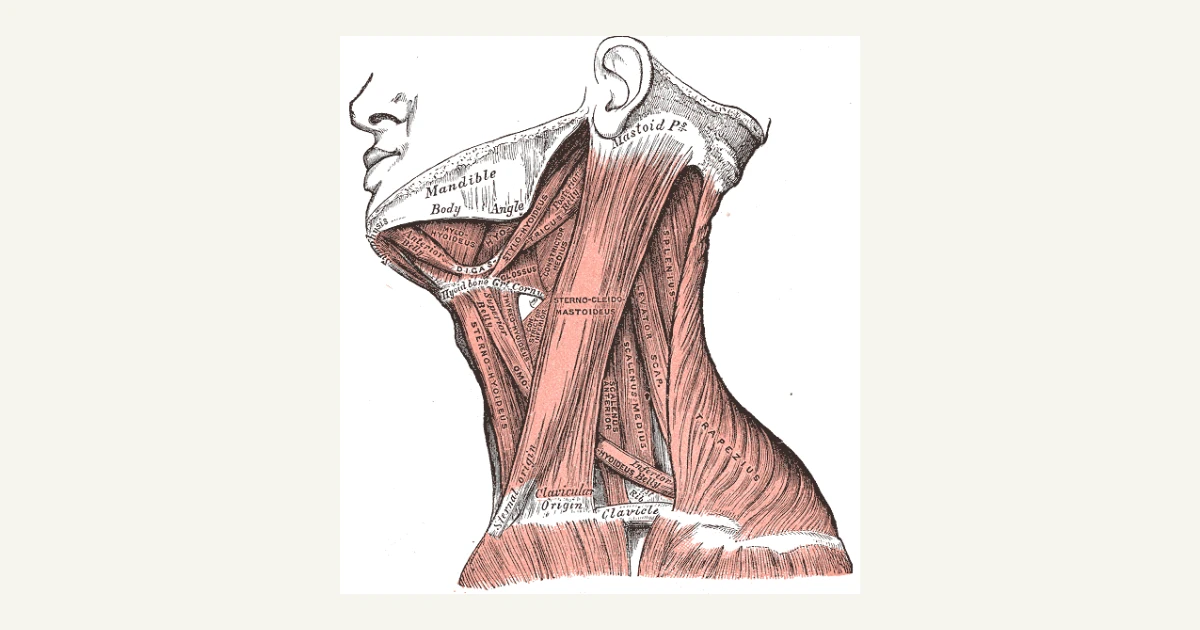
Your neck is seven small bones with a disc between each pair, two small facet joints at the back of each level, and the muscles that hold your head up and turn it. Most everyday neck pain comes from those muscles and small joints, and most of it from one habit: a position held too long.
- The desk. A laptop on the dining table or the sofa brings your head forward and down for hours. The muscles at the back of the neck hold the weight of your head for as long as you hold the position.
- The phone. The MRT ride, the messages, the scroll in bed. The same head position on a smaller screen.
- The pillow and the way you sleep. Sleeping on your stomach keeps the head turned to one side for the whole night. A pillow that is too high or too flat leaves the neck bent sideways for hours.
- A strain. A sudden turn, a heavy bag on one shoulder, a new movement at the gym.
- Stress. Shoulders held up toward the ears and a clenched jaw through a long afternoon. See stress and neck pain.
Wear in the discs and joints shows up on many scans past middle age, often in people with no neck pain at all. A scan finding and the cause of your pain can be two different things, and reading a scan is your doctor’s job.
Also on this site: the page on pain at the front of the neck covers the muscle and joint causes and the ones for a doctor, and the page on neck and shoulder pain on the left side covers the usual causes on that side.
Which kind of neck pain is it?
| Type | How it started | What you notice | What it needs first |
|---|---|---|---|
| Everyday neck strain | Built up through a day at the screen, or a sudden turn or a heavy bag | An ache across the back of the neck and the top of the shoulders, easier when you move | The home plan on this page |
| Stiff neck on waking (wry neck) | You woke up with it | The head stuck, often turned a little away from the sore side, with a sharp catch turning one way | The home plan, and the page on neck pain after waking up |
| Neck pain with arm symptoms | Sometimes after a strain, often with no single moment | Pain, pins and needles, numbness or weakness running past the elbow | A physiotherapist or a doctor, and the page on a pinched nerve in the neck. New weakness: a doctor the same day |
| Headache from the neck | Long meetings, long drives, hours on a laptop | A one-sided headache from the base of the skull toward the eye, with a stiff neck on the same side | A physiotherapist, and the page on headaches that start in the neck |
| After a fall, a crash or a blow | One moment of impact | Neck pain, with or without tingling in the arms | The emergency department now. Call 995 and keep still if the arms or legs tingle, go numb or feel weak |
| With fever | An illness, no injury | Fever and headache, a neck that will not bend forward, light that hurts the eyes | The emergency department now |
| Heart or stroke | No injury | Neck or jaw pain with chest pain, breathlessness or sweating. Or a drooping face, a weak arm, slurred speech | Call 995 |
How to reduce neck pain naturally: the plan, day by day
Tonight
- Keep it moving. Every hour or so, turn your head each way and tip each ear toward the shoulder, as far as is comfortable, 5 times each way. A neck held still all evening is stiffer by morning.
- Heat or cold, for comfort. A warm shower, or a warm pack for 10 to 15 minutes, suits a stiff and achy neck. An ice pack wrapped in a cloth for 10 to 15 minutes suits a sharp one you strained today. Use whichever lets you move more, and never fall asleep on a heat pack.
- Light self-massage. Small circles with the fingertips at the base of the skull and across the top of the shoulders, for comfort. Keep the pressure light.
- Set up the bed. Sleep on your back or your side, with a pillow that keeps your head level with your body. On your side, your nose lines up with the middle of your chest. Leave stomach sleeping for when the neck has settled.
- Leave the laptop out of bed. Watching a screen propped on your knees is the desk problem again, lying down.
- Pain relief and anti-inflammatory medication are a decision for your doctor or pharmacist.
The next three days
- Start the first four exercises below: chin tucks, neck turns, side bends and shoulder rolls, 2 to 3 times a day.
- At the desk, raise the screen so its top edge sits at eye level. A laptop goes on a stand or a stack of books, with a separate keyboard and mouse. Get up and change position every 30 to 45 minutes.
- Hold the phone up at eye level instead of dropping your head to it.
- Keep walking and keep to your normal day as far as the pain allows. Days in bed, or a soft collar you bought yourself, leave most necks stiffer. A collar a doctor fitted after an injury stays on until that doctor says otherwise.
- Leave heavy overhead lifting and contact sport out for now.
The first two weeks
- Add shoulder blade squeezes, the upper back stretch over a chair, the doorway chest stretch and the neck holds.
- Each day the neck should turn a little further, and the mornings should loosen sooner.
- Bring the gym and sport back in steps: lighter weights first, and nothing overhead until turning your head both ways is easy.
- If it is no better after two weeks, or it was settling and has stopped, see the three states near the end of this page.
The exercises, and when to stop
A mild stretch or ache while you do them is fine if it settles within an hour. Stop for sharp pain, pain or tingling running into the arm or hand, dizziness, blurred vision, or a headache that builds. Those belong in the doctor section below.
1. Chin tucks
The deep muscles at the front of the neck hold your head over your shoulders. Chin tucks work them without loading the sore joints at the back.
- Sit tall, or lie on your back with your head on a thin pillow.
- Draw your chin straight back, as if making a double chin, without tipping your head down.
- Hold 5 seconds, then relax. Do 10, 2 to 3 times a day.
- Stop if it brings on a headache or tingling in the arm.
2. Neck Rotation (Turning your head left and right)
Neck rotations help release stiffness in the neck and improve its range of motion.
The neck rotators turn your head for driving, for looking over your shoulder and for crossing the road.
- Begin in a neutral position with your head facing forward.
- Slowly turn your head to your left side, trying to look over your left shoulder, as far as is comfortable.
- In the first three days, hold for 2 to 3 seconds and come back, 5 to 10 times each way. After that, hold the position for 15-30 seconds and then repeat on the other side.
- Perform three sets on each side.
3. Lateral Neck Flexion (Sideways bending, left and right)
These neck stretches are a fundamental way to ease tension and increase flexibility in the neck muscles.
- Start by sitting or standing comfortably (we recommend doing this in sitting or lying down with good support) with your back straight and shoulders relaxed.
- Slowly tilt your head to the right.
- After the first three days, if it is comfortable, rest your right hand on your head and let its weight add a little to the stretch. You will feel a stretch along the left side of the neck and the top of the left shoulder.
- Hold the stretch for 15-30 seconds, feeling the gentle stretch along the side of your neck.
- Repeat on the left side.
- Do three sets on each side.
4. Shoulder Rolls
The shoulder rolls exercise is a simple and effective way to ease tension in your shoulder and neck muscles while promoting improved neck mobility and flexibility.
You can do it anywhere you sit: the office, the MRT, a hotel room.
- Sit or stand with your back straight and shoulders relaxed.
- Slowly roll your shoulders forward in a circular motion for 10-15 repetitions, then reverse the direction.
- Perform three sets in each direction.
5. Shoulder blade squeezes
- Sit tall with your arms relaxed by your sides.
- Draw your shoulder blades back and down, toward your back pockets, without lifting your shoulders.
- Hold 5 seconds. Do 10, 2 to 3 times a day.
- Stop if it pinches between the shoulder blades or tingles into the arm.
6. Upper back stretch over a chair
A stiff upper back passes more of the turning and bending up to the neck. This one moves the upper back instead.
- Sit on a chair whose backrest reaches the bottom of your shoulder blades.
- Put your hands behind your head, elbows pointing forward, so your hands carry the weight of your head.
- Lean back over the top of the backrest, then come back up.
- Do 10, twice a day. Stop for sharp pain in the back or tingling in the arm.
7. Doorway chest stretch
- Stand in a doorway with your forearms on the frame, elbows at shoulder height.
- Step one foot through until you feel a stretch across the front of the chest.
- Hold 20 to 30 seconds, 3 times, once or twice a day.
- If your hand tingles or goes numb, lower the elbows. If it still does, stop.
8. Isometric Neck Exercises
Isometric neck exercises involve contracting the neck muscles without moving your head, the way you can harden the muscles of your hand without moving your fingers.
These neck exercises can help build neck strength and stability, which is essential for supporting the weight of your head and maintaining proper neck posture.
- Place your hand against your forehead and gently push your head forward while resisting the movement with your neck muscles.
- Continue looking straight ahead, holding the contraction for 5-10 seconds, and then relax.
- Repeat with your hand against the side of your head and the back of your head. Perform three sets for each direction.
- Push at about half your effort, and start these in the second week.
9. Neck Extension (Backwards neck movement)
Tilting the head back moves the joints at the back of the neck through their range: the movement you use to look up at a shelf or a departure board.
- Sit or stand with your back straight and tilt your head backward slowly, looking up toward the ceiling.
- Go only as far as is comfortable, then return to the starting position. Repeat 10 times.
- Skip this one if looking up makes you dizzy, blurs your vision or sends tingling into the arm, and tell your doctor.
The stiff neck you woke up with
You went to bed fine and woke with your head stuck, often turned a little away from the sore side, and a sharp catch when you try to turn back. People call it a wry neck or a crick in the neck. One of the small facet joints at the back of the neck is irritated, and the muscles around it have tightened to stop you moving that way. It feels more alarming than it usually is.
Most loosen a little each day, are much easier within a few days, and settle within one to two weeks. Short, frequent movement within the comfortable range helps, and holding the neck still leaves it stiffer. Start with the neck turns, the side bends and heat. The page on neck pain after waking up covers the pillow and sleep causes in more detail.
A stiff neck on waking with a fever, a headache, or a neck that will not bend forward to put your chin on your chest is a different matter. See the doctor section below.
Neck pain with pins and needles, numbness or weakness in the arm
An ache spreading into the top of the shoulder or across the shoulder blade is common with everyday neck pain. Pain, pins and needles, numbness or weakness that runs past the elbow into the forearm, hand or fingers points to a nerve root in the neck. That is not a home-exercise problem, and some of the stretches above can irritate a nerve further.
Stop the side bends and the neck extension, keep moving within comfort, and have it assessed by a physiotherapist or a doctor. New weakness, or dropping things, needs a doctor the same day. The page on cervical radiculopathy, a pinched nerve in the neck covers it in full.
Is this normal?
Usually expected: stiffness on waking that loosens as you move. An ache after a long day at the screen. A click or a crunch when you turn, with no pain. Mild soreness after the exercises that settles within an hour.
Worth getting checked: a neck no better after two weeks of the plan. Headaches from the neck on most days. Pain that wakes you. An ache creeping further down one arm.
When to see a doctor first
- Call 995 if neck or jaw pain comes with chest pain or tightness, breathlessness, sweating or nausea, which can be the heart. Also for a drooping face, weakness in one arm or one side, slurred speech, sudden loss of vision or balance, or a sudden headache worse than any you have had, which can be a stroke. Also after a fall, a crash or a blow if the arms or legs tingle, go numb or feel weak: keep still and do not let anyone move your neck. And for fever with a stiff neck plus a rash that does not fade when you press a glass on it, confusion or drowsiness.
- Go to the emergency department now for neck pain after a fall, a car accident or a blow to the head or neck, even if you can walk. For fever with a stiff neck that will not bend forward, with a headache, light hurting your eyes, or a rash. For new weakness, numbness or clumsiness in both arms or both legs, unsteady walking or loss of balance, or any change in bladder or bowel control.
- See a doctor the same day for neck pain with fever without the signs above. For severe pain that came on at rest with no injury, or pain at night that does not ease when you change position. For new pins and needles, numbness or weakness in one arm, or dropping things. For new neck pain if you have had cancer.
- See a doctor soon if the neck is no better after 6 weeks of the plan, if you are losing weight without trying or feel unwell in yourself, or if an ache in one arm is spreading week by week.
How long does neck pain take to settle?
These are typical ranges, not promises.
- A stiff neck you woke up with: a few days to two weeks.
- An everyday strain from the desk or a sudden turn: easing over 2 to 6 weeks.
- Neck pain with arm symptoms: often longer, weeks to a few months, and covered on its own page.
Clinical guidelines describe the course of neck pain as variable, and it often comes back.1 Pain is the first thing to leave. The turn as far as the other side, and deep neck muscles that hold through a full working day, come later. The flare we see most arrives in the first long week at the laptop after the pain has gone, when nobody has measured either.
What we measure if it does not settle
- Neck range. Turning, side bending, looking up and looking down, in degrees, compared side to side.
- Deep neck flexor endurance. How many seconds the deep muscles at the front of the neck hold a chin tuck, and the craniocervical flexion test, a small chin nod held against a pressure gauge.3
- Upper back mobility. How far the upper back extends and rotates, each way.
- Shoulder blade control. How the shoulder blades move as you lift your arms.
- Grip and arm strength, reflexes and sensation, when a nerve is involved.
- The Neck Disability Index. Ten questions on how neck pain affects your day, scored at the start and at each review.4
Exercise has the evidence behind it. In a Cochrane review, neck and shoulder blade stretching and strengthening done together reduced pain and improved function, with a moderate benefit.2 The measures decide which exercises, and how much.
Neck pain: who does what
- A doctor (your GP, a polyclinic doctor or the emergency department) examines the neck, makes the diagnosis, rules out the serious causes, decides whether you need an X-ray or an MRI, decides about medication, and refers you on when a finding needs it.
- An orthopedic spine surgeon or a neurologist sees the nerve and spinal cord problems that need more than rehabilitation.
- A physiotherapist assesses and measures the neck, treats the stiffness with hands-on joint mobilization and soft tissue work, sets and progresses the exercises, advises on the desk and the bed, and refers you back to a doctor when a finding needs one.
The four stages, applied to a neck
In the Phoenix Recovery Protocol the work starts at Calm & Protect: movement within comfort, heat or cold, and the desk and sleep changes. Move & Mobilize takes the turn, the side bend and the upper back toward the other side. Rebuild & Strengthen trains the deep neck muscles and the shoulder blades to hold through a full working day. Return & Perform tests the tasks themselves: the head check before changing lanes, the long drive, the overhead press, the badminton smash. None of the four is passive. The measures set the pace.
Where are you with this right now?
1. It is settling on its own
Each morning the neck turns a little further. By day three you check your blind spot without turning your shoulders. The laptop ache arrives later in the afternoon, then stops arriving. Nothing runs into the arm. That is everyday neck pain behaving as expected. You do not need us for this, and we would rather say so.
2. It has been weeks, and it keeps coming back
Seven weeks ago it was a crick on waking. Now it is there every morning. You turn your shoulders with your head for the head check before changing lanes. By 4pm the laptop sits on two dictionaries and your hand is on the back of your neck. The pillow is the third one you have bought this year.
You take the afternoon call standing because sitting pulls at it. You left the overhead presses out at the gym again. You woke at 3am to turn over, and it took two tries.
It loosens up by lunchtime, so it must be fine. It has loosened up by lunchtime every day for seven weeks, and it has been back every morning.
What our patients say
Google reviews from our clinics in Singapore.


Your neck turns again by noon. Has anyone measured how far it turns, or how long the deep neck muscles hold?
If pain or tingling runs into the arm, or anything in the doctor list applies, see a doctor first. If a doctor has ruled those out, or you never needed one, one Assessment & Treatment with a physiotherapist measures the turn in degrees each way, times how long the deep neck muscles hold, checks the upper back, treats what is limiting you in the same visit, and tells you which stage you are in.
3. It has been months, or you have had neck surgery
Neck pain that has lasted months, or returns every few weeks, needs the whole picture: the neck, the upper back, the shoulder blades and the day you put them through. See neck physiotherapy. If you have been treated and it stopped improving, the Stalled Recovery Review is three weeks with the same physiotherapist. The first visit measures the neck, the deep neck muscles and the upper back. The next two measure how they respond.
After neck surgery, your surgeon’s protocol takes precedence. See physiotherapy after surgery.
All of it runs on the same four stages. The Phoenix Recovery Protocol explains what each stage works on and what you have to meet to move up. No referral needed to start.
Next step
Find out which stage you are in
Pain is the first thing to leave. Movement and strength are the last things trained back, and most people stop before that part is done. One Assessment and Treatment is a single 45-minute appointment at $230, nett, no GST. Your therapist finds what is actually limiting you, treats it in the same appointment, and you leave with your current stage and a written plan.
Prefer to phone? Each of our five clinics has its own number on the clinics page. No referral needed to book.
Related reading
Sources: 1. Blanpied PR, Gross AR, Elliott JM, Devaney LL, Clewley D, Walton DM, Sparks C, Robertson EK. Neck pain: revision 2017. J Orthop Sports Phys Ther. 2017;47(7):A1-A83. 2. Gross A, Kay TM, Paquin JP, et al. Exercises for mechanical neck disorders. Cochrane Database Syst Rev. 2015;CD004250. 3. Jull GA, O’Leary SP, Falla DL. Clinical assessment of the deep cervical flexor muscles: the craniocervical flexion test. J Manipulative Physiol Ther. 2008;31(7):525-533. 4. Vernon H, Mior S. The Neck Disability Index: a study of reliability and validity. J Manipulative Physiol Ther. 1991;14(7):409-415.
Where we are
Clinics across Singapore
ORCHARD
400 Orchard Road #12-12
Orchard Towers, S238875
NS22 Orchard MRT
Physiotherapy and hand therapy in Orchard →
WhatsApp 8800 1830TAMPINES
9 Tampines Grande #01-20
Asia Green, S528735
EW2DT32 Tampines MRT
Physiotherapy and hand therapy in Tampines →
WhatsApp 8780 9608SERANGOON
265 Serangoon Central Drive #04-269
S550265 · Lift C only
NE12CC13 Serangoon MRT
Physiotherapy and hand therapy in Serangoon →
WhatsApp 8892 4121TANJONG PAGAR
10 Anson Road #02-77A
International Plaza, S079903
EW15 Tanjong Pagar MRT
Physiotherapy and hand therapy in Tanjong Pagar →
WhatsApp 8227 7074JURONG EAST
2 Venture Drive #02-02
Vision Exchange, S608526
NS1EW24 Jurong East MRT
Opening 25 October 2026
Physiotherapy and hand therapy in Jurong East →
WhatsApp 8242 7340