
Written by Zita Sham, Fairuuz Saleh and Shiv Mohan Banka, Principal Physiotherapists at Phoenix Rehab.Clinically reviewed by Louise Yow, Principal Physiotherapist & Director, AHPC A1300363H.Last reviewed 28 September 2026.
One of physiotherapy’s most effective-and-underrated healing skills is manual therapy.
It is a form of clinical treatment that utilises skilled and experienced “hands-on” techniques to reduce pain and improve joint mobility, soft tissues, and even calm inflamed, painful tissues such as muscles and nerves.
You may have heard about the various benefits of physical therapy’s manual therapy, such as pain reduction, improved tissue repair, and reduced soft-tissue inflammation and muscle tension.
But how does manual therapy work exactly?
In this article, we will explore what manual therapy is, the various techniques practised, and who can benefit from such treatment.
First of all, what is manual therapy?
Manual therapy is a physical therapy treatment that uses our clinical and clinician hands-on-soft-tissue, which weaves in a special trained clinical touch (called palpation) that BOTH diagnose and treat various conditions that causes pain, instability or disorders.
It’s a holistic approach to rehabilitation that improves joint mobility, reduce pain, and improve function by manipulating joints, soft tissues, and other physical structures.
Manual therapy here refers to controlled, specific and carefully selected gliding, stretching, and applying controlled long or short; light or deep pressure, glide or rotation movements for the purpose of treating painful conditions and injuries in the bones, muscles, joints and tendons.
We have patients who walk in and make appointments directly with us daily for all their bone, muscle and joint aches and pains. We also get physiotherapy referrals from doctors for their patients with painful injuries and conditions as well.
Physical therapists often use manual therapies in combination with other physiotherapy techniques, such as exercise programs and electrotherapy (ultrasound therapy, TENS, EMS etc), to provide a comprehensive targeted treatment approach.
These treatment techniques synergize well together, increasing healing and recovery.
What types of manual therapy techniques are there?
Manual physical therapy encompasses various focused techniques, each tailored to address specific musculoskeletal conditions and patient needs.
Here are some manual physical therapy techniques you may have heard of or even experienced yourself:
Joint Mobilization
This technique uses carefully selected and skilled passive movements of a joint by a physical therapist to improve its normal range of motion.
Joint mobilization helps reduce pain, improve joint flexibility, and enhance overall joint function, especially in painful joints, stiff joints, swollen joints or injured joints.
Joint Manipulation (High-Velocity Low-Amplitude Thrust)
Similar to the movements in joint mobilization, joint manipulation is a more forceful technique involving a quick and controlled thrust to move a joint beyond its usual range of motion.
It is often associated with a popping or cracking sound and is used to improve joint mobility and relieve pain (ONLY when there is no safety or contraindications, and the benefits outweighs the risks).
This is useful for very selective conditions and does well when combined with soft tissue mobilization and joint mobilization.
Soft Tissue Mobilization
Soft tissue mobilization techniques target the muscles, tendons, ligaments, nerves, cartilage and fascia using different types of hands-on techniques, such as different types of palpative massage combined with stretching and myofascial release.
Soft tissue mobilization can help to reduce muscle tension, improves circulation, and promotes tissue healing. Patients often get surprised when their stiff joint or spasming muscles relax, and their range of movement improves “suddenly”.
A classic example is patient coming into the clinic with limited range in their neck of back, and after an effective spinal physiotherapy soft tissue mobilizations, tissue glidings and specific treatments, they achieve marked improvements to their necks or lower backs which now can move so much more than before (without cracking or manipulative treatments).
Muscle Energy Technique (MET)
MET involves the patient’s active participation in resisted muscle contractions while the therapist applies counter-pressure.
This technique improves joint mobility, corrects joint alignment, and addresses muscle imbalances caused by compensatory and poor alignment in sitting, walking and resting postures.
Myofascial Release (Trigger Point Release Therapy)
Myofascial release removes tension and restrictions in the fascia, a connective tissue surrounding and supporting muscles and organs, as well as tight knots in the muscles that are caused by poor posture or injuries. It is a gentle and sustained pressure technique to alleviate pain and improve mobility.
When left untreated, these myofascial trigger points can cause pain that radiates (travel) up or down the trigger point. For example, a myofascial trigger point in the shoulder can radiate down the arm and hand, and this sometimes confuses patients as to where the source of the pain is from.
Who can benefit from manual therapy?
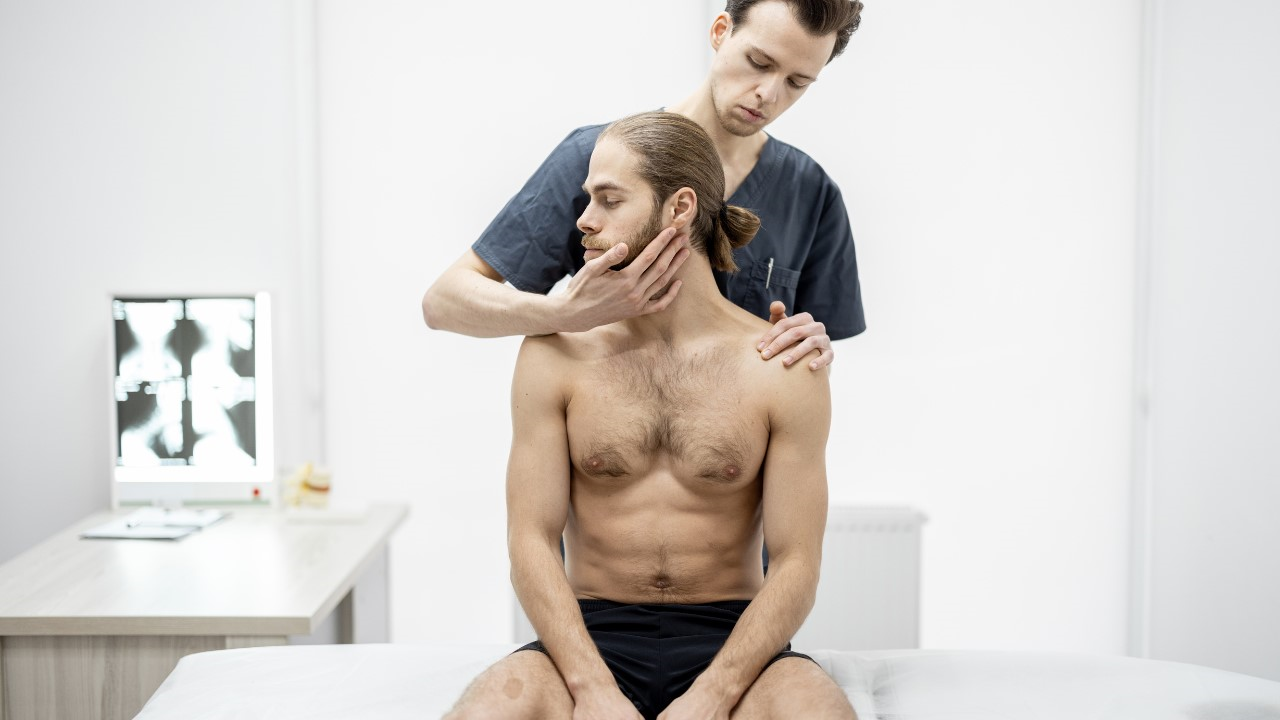
Manual therapy interventions can benefit people of all ages and activity levels.
That being said, it is particularly effective for people who are having musculoskeletal (bone, muscles, tendons, joints) pain, aches and discomfort. It also helps with people who have joint tightness or stiffness.
For patients and individuals who aims and aspires to have higher physical performance and less injuries, we recommend regular preventative soft tissue mobilization and management. The reason is that our bodies, joints and muscles can take a lot of strain before we even feel the pain, and regular preventative soft tissue mobilization can prevent any mild issues from escalating.
Some of the common conditions that can be treated with manual therapy include:
Neck and back pain
Manual therapy techniques can alleviate pain and improve mobility in individuals with herniated discs, sciatica, and muscular strains.
Some of our patients with tight or “locked” neck gets shocked when their neck rotation and range of movement increases rapidly after neck manual therapy.
Joint disorders
Manual therapy benefits individuals with joint conditions, including osteoarthritis, rheumatoid arthritis, and frozen shoulder. It helps decrease pain and improve pain-free joint movement and function, a very important point to increase overall use and quality of life.
Sports injuries
Manual therapy for physical therapy is commonly used to rehabilitate sports-related injuries, such as sprains, strains, and ligament tears. It helps with healing, improves normal function, and helps prevent re-injury.
Post-surgical rehabilitation
Manual therapy promotes rapid physical tissue healing, reducing scar tissue formation and improving normal movement patterns, which is very important for post-surgery and post-operation physiotherapy and recovery.
Work-related and repetitive strain injuries
Individuals with work-related injuries such as carpal tunnel syndrome, tennis or golfer’s elbow, neck pains or low back pain can benefit from manual therapy to relieve soft tissue tightness and pain.
What our patients say
Google reviews from our clinics in Singapore.


Experience the benefits of a tailored physiotherapy treatment plan with Phoenix Rehab today.
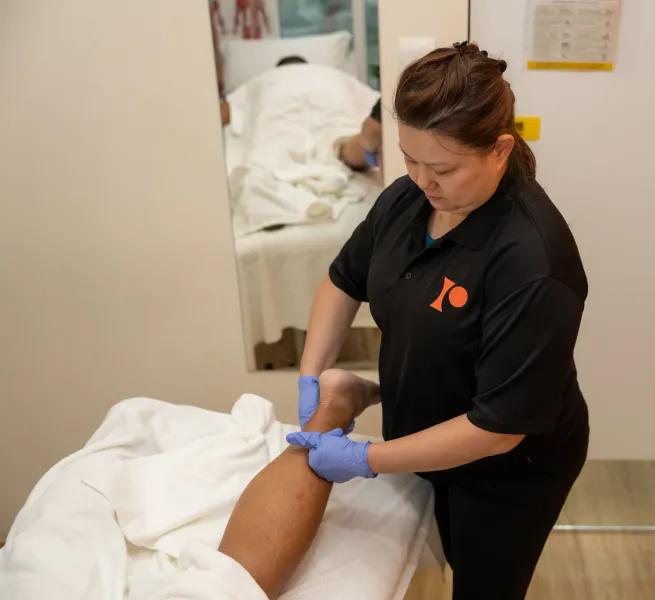
As our name suggests, we’re here to help you feel like a phoenix, renewed and born again after recovering from your pain and injuries.
Our locally and internationally trained clinicians are experienced physiotherapists and rehab specialists, who provide dedicated and personalised care, to give you the confidence you need for your path to recovery.
Don’t just take our word for it.
Where are you with this right now?
1. It is settling on its own
Most injuries and most flare-ups settle over weeks with sensible load management and a return to normal movement. Improvement is judged over a month, not over a day, and good days and bad days inside that are usual. If you are doing more this month than last, and sleeping better, it is behaving the way it should. You do not need us for this, and we would rather say so.
2. It has stopped improving
You have adapted without noticing. The other side takes the load, you plan movements you used to make without thinking, and you have quietly dropped things you used to do.
Pain is the first thing to leave. Movement and strength are the last things trained back, and most people stop before that part is done. That is the gap worth measuring, and it is not measured by how you feel on the day.
The Stalled Recovery Review is three appointments over three weeks with the same therapist, because what a joint does under load cannot be read in one visit. The first finds what is limiting it. The next two measure how it responds. $690, nett, no GST, which is three appointments at $230.
3. You have had surgery, or you have a date
Recovery after an operation has a shape, and knowing which stage you are in tells you whether you are on it. See the recovery programs, hand and physiotherapy, or the four stages and what each one works on if you are not sure which applies to you.
All of it runs on the same four stages. The Phoenix Recovery Protocol explains what each stage works on and what you have to meet to move up. No referral needed to start.
Next step
Find out which stage you are in
Pain is the first thing to leave. Movement and strength are the last things trained back, and most people stop before that part is done. One Assessment and Treatment is a single 45-minute appointment at $230, nett, no GST. Your therapist finds what is actually limiting you, treats it in the same appointment, and you leave with your current stage and a written plan.
Prefer to phone? Each of our five clinics has its own number on the clinics page. No referral needed to book.
Related reading
Where we are
Clinics across Singapore
ORCHARD
400 Orchard Road #12-12
Orchard Towers, S238875
NS22 Orchard MRT
Physiotherapy and hand therapy in Orchard →
WhatsApp 8800 1830TAMPINES
9 Tampines Grande #01-20
Asia Green, S528735
EW2DT32 Tampines MRT
Physiotherapy and hand therapy in Tampines →
WhatsApp 8780 9608SERANGOON
265 Serangoon Central Drive #04-269
S550265 · Lift C only
NE12CC13 Serangoon MRT
Physiotherapy and hand therapy in Serangoon →
WhatsApp 8892 4121TANJONG PAGAR
10 Anson Road #02-77A
International Plaza, S079903
EW15 Tanjong Pagar MRT
Physiotherapy and hand therapy in Tanjong Pagar →
WhatsApp 8227 7074JURONG EAST
2 Venture Drive #02-02
Vision Exchange, S608526
NS1EW24 Jurong East MRT
Opening 25 October 2026
Physiotherapy and hand therapy in Jurong East →
WhatsApp 8242 7340