
Written by Zita Sham, Fairuuz Saleh and Shiv Mohan Banka, Principal Physiotherapists at Phoenix Rehab.Clinically reviewed by Louise Yow, Principal Physiotherapist & Director, AHPC A1300363H.Last reviewed 28 September 2026.
With the pace of life, work, and societal demands moving at breakneck speed, we notice that there is an increasing trend of people reporting and suffering from headaches.
These patients often report two reasons for their headaches:
- The mental, emotional and physical stress from the type of lifestyle they have or want to pursue
- The nature of work that requires an individual to be in a prolonged static position, working on devices such as computers and smart phones.
NOT ALL HEADACHES ARE MIGRAINES
Sometimes patients naturally call their headache a migraine, but it can be inaccurate because there are a few types of headaches.
We recommend that patients who often suffer from headaches should understand and identify the type of headache that they have, so it will help them to:
- identify the specific triggers
- be able to sense if there is a headache coming soon
- be able to seek appropriate management.
This can help to reduce the intensity and duration of headaches.
The cervicogenic headache is one of the common type of headaches. The good news is that it can be treated with physiotherapy, whereas the main treatment for migraines is medication.
CERVICOGENIC HEADACHE VERSUS MIGRAINE
Migraine refers to a neurovascular disorder with signs of
- mostly one-sided (half) throbbing head pain
- lasting 4-72 hours and
- a group of neurological symptoms including increased sensitivity to light, sound and smell, nausea, and a variety of autonomic, cognitive, emotional and motor disturbances.
Triggers of a migraine attack are frequently associated with a wide variety of internal and external triggers such as
- stress
- hormonal fluctuations
- sleep disturbances
- skipping meals
- sensory overload.
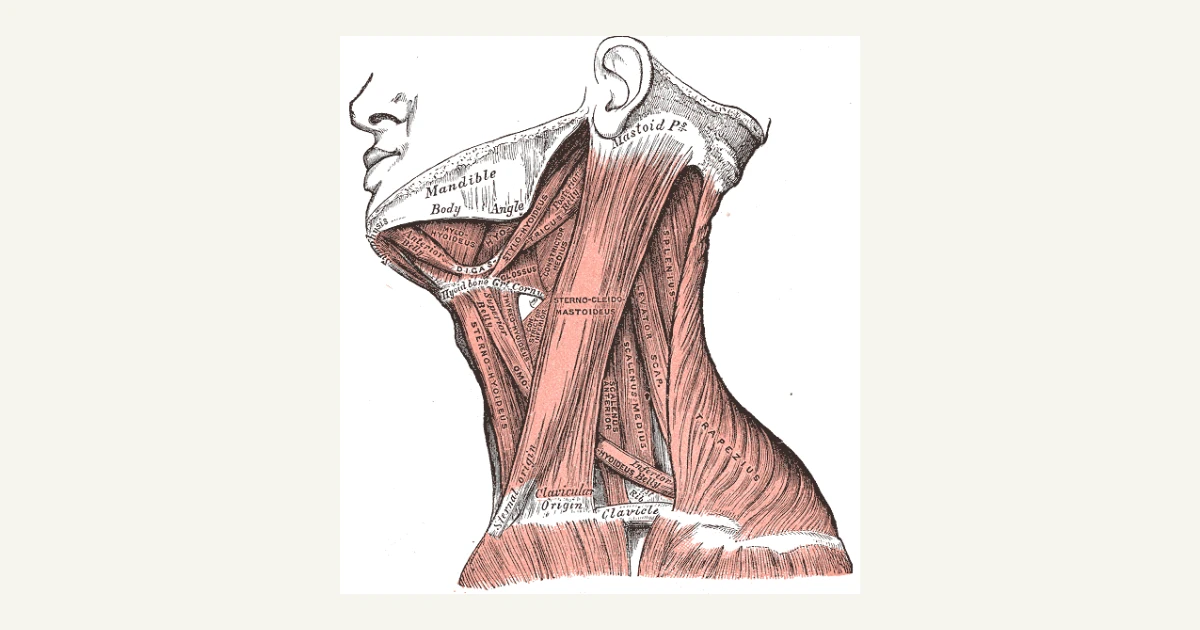
Cervicogenic headache refers specifically to pain referred from a source in the neck that presents itself higher up, in the head. It is caused by another illness or physical issue, usually due to a neck disorder or lesion.
In the upper neck area there is a region called the trigeminocervical nucleus, which interacts with the sensory fibers from the upper cervical neck.
This allows pain referral between the neck, face and head. This explains why the source of pain from a headache may actually be in the neck.
SIGNS AND SYMPTOMS OF CERVICOGENIC HEADACHE
Common signs of people with cervicogenic headache:
- Altered neck posture
- Restricted cervical range of motion
- Upper cervical joint dysfunction assessed by manual examination.
This cervicogenic tension headache can be reproduced or triggered by active and/or passive neck positioning and/or movement, or by pressure applied to the affected regions.
Trigger points (tight and sometimes sensitive knots in muscles) are usually found in the suboccipital, cervical, or shoulder musculature, which can cause headaches when manually or physically stimulated.
PHYSIOTHERAPY TREATMENT FOR CERVICOGENIC HEADACHE
There are a variety of treatments including
- nerve blocks
- physiotherapy and exercise
- Botox injections
- medications.
The most common treatment for cervicogenic headache should target the neck, as it is the cause of the pain. Treatment varies from patient to patient.
Physiotherapy interventions depend on the outcomes and conclusions our senior physios in Phoenix Rehab Singapore reach after assessing your pain, work and exercise history, before creating a physio program specific to you.
Physiotherapy and an ongoing exercise regimen often produce the best outcomes, with low recurrence rate of tension headaches. However, we still recommend that patients have medications or anesthetic injections for temporary pain reduction, especially at times when the pains seems very intense.
This will allow you to:
- have short term pain relief so you can be still functional, e.g. go to work, participate in life events.
- be able to participate effectively with physiotherapy for even more positive long term pain relief.
Physiotherapy treatment involves three main components:
Pain relieving physiotherapy treatments
Manual therapy can be done, such as low-velocity cervical joint mobilization techniques (in which the cervical segment is moved passively with rhythmical movements), and high-velocity cervical manipulation techniques (cracking of the joint in a controlled, clinical and safe manner for the relief of tight joints).
This approach encourages the body to modulate pain levels.
Next, we will always work on soft tissue. Joint manipulations are quick and effective, but short term. Soft tissue treatment, though slower in outcomes, gives medium to long term benefits – hence combining these two treatments is ideal.
Soft tissue release is an essential tool to help relieve tight connective tissues or muscle knots that can be irritating the nerves, causing headache.
Physiotherapy modalities such as
- electrical therapy
- ultrasound therapy to accelerate soft tissue healing
- heat therapy to increase circulation as well as joint and soft tissue flexibility
- cold therapy
are also commonly used to complement the hands-on techniques for pain relief and to facilitate recovery.
Reconditioning of muscular imbalances
Reconditioning of muscular imbalance includes low load endurance exercises to train muscle control of the cervicoscapular region.
The first stage consists of specific exercises to address the impairment in neck flexor synergy found in cervicogenic headache and other neck pain disorders.
Neck flexors have an important supporting function for the cervical region. Shoulder blade muscles, particularly the lower trapezius and serratus anterior, are also trained for better postural control.
Subsequently, co-contraction of the neck flexors and extensors is performed to increase general strength at the cervical region. Muscle stretching exercises are also taught as necessary to optimize loading at the cervicoscapular region.
Postural and ergonomic correction
Postural correction of daily activities is crucial to optimize loading on the spine and overlaying muscles, preventing unnecessary fatigue or stress on the supporting muscles. Use of a mirror for visual feedback and tactile feedback, such as tape application, may be used to aid posture correction.
Rearrangement of layouts and work processes are recommended to minimize undue strain from prolonged postures, especially for people who have desk-bound jobs.
What our patients say
Google reviews from our clinics in Singapore.


Also on this site: the page on pain at the front of the neck covers the muscle and joint causes and the ones for a doctor.
Where are you with this right now?
1. It is settling on its own
Most neck pain settles within a few weeks. Stiffness in the morning that eases as you move is usual, and so is pain that flares after a long day at a desk. If the range is coming back and the headaches are less frequent, it is settling the way it should. You do not need us for this, and we would rather say so.
2. It has stopped improving
You reverse the car using the mirrors. You reset your shoulders every twenty minutes and it lasts twenty minutes.
A neck that stops hurting is not the same as a neck that holds up. The deep neck and shoulder blade muscles are trained back, not waited back. That is the gap worth measuring, and it is not measured by how you feel on the day.
The Stalled Recovery Review is three appointments over three weeks with the same therapist, because what a joint does under load cannot be read in one visit. The first finds what is limiting it. The next two measure how it responds. $690, nett, no GST, which is three appointments at $230.
3. You have had surgery, or you have a date
Recovery after an operation has a shape, and knowing which stage you are in tells you whether you are on it. See the recovery programs, or neck physiotherapy if you are not sure which applies to you.
All of it runs on the same four stages. The Phoenix Recovery Protocol explains what each stage works on and what you have to meet to move up. No referral needed to start.
Next step
Find out which stage you are in
Pain is the first thing to leave. Movement and strength are the last things trained back, and most people stop before that part is done. One Assessment and Treatment is a single 45-minute appointment at $230, nett, no GST. Your therapist finds what is actually limiting you, treats it in the same appointment, and you leave with your current stage and a written plan.
Prefer to phone? Each of our five clinics has its own number on the clinics page. No referral needed to book.
Related reading
Where we are
Clinics across Singapore
ORCHARD
400 Orchard Road #12-12
Orchard Towers, S238875
NS22 Orchard MRT
Physiotherapy and hand therapy in Orchard →
WhatsApp 8800 1830TAMPINES
9 Tampines Grande #01-20
Asia Green, S528735
EW2DT32 Tampines MRT
Physiotherapy and hand therapy in Tampines →
WhatsApp 8780 9608SERANGOON
265 Serangoon Central Drive #04-269
S550265 · Lift C only
NE12CC13 Serangoon MRT
Physiotherapy and hand therapy in Serangoon →
WhatsApp 8892 4121TANJONG PAGAR
10 Anson Road #02-77A
International Plaza, S079903
EW15 Tanjong Pagar MRT
Physiotherapy and hand therapy in Tanjong Pagar →
WhatsApp 8227 7074JURONG EAST
2 Venture Drive #02-02
Vision Exchange, S608526
NS1EW24 Jurong East MRT
Opening 20 October 2026
Physiotherapy and hand therapy in Jurong East →
WhatsApp 8242 7340