
Written by Zita Sham, Fairuuz Saleh and Shiv Mohan Banka, Principal Physiotherapists at Phoenix Rehab.Clinically reviewed by Louise Yow, Principal Physiotherapist & Director, AHPC A1300363H.Last reviewed 28 September 2026.
Two weeks ago you rolled it.
It swelled up fat, went an ugly color, and you hobbled for a few days. Now the swelling is down and you walk normally. You are quietly planning to play again this weekend.
You are exactly the person this page was written for.
A sprain on the ankle is the most common injury in sport, and the one most people walk away from too early. The pain leaves long before the ankle is ready, so the signal you are judging by goes quiet while the problem is still there.
A large share of people who sprain an ankle once end up with an ankle that keeps giving way. On kerbs. On a wet floor. Coming down off a rebound. Years later, still doing it, and by then they have stopped calling it an injury and started calling it “my bad ankle”.
Our physios at Phoenix Rehab see that person constantly. Not the one who rolled it yesterday. The one who rolled it four years ago and has rolled it eleven times since.
What a sprain on the ankle actually is
Roll your foot inwards so the sole turns towards your other leg. That movement, at speed, under your body weight, is what happens in most ankle sprains. Landing on someone’s foot. Stepping half off a kerb.
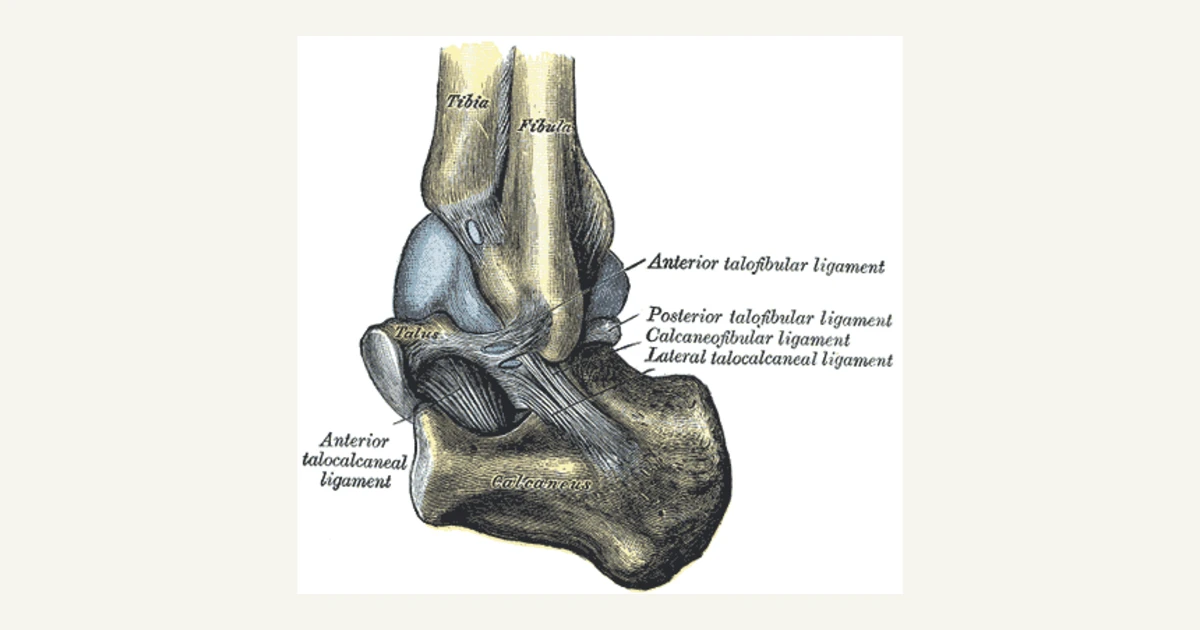
That roll stretches the ligaments on the outside of your ankle.
A ligament is a short, tough strap tying one bone to another. Everyone knows its first job, stopping the joint going where it should not. Almost nobody knows the second, and the second is why this page exists. Ligaments are packed with tiny sensors telling your brain where the joint sits and how fast it is moving. They are part of your balance system, not only your scaffolding.
Three sit on the outside of the ankle. The one at the front, running from your outer shin bone forwards to the main ankle bone, goes first in most sprains, which is why the sore, puffy spot sits just in front of and below the bony lump. The second runs down from that lump to your heel bone and joins in when the sprain is harder.
An overstretched ligament heals, but often longer and slacker than it started. Think of a seatbelt that has taken one hard pull. It still works. There is more play in it now, and the slack shows up exactly when you need it not to.
That is how a sprained ankle stops hurting and stays unreliable.
The grades, and what each one means for you
Grade 1. Overstretched, a few fibers damaged. Mild swelling, sore to press, usually still walking with a limp. Most are moving comfortably within a week or two.
Grade 2. A partial tear. More swelling, bruising tracking into the foot, walking genuinely painful. Several weeks to feel normal, longer before it is ready for sport. This is the one most often undertreated, because it settles enough to fool you.
Grade 3. A complete tear of one or more ligaments. Heavy swelling, dramatic bruising, real difficulty weight bearing. Months rather than weeks. Most still do not need surgery, but they do need proper rehabilitation.
The grade does not predict how much trouble the ankle gives you later. What you do afterwards matters more.
The high ankle sprain, which behaves nothing like the usual one
Your two shin bones are bound together just above the ankle by tough fibers that stop them separating under load. A high ankle sprain damages that binding, usually from the foot twisting outwards rather than rolling inwards. Far less common, much slower to settle.
It is genuinely hard to spot early. That is worth saying plainly, because people go looking for someone to blame. There is nobody to blame. It often swells less than the ordinary sprain in the first days, and in a different place, so early on it looks like the milder injury.
What raises suspicion:
- Pain higher up, above the ankle joint, in the front of the lower shin rather than on the outer bony lump
- Twisting the foot outwards reproduces it sharply
- Pushing off, turning and stairs hurt more than flat walking
- Swelling looks modest compared with how much it hurts
- Two or three weeks in and it has barely improved
If that is your pattern, get it assessed rather than waiting it out. The rehabilitation is different, the timeline longer, and a small number need surgery.
How to tell if this is what you have
- A roll or a twist, usually inwards, usually with a moment you can point to
- Bruising over the following days, often traveling into the foot and toes, which is normal
- The sorest spot at the front and below the bony lump on the outer ankle
- Walking possible but limping, stairs down worse than stairs up
- Turning and uneven ground are what you start avoiding
Two things get mistaken for this. Outer ankle pain that came on gradually with no roll is usually a tendon problem. Pain and swelling across the top of the midfoot after a twist, especially with bruising on the sole, needs a different look, because a midfoot injury is subtle and not one to treat as a sprain.
Pain under the heel on the first steps out of bed is a separate problem, covered on our page about heel pain.
What causes it, and why Singapore produces so many
Court sports. Basketball is the biggest single producer, almost always the landing, coming down on someone’s foot under the basket. Netball adds the hard stop and the pivot, which plants the foot while the body keeps turning. Badminton is a run of lunges on a high grip surface, and the deep lunge to the forehand corner is the classic moment.
Football. Boots on a hard pitch, a tackle where the foot is planted and the leg keeps going.
Trail and park running. The MacRitchie loop is wonderful and it is also root, rock and camber. These happen late in the run, when fatigue is up and foot placement gets sloppy.
Kerbs, drain covers and pavement edges. A huge share of what we see. A kerb you did not clock. A raised paver. Walking fast to a meeting looking at your phone. Add a flip flop, which lets the foot roll with nothing holding it.
Having done it before. The strongest single predictor of an ankle sprain is a previous ankle sprain. That is this whole page in one sentence.
When you need to get this looked at
Most ankle sprains do not involve a broken bone. Some do. Get medical assessment promptly if any of these apply:
- You cannot take a few steps on it, even limping
- The ankle or foot looks deformed or out of shape
- Sharp bone tenderness on specific bony points, rather than soreness in the soft tissue
- Numbness, pins and needles, or loss of feeling in the foot
- The foot looks pale or dusky, or feels cold compared with the other one
- Severe pain not settling at all over the first days
- The ankle is hot and red and you feel unwell or feverish
The common question is whether you need an x-ray. Clinicians do not order one for every sprained ankle, and they are not guessing. Established rules exist, built around exactly where bone is tender and whether you can bear weight, and they decide who is likely enough to have a fracture to justify imaging. Those rules are for a trained person with hands on your ankle, not for you to run on yourself.
Not sure which side of the line you are on? WhatsApp us on 8336 6009 and tell us what happened and what you can do on it.
What happens if you leave it
The pain will almost certainly go on its own. Swelling settles, bruising fades, walking returns. If your only goal is to stop hurting, doing nothing usually gets you there, and that is exactly why this injury is so badly served.
What often does not come back is the ankle’s reliability. Left alone, a meaningful share of people end up with chronic ankle instability: an ankle that gives way, feels untrustworthy on uneven ground, and rolls again on things it should handle. Each roll adds damage, and the cycle tightens.
There is a longer term cost. An ankle that keeps rolling takes repeated knocks to the joint surface, and over many years that raises the risk of arthritis there. Not a reason to panic. A reason to take rehabilitation seriously now instead of at year six.
Ankle sprain and treatment: what actually changes the outcome
Search ankle sprain and treatment and most of what comes back is advice from thirty years ago. Rest it, ice it, wrap it, lift it, wait. That advice is incomplete, and one part has aged badly.
Rest, in the old sense, is out. Long spells of complete rest, and weeks in a boot, are no longer the default for most sprains. Ligament responds to load. Take load away and the ankle stiffens, the calf wastes, and the balance system stays switched off. Protect the ankle briefly, then get movement and weight through it early, within what the pain allows.
Ice is for comfort. It takes the edge off and helps you sleep in the first days. Evidence it speeds healing is weak. Compression and elevation still earn their place early, for swelling.
Bracing or taping helps during the return to sport, and for a spell after, in people who have rolled it repeatedly. A scaffold, not the building.
Medication. Simple pain relief can make early movement possible, which is the point of it. Anti inflammatory medication is sometimes used short term, and that is your doctor’s decision. Some clinicians discuss other injection options in stubborn cases.
Surgery. Not needed for the great majority, including most complete tears. It enters the conversation for high ankle sprains with separation of the shin bones, for fractures, and for instability that has not responded to rehabilitation.
What physiotherapy is for here. Work out what was injured, because sprains are often not only sprains. Improve the movement, calf strength and loading capacity the ankle has lost. And retrain the sense of position the injury knocked out, which almost nobody does alone. More on how we work with sports injuries.
The part nobody tells you: your ankle lost its sense of where it is
This is the most important section on this page.
Close your eyes and lift one foot off the floor. You still know where it is. You know whether it is pointing down or turned in, without looking. That sense is called proprioception, your body’s internal map of where its own parts are in space. It runs on sensors buried in your ligaments and muscles.
Tear a ligament and you damage those sensors along with it. The strap gets repaired by healing tissue. The reporting line does not come back on its own.
That is why an ankle keeps rolling long after the pain has gone. The joint is asked to correct itself in a fraction of a second, as your foot meets an edge, and the information arriving is late and blurry. Your muscles fire too slow. By the time the message lands, the ankle is already over.
You cannot feel this standing still. You find out on a kerb in the rain, or on the fifth cut of a game, which is the worst possible time to find out.
It trains back. Balance work is not filler. Standing on one leg, then with eyes closed, then on something soft, rebuilds that reporting line directly. It is dull, it takes minutes a day, and it is the single thing most likely to stop you rolling this ankle again.
The ankle that keeps giving way, even years later
If your ankle has been unreliable for years, the usual assumption is that the ligament is permanently loose and that is that. Some looseness may well be permanent. What is usually also true, and almost always fixable, is that the balance system was never retrained, the calf on that side is weaker, and the hip above it has quietly stopped helping.
Chronic ankle instability responds to rehabilitation even when the original sprain was long ago. Not always back to a brand new ankle, and we will not promise you that. For most people the giving way becomes much less frequent. Years late is still worth doing.
Exercises and what to do at home
These are general, and an assessment comes first, especially if you cannot bear weight, if anything matched the red flag list above, or if your pain sits higher up the shin. If a movement sharply increases pain, stop it. Work the stages in order.
Stage 1: early movement
Ankle alphabet. Sitting, foot off the floor, trace A to Z with your big toe. Pain free range only. 2 to 3 times daily.
Pain free up and down. Point the foot down, then pull it up slowly, stopping short of pain. 3 sets of 15, 3 times daily.
Towel calf stretch. Leg straight, towel around the ball of the foot, pull until the calf stretches. Hold 30 seconds, 3 repetitions, twice daily.
Weight through it early. Load the ankle as pain allows, using a crutch at first. Walk rather than hop.
Move on when: walking is close to normal and most of your movement is back.
Stage 2: strength
Band work, four directions. Sitting, band around the foot. Push down, pull up, turn out, turn in, against the resistance. 3 sets of 15 each direction, daily. Turning out protects against the next roll, so do not skip it.
Double leg calf raises. Rise onto both toes slowly, lower slowly. 3 sets of 15, daily.
Single leg calf raises. Once double leg is easy, one leg, hand on a wall for balance only. 3 sets of as many as you manage at full height. Count both sides.
Move on when: band work is comfortable in all four directions and single leg calf raises build without sharp pain.
Stage 3: balance and position sense
The stage people skip. Do not skip it.
Single leg balance. Injured leg, hip level. Build to 30 seconds, 3 repetitions, twice daily. Then repeat it with your eyes shut, near a wall. Much harder.
Soft surface. A folded pillow or balance pad. Eyes open first, eyes closed once steady. 3 repetitions of 30 seconds.
Move on when: 30 seconds on the soft surface with eyes closed feels controlled and roughly matches your other side.
Stage 4: back to sport
Hopping in place. Single leg, small hops, soft knee, quiet landings. 3 sets of 20.
Hop and stick. Hop forwards onto the injured leg and hold the landing for 3 seconds. Then sideways, then diagonally. 3 sets of 8 each direction. Add jogging, figure of eight runs and cutting at rising speed across appointments.
The progression rule. Move up when you finish every set with control and the ankle feels the same next morning. If it is worse, drop back one level for a few days. One level, not back to nothing.
Go back on criteria, not on a date
Going back on a date is how people get hurt again. The calendar says Saturday, so Saturday it is, and the ankle had no say in it. Before returning to sport you want all of these:
- Full movement compared with the other ankle, in every direction
- No swelling the day after a hard training day
- Single leg calf raises within roughly the same number as the other side
- Single leg balance comparable with the good side, including eyes closed
- Hopping and landing without pain and without a wobble you have to catch
- Real confidence changing direction at speed, not bracing for it
What recovery actually looks like
It runs in stages rather than on a calendar. Settle the swelling and get walking. Rebuild the calf and the strength around the joint. Retrain the balance. Then return to sport on the criteria above. Some take longer than the grade would suggest.
What slows it down is predictable. Going back on a date rather than on ability. Skipping the balance stage because it is boring. Sitting out completely, so the calf wastes and has to be rebuilt. Swelling that returns every time and never settles is worth getting looked at.
Getting assessed at Phoenix Rehab
The first appointment starts with what happened. How the foot went, what you felt or heard, whether you could weight bear afterwards, how it behaved over the days after. That story narrows things down more than most tests do.
Then our physios examine it. Which ligaments are tender and how much give there is in the joint, whether the bony points suggest imaging, and whether the injury sits higher than the ankle. We test calf strength against your other side and look at your balance, because those two usually explain why it happened and what it takes to stop it happening again.
You leave with a staged plan and a clear rule for progressing. We see sports injuries at Orchard, Tampines, Serangoon and Tanjong Pagar, with Jurong East opening on 25 October 2026. Details are on our clinic locations page.
Frequently asked questions
How long does a sprain on the ankle take to heal?
A mild one usually settles enough for normal walking in one to two weeks, with sport a few weeks after. A moderate sprain takes several weeks before daily life feels normal, and longer before sport. Severe and high ankle sprains run into months.
Should I walk on a sprained ankle or rest it completely?
Walk on it as pain allows, using a crutch early if you need one. Long spells of complete rest leave the ankle stiff, the calf weak and the balance system switched off, a slower road back. If you cannot take a few steps, get it assessed first.
Do I need an x-ray for a sprained ankle?
Often not. Clinicians use established rules based on where bone is tender and whether you can bear weight to decide who needs imaging. If you are sent for one, the examination pointed there. If you are not, that is a considered finding rather than a shortcut.
Why does my ankle keep giving way months after the sprain?
The ligament may have healed slightly slack, and the position sensors inside it were never retrained, so the ankle reacts a fraction too late when it meets an edge. Balance and strength work rebuilds that reaction, and it is treatable even years afterwards.
Is ice still right for ankle sprain and treatment in the first few days?
Ice helps comfort and sleep early on. It does not appear to speed healing. Use it if it helps, alongside compression and elevation for swelling, but build recovery around early protected movement and graded strengthening. Prolonged complete rest is the part of the old advice to drop.
I sprained my ankle years ago and it still rolls. Is it too late?
No. Chronic ankle instability responds to rehabilitation long after the original injury. Some laxity may be permanent, but for most people the strength and balance deficits are the bigger problem, and those retrain.
You did not get away with it just because it stopped hurting. An ankle sprained once is more likely to be sprained again, and the difference between the people it keeps happening to and the people it does not is almost entirely what they did in the weeks afterwards. A few minutes of balance work a day. Calf strength back to match the other side.
If your ankle is two weeks in, or two years in and still rolling, WhatsApp us on 8336 6009 and tell us what it does on a kerb.
The point was never an ankle that stops swelling. It is landing, cutting, running a trail, chasing your kid across a car park and stepping off a wet kerb in the dark without a thought, for the next thirty years.
An ankle that keeps rolling has lost position sense as well as ligament, and both are trained back. See the Ankle Ligament Reconstruction Recovery Program, which sets out the four stages and what moves you up.
Also on this site: the page on eversion ankle injuries covers the less common sprain to the inside of the ankle, the page on ankle pain from running covers the usual causes in runners, and the page on peroneal tendonitis exercises covers the exercises for the tendons behind the outer ankle bone.
Where are you with this right now?
1. It is settling on its own
Foot and ankle problems are slow but usually very treatable. Months rather than weeks is normal, and improvement is judged over a month, not a day. If the first steps in the morning are easier than they were four weeks ago, you are on the right road. You do not need us for this, and we would rather say so.
2. It has stopped improving
The first ten steps out of bed are still the worst part of the day. You choose shoes by how long you will be standing. You still look at the ground when you walk.
Symptoms settle well before the tissue has rebuilt its capacity, which is why stopping the loading work early is the most common reason this drags on for years. That is the gap worth measuring, and it is not measured by how you feel on the day.
The Stalled Recovery Review is three appointments over three weeks with the same therapist, because what a joint does under load cannot be read in one visit. The first finds what is limiting it. The next two measure how it responds. $690, nett, no GST, which is three appointments at $230.
3. You have had surgery, or you have a date
Recovery after an operation has a shape, and knowing which stage you are in tells you whether you are on it. See the recovery programs, or ankle physiotherapy if you are not sure which applies to you.
All of it runs on the same four stages. The Phoenix Recovery Protocol explains what each stage works on and what you have to meet to move up. No referral needed to start.
Next step
Find out which stage you are in
Pain is the first thing to leave. Movement and strength are the last things trained back, and most people stop before that part is done. One Assessment and Treatment is a single 45-minute appointment at $230, nett, no GST. Your therapist finds what is actually limiting you, treats it in the same appointment, and you leave with your current stage and a written plan.
Prefer to phone? Each of our five clinics has its own number on the clinics page. No referral needed to book.
Related reading
Where we are
Clinics across Singapore
ORCHARD
400 Orchard Road #12-12
Orchard Towers, S238875
NS22 Orchard MRT
Physiotherapy and hand therapy in Orchard →
WhatsApp 8800 1830TAMPINES
9 Tampines Grande #01-20
Asia Green, S528735
EW2DT32 Tampines MRT
Physiotherapy and hand therapy in Tampines →
WhatsApp 8780 9608SERANGOON
265 Serangoon Central Drive #04-269
S550265 · Lift C only
NE12CC13 Serangoon MRT
Physiotherapy and hand therapy in Serangoon →
WhatsApp 8892 4121TANJONG PAGAR
10 Anson Road #02-77A
International Plaza, S079903
EW15 Tanjong Pagar MRT
Physiotherapy and hand therapy in Tanjong Pagar →
WhatsApp 8227 7074JURONG EAST
2 Venture Drive #02-02
Vision Exchange, S608526
NS1EW24 Jurong East MRT
Opening 25 October 2026
Physiotherapy and hand therapy in Jurong East →
WhatsApp 8242 7340What our patients say
Google reviews from our clinics in Singapore.


