
Broken kneecap · Physiotherapy after surgery or a brace · Singapore
Written by Fairuuz Saleh, Principal Physiotherapist at Phoenix Rehab, AHPC A1301092H.Clinically reviewed by Louise Yow, Principal Physiotherapist & Director, AHPC A1300363H.Last reviewed 12 October 2026.
The kneecap usually knits in six to eight weeks. The thigh muscle that straightens your knee takes months longer.
A patella fracture is a break in the kneecap, the bone that sits inside the tendon that straightens your knee. When the pieces stay together and you can still lift the straight leg, it is usually treated in a brace held straight. When they have pulled apart, it is usually fixed with wires, screws or a plate. Either way, the long work is the quadriceps.
This program is run by our physiotherapy team at five clinics. Every first visit is one 45-minute Assessment & Treatment, $230, nett, no GST. Bring your X-ray report or operation note, and the brace.
Tap to WhatsApp us. Phoebe replies with a clinic and two times. No referral needed.
Where are you right now?
Four places people are when they find this page
- Your surgeon has just said it needs wires or screws. Ask three things before you leave the room: how much weight the leg can take, how long the brace stays locked straight, and when bending can start. Those answers set Stage 1. See how it is treated.
- In the brace, or in the first weeks after the operation. The work now is switching the thigh muscle on, keeping the swelling down and wearing the brace exactly as set. See is this normal.
- Months on, the X-ray says it has healed, and stairs down are still one at a time. That is usually a strength question, and it is a number on each leg. See if it is not going to plan.
- When can I drive, take stairs, kneel, go back to work or run? See the table.
What the injury is
What is a patella fracture?
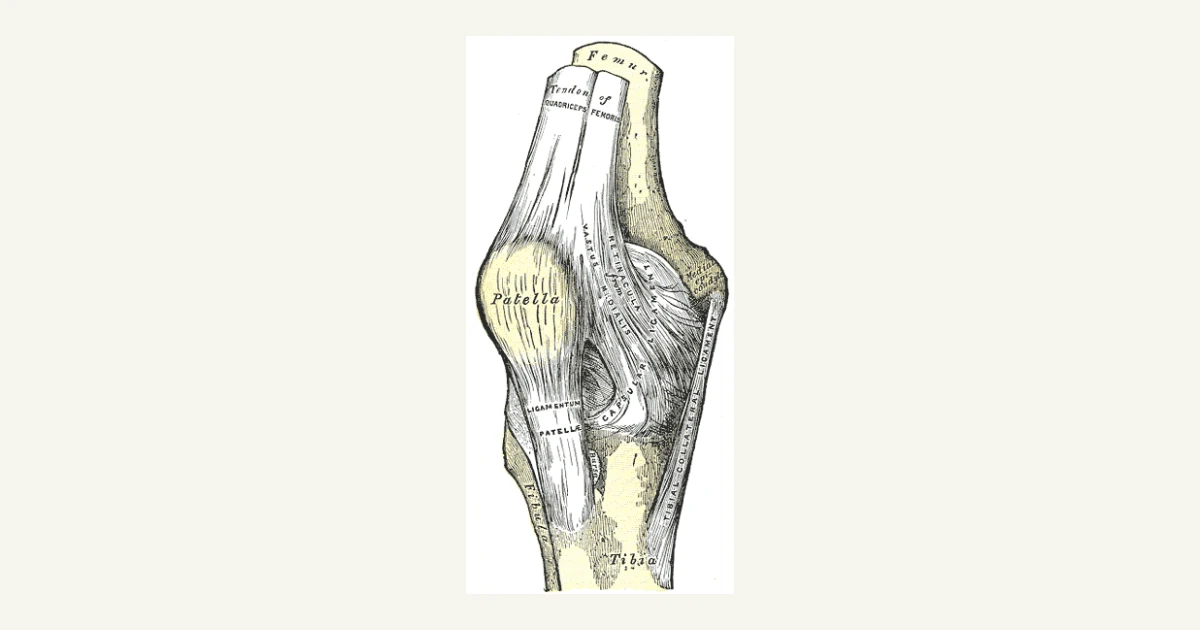
Short answer: a break in the kneecap. The kneecap sits inside the tendon that runs from the thigh muscle to the shin, and it acts as a lever when you straighten the knee. Break it, and the chain that straightens your knee is broken too. That is why surgeons call it an extensor mechanism injury.1
Most kneecap fractures come from landing directly on the knee: a fall on the MRT station stairs, a slip on a wet kitchen floor, the knee striking the dashboard in a car accident. Some come from a stumble, when the thigh muscle contracts hard on a bent knee and pulls the kneecap apart.1
The X-ray report usually names the pattern. A transverse fracture runs across the kneecap and is the most common. A comminuted or stellate fracture is in several pieces. A vertical fracture runs lengthwise. A pole fracture breaks off the lower or upper tip.1 The pattern, how far apart the pieces are, and whether you can lift the straight leg decide the plan, and that plan belongs to your orthopedic surgeon.
Can a patella fracture heal without surgery?
Short answer: often, yes. If the pieces have stayed together and you can lift the straight leg off the bed, it is usually treated in a brace or cast held straight, commonly for about four to six weeks, with weight through the leg as your doctor allows. An X-ray decides, and the decision is your orthopedic surgeon’s.1,2
The test that decides a lot of this is whether you can lift a straight leg off the bed. Your surgeon will have done it. It is worth knowing what the answer was.
If the pieces have pulled apart, or you cannot lift the straight leg, the usual operations are:
- Tension band wiring. Two pins across the kneecap and a loop of wire in a figure of eight over the front. It turns the pull of the thigh muscle into pressure that holds the pieces together as the knee bends.1
- Screws, with or without a wire. Hollow screws across the break, often with a wire threaded through them.
- A plate. Used for some fractures in several pieces.
- Partial patellectomy. When the tip of the kneecap is shattered, the surgeon removes the small pieces and stitches the tendon back to the bone that is left.1
Kneecap metalwork sits just under the skin. Having it removed once the bone has healed is common, usually because it aches when you kneel.4 That is a decision for your surgeon.
Can you walk with a fractured kneecap?
Short answer: usually, yes, in a brace that holds the knee straight, often with crutches for the first weeks, as your surgeon allows. The brace stops the knee bending, so the thigh muscle does not pull the pieces apart. Not being able to lift the straight leg after a fall onto the knee needs a doctor the same day.
Walking in the brace is not the same as walking without it. Once the brace comes off, the knee has to bend as you step and the thigh muscle has to control it, and that is the part that is trained back.
Why the quadriceps is the whole story
Short answer: swelling in the knee switches the thigh muscle off by reflex, and weeks in a straight brace take away the load that keeps it strong.5 The bone heals on its own timetable. The muscle does not come back on its own, and it is measured in two numbers: the lag, and strength against the other leg.
The lag is the gap between how straight your knee goes when someone lifts it for you and how straight you can hold it with your own thigh muscle. A knee that sags when you lift the straight leg has a lag, and it is measured in degrees. A knee that cannot fully straighten under its own power walks with a bend, which loads the front of the knee more, which aches, which makes you use it less.
Going down a step is the test that finds it. Lowering your weight on one bent knee asks more of the thigh muscle than anything you do on the flat. That is why people are discharged walking well and then discover what is missing at an MRT station.
Studies that followed people for years after kneecap surgery found aching at the front of the knee, and thigh weakness on that side, were common long after the bone had healed.3
How long does a broken kneecap take to heal?
Short answer: the bone usually knits in about six to eight weeks. Walking without crutches, bending the knee past a right angle and taking stairs step over step usually follow over the next one to three months. Thigh strength, kneeling, running and sport take four to six months or longer. Your surgeon’s protocol takes precedence.
The shape of it
Patella fracture recovery, week by week
These are the common shapes for the two main routes. Your surgeon sets the brace, the weight and the bend limits, and those instructions take precedence over anything below.
In a brace, without an operation
- Weeks 0 to 6Stage 1 · Calm & ProtectBrace held straight, weight through the leg as your doctor allows, often with crutches at first. Swelling controlled, the thigh muscle switched on with the knee straight, the ankle and hip kept moving.
- Weeks 4 to 12Stage 2 · Move & MobilizeThe brace is unlocked in steps and then comes off, as your doctor allows. Bending recovered in degrees, crutches put away, walking without a limp.
- Months 3 to 4Stage 3 · Rebuild & StrengthenThigh and hip strength, loaded and measured against the other leg. Stairs down, sit to stand, squats.
- Month 4 onwardStage 4 · Return & PerformKneeling, deep squats, running, work and sport where they apply, tested side to side.
After wiring, screws, a plate or a partial patellectomy
- Weeks 0 to 6Stage 1 · Calm & ProtectThe wound, the swelling, and the brace exactly as set. Bending is usually allowed in steps your surgeon writes down, for example a set number of degrees more every two weeks. The thigh muscle switched on from the first days.
- Weeks 6 to 12Stage 2 · Move & MobilizeThe brace comes off as your surgeon allows. Bending past a right angle, the knee fully straight under your own power, off the crutches and walking without a limp.
- Months 3 to 6Stage 3 · Rebuild & StrengthenThigh strength against the other leg, step-downs, stairs step over step, squats to a chair and lower.
- From months 4 to 6Stage 4 · Return & PerformKneeling, deep squats, running, lifting at work, sport, and IPPT where it applies.
The weeks are typical ranges, not a promise. You move up a stage when you meet its criteria, not when a date arrives.
Usually expected, and what is not
Is this normal after a kneecap fracture?
Usually expected
- A knee that is swollen and warm, worse by the evening, for weeks to months.
- A thigh that is visibly thinner than the other one.
- Stiffness that is worst first thing, and an ache after activity that settles by the next day.
- Being able to feel the metalwork under the skin. Kneecap hardware is close to the surface and often palpable, sometimes permanently.
- A numb patch of skin on the outer side of the scar.
- A knee that will not yet bend as far as the other one when the brace first comes off.
Call 995 for chest pain, sudden breathlessness or coughing up blood, especially in the weeks after the injury or the operation.
Go to the emergency department now if, after a fall onto the knee, you cannot take any weight on the leg or the knee looks deformed. Also for a wound that has opened, or metal showing through the skin. Also for a calf that has become swollen, warm and painful, which can be a clot.
See a doctor the same day if the wound is red, leaking or more painful, or you have a fever. Also if you suddenly cannot lift the straight leg or hold the knee straight when you had been managing, or you felt a new pop or crack at the kneecap. Also if the brace breaks or no longer holds the knee where your surgeon set it.
See a doctor soon if the metalwork rubs or hurts when you kneel or the brace presses on it, a wire end you can feel seems to be moving, or the bend has not improved over 3 to 4 weeks of rehabilitation.
If it is not going to plan
Months after a kneecap fracture and still taking the stairs one at a time? What that usually means
Four months since you went down on the knee. The brace went into the cupboard weeks ago. At the last review the surgeon held up the X-ray and said the bone has healed.
You still go down the MRT station stairs one at a time, good leg last, a hand on the rail. You get up from the kopitiam stool by pushing off the table. Kneeling to pray, or to reach under the bed, is something you plan around. The thigh on that side looks thin in shorts.
At work you are still on light duties. The futsal group has stopped asking.
You were told to keep walking and it would come back. You did. In your own weeks since, the stairs have not changed.
The bone has healed. Has anyone measured how far that knee sags when you lift the straight leg, or how strong that thigh is against the other one?
Your next surgeon review, the date your light duties end, or your IPPT window. Whichever is yours, it is a date when that knee has to take you down a flight of stairs.
If the knee is getting stiffer or more painful each week, or the metalwork is rubbing, that goes to your surgeon first. If your surgeon is happy with the bone and the knee is still behind, the Stalled Recovery Review is three appointments over three weeks with the same physiotherapist, $690, nett, no GST. The first visit measures the bend, the lag, thigh strength and a step-down against the other leg. The next two measure how they respond.
Logistics
When can I…
Your surgeon decides, based on the fracture, the fixation and what your job demands. These are typical points, not permissions.
| Activity | Typical point | What has to be true first |
|---|---|---|
| Desk work | 1 to 2 weeks | You can get there safely on crutches and keep the leg up when it swells. |
| Walk without crutches | Often 2 to 6 weeks, in the brace | Your surgeon allows full weight, and you walk without a limp. |
| Driving | 6 to 9 weeks for the right knee, often earlier for the left in an automatic | Out of the brace, full control of the pedals and an emergency stop. Your surgeon agrees, and check your insurer. |
| Stairs, step over step | 8 to 12 weeks | Enough bend and enough quadriceps control to lower yourself slowly. |
| Squat | Sitting to a chair without pushing off: around 8 to 12 weeks. A deep squat: 4 to 6 months or later | The knee bends past about 110 degrees for a chair and further for a deep squat, and the thigh controls the way down. |
| Kneeling | Varies | Often the last thing to become comfortable, particularly with wires in place. |
| Standing work, lifting | 10 to 12 weeks or longer | Strength tested against the other leg. We can write to your employer about modified duties. |
| Jogging | Around 4 to 6 months | Stage 3 criteria met, a single-leg step-down without the knee wobbling, and your surgeon’s clearance. |
| Sport with jumping, cutting or kneeling | Around 6 months or later | Stage 4 criteria met, strength and hopping tested against the other leg, and your surgeon’s clearance. |
| IPPT (sit-ups, push-ups, 2.4 km run) | Push-ups earlier, as your surgeon allows. Sit-ups once the knee bends comfortably past a right angle. The 2.4 km run around 6 months or later | A continuous run built up to 2.4 km without swelling the next day, thigh strength tested against the other leg, and your surgeon’s go-ahead. Your unit’s medical officer decides your medical status and when you take IPPT. |
| Medical certificate | Your doctor issues it | Physiotherapists do not issue MCs. We can write a report on your functional limits for your doctor or employer. |
What you can do this week
In the brace, at home
- Wear the brace exactly as your surgeon set it, including at night if you were told to.
- Sleep on your back with a pillow under the heel, not under the knee, so the knee rests straight.
- Tighten the thigh muscle with the knee straight, hold for 5 seconds, 10 times, a few times a day, unless your surgeon has said otherwise.
- Keep the ankle and toes moving, and sit with the leg raised when it swells.
- Write down what your surgeon said about weight, the brace and the bend limits, and the date of the next X-ray. Bring it to the first visit.
- Pain relief and anti-inflammatory medication are a decision for your doctor or pharmacist.
The program
The Patella Fracture Recovery Program
It starts with one Assessment & Treatment. Finding the real problem is half the battle. Treating it is the other half. In 45 minutes, one to one, your physiotherapist reads your surgeon’s instructions, measures the bend, the lag and the strength in that thigh against the other leg, then spends most of the appointment treating what is limiting you: swelling, the thigh muscle that will not switch on, the knee that stops short.
You leave with your current stage, what is limiting you, what Stage 4 requires for your work and your sport, and a written plan with your next review dated into the diary.
The four stages, and what moves you up
- Stage 1, Calm & Protect. The brace and the weight exactly as your surgeon set them, swelling down, and the thigh muscle switched on from the first days, because it switches off within days.
Move up when: your surgeon allows the brace unlocked or off, you can lift the straight leg without the knee sagging, or the sag is shrinking week on week, and the knee bends to the limit your surgeon set. - Stage 2, Move & Mobilize. Bending recovered to the limits allowed, full straightening under your own power, and walking without aids.
Move up when: the knee bends to at least about 110 degrees, straightens fully with no lag, and you walk without crutches or a limp. - Stage 3, Rebuild & Strengthen. The thigh loaded properly and measured side to side. This is the long stage and the one that gets cut short.
Move up when: thigh strength is measured and approaching the other side, you take stairs down step over step, and a slow single-leg step-down stays straight. - Stage 4, Return & Perform. Stairs down, squatting, kneeling if your surgeon permits it, and running or sport where that applies.
Graduate when: the tasks you named at your first appointment are tested, and single-leg strength and, where it applies, hopping are recorded against the other side.
Measured at your first appointment and again at graduation: knee range in degrees, bend and straightening, including the lag on a straight-leg raise; thigh strength on both legs once your surgeon allows load; and a knee function questionnaire, the KOOS.
The program runs Stages 1 to 4 of the Phoenix Recovery Protocol, and sits under physiotherapy after surgery with the rest of our recovery programs. Graduation, Not Discharge: it ends when you meet the Stage 4 criteria for what you need to get back to.
Patella Fracture Recovery Program, Stages 1 to 4
Patella Fracture Recovery Program. $230 per 45-minute appointment, nett, no GST. The program is set at 12 appointments across Stages 1 to 4. Your therapist confirms your plan at your first visit.
- An Assessment & Treatment first: which stage you are in, what is limiting you, and a written plan you walk out holding
- Swelling and scar management
- Bending progressed inside your surgeon’s limits, measured in degrees every visit
- Thigh strength and the lag measured against the other leg
- A home program, written down
- A one-page report to your surgeon at weeks 2, 6 and 12 if you were referred
- Your next stage review dated into the diary, with the same physiotherapist
Who you will see
The physiotherapy team that runs this program
This program is run by the physiotherapy team. You are matched to the therapist whose declared clinical interest fits what happened to you and the clinic that suits you, and you stay with the same therapist through the program. Every appointment is one to one with your therapist for the full 45 minutes. No therapy assistants. All are registered with the Allied Health Professions Council.
Principal Physiotherapist. ACL reconstruction and return to sport, hip and knee rehabilitation.
Tampines

Principal Physiotherapist. Shoulder and knee problems, spinal dysfunction, sports injury.
Orchard, Tampines

Principal Physiotherapist. Knee and hip replacement recovery, neck and shoulder pain, dry needling.
Tanjong Pagar, Jurong East

Principal Physiotherapist. Achilles tendinopathy, rotator cuff injury and repair, shoulder stiffness.
Orchard, Tampines, Jurong East

The program belongs to Phoenix, not to one therapist. Your plan, your measurements and your surgeon’s protocol move with you if you change clinic.
Next step
Find out which stage you are in
Weeks after the kneecap fracture and the stairs still go one at a time. Get Assessed & Treated, and leave knowing which stage you are in, what is limiting you and what Stage 4 asks of that knee.
Tap and Phoebe replies on WhatsApp with a clinic and two times. One 45-minute appointment, $230, nett, no GST. Bring your surgeon’s letter or operation note, the X-ray or scan report, and the brace. Prefer to phone? Each of our five clinics has its own number on the clinics page. No referral needed to book.
Timeframes on this page are typical ranges, not promises. Where your surgeon has given you a protocol, that protocol takes precedence over anything written here.
Related reading
Sources: 1. Melvin JS, Mehta S. Patellar fractures in adults. J Am Acad Orthop Surg. 2011;19(4):198-207. 2. Boström A. Fracture of the patella. A study of 422 patellar fractures. Acta Orthop Scand Suppl. 1972;143:1-80. 3. LeBrun CT, Langford JR, Sagi HC. Functional outcomes after operatively treated patella fractures. J Orthop Trauma. 2012;26(7):422-426. 4. Hoshino CM, Tran W, Tiberi JV, et al. Complications following tension-band fixation of patellar fractures with cannulated screws compared with Kirschner wires. J Bone Joint Surg Am. 2013;95(7):653-659. 5. Rice DA, McNair PJ. Quadriceps arthrogenic muscle inhibition: neural mechanisms and treatment perspectives. Semin Arthritis Rheum. 2010;40(3):250-266.
Where we are
Clinics across Singapore
ORCHARD
400 Orchard Road #12-12
Orchard Towers, S238875
NS22 Orchard MRT
Physiotherapy and hand therapy in Orchard →
WhatsApp 8800 1830TAMPINES
9 Tampines Grande #01-20
Asia Green, S528735
EW2DT32 Tampines MRT
Physiotherapy and hand therapy in Tampines →
WhatsApp 8780 9608SERANGOON
265 Serangoon Central Drive #04-269
S550265 · Lift C only
NE12CC13 Serangoon MRT
Physiotherapy and hand therapy in Serangoon →
WhatsApp 8892 4121TANJONG PAGAR
10 Anson Road #02-77A
International Plaza, S079903
EW15 Tanjong Pagar MRT
Physiotherapy and hand therapy in Tanjong Pagar →
WhatsApp 8227 7074JURONG EAST
2 Venture Drive #02-02
Vision Exchange, S608526
NS1EW24 Jurong East MRT
Opening 25 October 2026
Physiotherapy and hand therapy in Jurong East →
WhatsApp 8242 7340What our patients say
Google reviews from our clinics in Singapore.



