
Written by Zita Sham, Principal Physiotherapist at Phoenix Rehab, AHPC A1302159H.Clinically reviewed by Louise Yow, Principal Physiotherapist & Director, AHPC A1300363H.Last reviewed 3 November 2026.
Twelve weeks after the repair, the brace is off and you are walking. So why does the knee still give on the last step down from the bus, and why does the leg sag when you try to lift it straight off the bed?
A torn patellar tendon or quadriceps tendon cuts the link that lets the thigh straighten the knee. This page covers what each injury is, how to tell them apart, why a complete tear is repaired early, what recovery after the repair usually looks like week by week, the signs that mean a doctor first, and what to do when the knee stops improving.
What is a patellar or quadriceps tendon rupture?
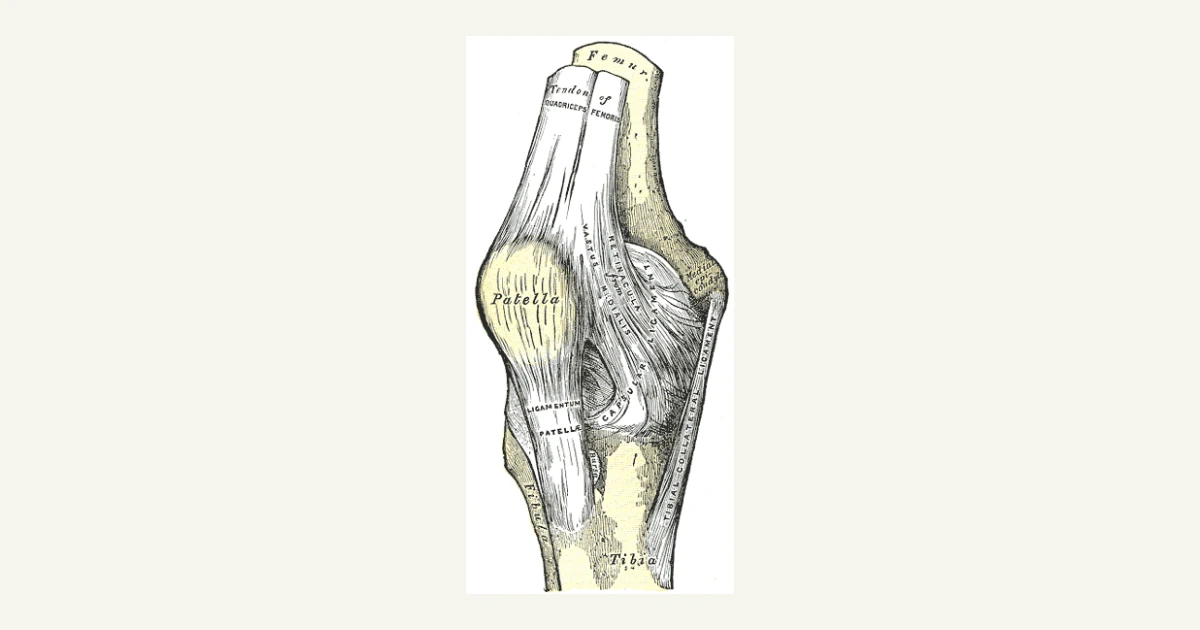
The quadriceps tendon joins the thigh muscle to the top of the kneecap. The patellar tendon joins the bottom of the kneecap to the shin bone. Together they straighten the knee. A rupture is a tear through either tendon. A complete rupture usually means the knee cannot be straightened or the leg lifted straight, and it is repaired surgically.1,2
Key takeaways
- The quadriceps tendon sits above the kneecap and the patellar tendon below it. Either one tearing through stops the knee straightening.
- A pop, then being unable to lift the leg straight or hold the knee straight, needs a doctor the same day. Imaging and the decision to operate are theirs.
- Complete ruptures are repaired surgically, and earlier repair is linked to better results. Partial tears with a working straight leg raise can often be braced and rehabilitated.
- After repair, the surgeon’s protocol sets the brace, the bend allowed and the weight you can take. Most people take at least four to six months to recover, and many take up to a year to reach their goals.
- The tendon heals before the thigh is strong again. Strength is measured against the other leg, not judged by how the knee feels.
First, the signs that mean a doctor, not this page
- Call 995 if the knee is visibly out of shape with bone showing through a wound, or the foot below it is cold, white or blue.
- Go to the emergency department now if you felt or heard a pop at the front of the knee and cannot now lift the leg straight off the bed, cannot keep the knee straight when someone lifts your heel, or can feel a dip just above or below the kneecap. The same applies after a repair if something gives way and you suddenly cannot straighten the knee again.
- See a doctor the same day if the wound after surgery is red, hot, oozing or you have a fever, or one calf is swollen, hot and tender, or you are short of breath. After knee surgery that calf can be a blood clot.
- See a doctor soon if pain at the front of the knee after a jump or a stumble has not eased in two weeks, or the knee keeps giving way on stairs.
None of these? Then the rest of this page is for you.
Patellar or quadriceps: which tendon is it?
| Quadriceps tendon rupture | Patellar tendon rupture | |
|---|---|---|
| Where the gap is | Just above the kneecap | Just below the kneecap |
| Who it usually happens to | Mostly men, average age about 60, often with diabetes, kidney disease, gout or long-term steroid use2,3 | Mostly men, average age about 40, often landing from a jump or catching a stumble3 |
| Where the kneecap sits | Often lower than the other side | Often higher than the other side, pulled up by the thigh |
| Who confirms it | A doctor, with an X-ray and usually an ultrasound or MRI | |
Can you walk with a torn patellar tendon?
Some people can shuffle with the knee locked straight, which is why a complete tear is sometimes mistaken for a bad sprain. What a complete tear takes away is the ability to straighten the knee yourself and to lift the leg straight off the bed. If you cannot do that after a pop, see a doctor the same day rather than testing it on stairs.
Does a ruptured tendon need surgery?
A partial tear, where you can still lift the leg straight, is often treated in a brace that holds the knee straight for several weeks, followed by rehabilitation. A complete rupture is repaired surgically, and the timing matters. A torn tendon pulls back and its ends degenerate the longer it is left. Ruptures that reach a surgeon about six weeks or more after the injury often need a reconstruction with graft tissue rather than a direct repair, and delayed treatment is linked to poorer results.1,2,4 That decision belongs to your orthopedic surgeon. If you have not been seen yet, the emergency department or your GP is the route.
Recovery time after a patellar or quadriceps tendon repair
Every surgeon has their own protocol, and theirs takes precedence over this table. These are the usual ranges, and how they map to the four stages of the Phoenix Recovery Protocol.2,4
| Weeks after surgery | Stage | What usually happens |
|---|---|---|
| 0 to 2 | Calm & Protect | Brace locked straight, crutches, weight through the leg as your surgeon allows. Swelling and wound care. Thigh muscle switched on without bending the knee. |
| 2 to 6 | Move & Mobilize | The bend allowed is increased in steps your surgeon sets, often toward 90 degrees by week six. No forceful straightening against resistance yet. |
| 6 to 12 | Rebuild & Strengthen | Crutches weaned, brace opened then removed. The thigh starts working against load. Walking without a limp is the target. |
| 12 to 16 | Rebuild & Strengthen | Full bend, stairs foot over foot, controlled squats, balance work. Strength measured against the other leg. |
| 16 onward | Return & Perform | Running, jumping, kneeling and the demands of work and sport, built up once strength and control meet the criteria. Many people need up to a year to reach their goals. |
When can I…?
| Activity | Typical range after repair |
|---|---|
| Return to desk work | 2 to 6 weeks, with the leg up and a way to get there safely on crutches |
| Drive | Left knee in an automatic car: once you are off strong painkillers and can get in and out safely. Right knee: usually not until the brace is off and you can brake hard, often 8 to 12 weeks. Check with your surgeon and your insurer. |
| Walk without crutches | 6 to 10 weeks |
| Stairs foot over foot | 3 to 4 months |
| Physical work, lifting, squatting | 4 to 6 months |
| Running | 4 to 6 months, once strength criteria are met |
| Jumping and cutting sports | 6 to 12 months |
Is this normal after the repair?
Usually expected: swelling and bruising that track down to the ankle in the first two weeks; a patch of numb skin beside the scar; stiffness bending the knee in the morning; the leg sagging a little when you lift it straight in the first weeks, while the thigh relearns.
Contact your surgeon: a new pop or a sudden loss of the ability to straighten the knee; a wound that is red, hot or oozing; fever; a hot, swollen calf; or a bend that has stopped improving for two to three weeks despite doing the exercises.
Why the brace comes off and the knee still is not right
The thinking goes: the surgeon fixed it, the scan looks fine, the brace is off. Give it time.
At week fourteen you still lead with the good leg on every step. You hold the rail on the MRT escalator and wait for the step to flatten before you get off. Getting up from the low stool at the hawker centre takes both hands on the table. You cannot kneel to pick up your daughter’s shoes, so she has learned to bring them to you. The return-to-work date is set, and the job has stairs in it.
The tendon is the first thing to heal. The thigh muscle is the last thing to recover, because for weeks it was held still in a brace and kept from working hard. Reviews of these repairs report that a third to a half of people are left with measurable weakness in that thigh, and many do not return to their previous level of sport.2 Walking does not rebuild it. Only load does, measured and stepped up.
Your knee no longer hurts much. Has anyone measured how much weaker that thigh is than the other one, or checked whether the leg still sags at the top of a straight leg raise? If not, nobody knows what the week twelve review should be looking at.
What a physiotherapist does with it
Finding the real problem is half the battle. Treating it is the other half.
At the Assessment & Treatment, a physiotherapist reads your surgeon’s protocol and operation notes, then measures what the knee can do today: how far it bends and straightens, whether the leg sags at the top of a straight leg raise, thigh strength against the other leg, how you rise from a chair on one leg, how you step down from a stair, and how you walk. The surgeon’s limits on bending and loading are followed exactly. If anything suggests the repair has given way, we stop and send you back to your surgeon the same day.
Most of the 45 minutes is treatment: hands-on work for the scar and the stiff joint within the allowed range, getting the thigh muscle to switch on fully, and a loading program for the thigh that starts where it is and is measured up at each review. You leave knowing which stage you are in, what is limiting the knee, and what the next stage asks of it, with a written plan.
After a repair, this runs as the Patellar and Quadriceps Tendon Repair Recovery Program. More on physiotherapy after surgery, the broken kneecap that is repaired and rehabilitated in a similar way, and patellar tendinitis if the tendon is sore but not torn. Every appointment is one to one with your physiotherapist for the full 45 minutes, at five clinics: Orchard, Tampines, Serangoon, Tanjong Pagar and Jurong East. Bring your surgeon’s letter, the operation notes if you have them, and your brace.
Questions about patellar and quadriceps tendon ruptures
Can you walk with a torn patellar tendon?
Some people can shuffle with the knee held straight, so walking does not rule out a tear. A complete tear takes away the ability to straighten the knee yourself and to lift the leg straight off the bed. If you cannot do that after a pop at the front of the knee, see a doctor the same day.
How long is recovery after a patellar tendon repair?
Most people walk without crutches by about two to three months, return to running at four to six months once strength allows, and return to jumping sports at six to twelve months. The surgeon’s protocol sets the timeline, and full strength often takes up to a year.
Can a ruptured quadriceps tendon heal on its own?
A partial tear, where the leg can still be lifted straight, is often treated in a brace followed by rehabilitation. A complete rupture does not reattach on its own and is repaired surgically, ideally soon after the injury. The decision is made by an orthopedic surgeon.
What is the difference between a patellar and a quadriceps tendon rupture?
The quadriceps tendon tears above the kneecap and usually in people over 40, often with conditions such as diabetes or kidney disease. The patellar tendon tears below the kneecap and usually in younger, active people landing from a jump. Both stop the knee straightening and both are usually repaired surgically when complete.
When can I drive after a patellar or quadriceps tendon repair?
After a left knee repair in an automatic car, often once you are off strong painkillers and can get in and out safely. After a right knee repair, usually not until the brace is off and you can brake hard, often around eight to twelve weeks. Your surgeon and your insurer have the final say.
Fourteen weeks after the repair and you still lead with the good leg on the stairs? Get Assessed & Treated, and leave knowing how strong that thigh is against the other one, which stage you are in, and what the next stage asks of it.
Sources: 1. Brinkman JC, Reeson E, Chhabra A. Acute patellar tendon ruptures: an update on management. J Am Acad Orthop Surg Glob Res Rev. 2024;8(4):e24.00060. 2. Pope JD, El Bitar Y, Mabrouk A, Plexousakis MP. Quadriceps tendon rupture. In: StatPearls. Treasure Island (FL): StatPearls Publishing; updated 2023. 3. Garner MR, Gausden E, Berkes MB, Nguyen JT, Lorich DG. Extensor mechanism injuries of the knee: demographic characteristics and comorbidities from a review of 726 patient records. J Bone Joint Surg Am. 2015;97(19):1592-1596. 4. Patellar tendon rupture. In: StatPearls. Treasure Island (FL): StatPearls Publishing; updated February 2026. NCBI Bookshelf NBK513275.
Where are you with this right now?
1. It is settling on its own
Most injuries and most flare-ups settle over weeks with sensible load management and a return to normal movement. Improvement is judged over a month, not over a day, and good days and bad days inside that are usual. If you are doing more this month than last, and sleeping better, it is behaving the way it should. You do not need us for this, and we would rather say so.
2. It has stopped improving
You have adapted without noticing. The other side takes the load, you plan movements you used to make without thinking, and you have quietly dropped things you used to do.
Pain is the first thing to leave. Movement and strength are the last things trained back, and most people stop before that part is done. That is the gap worth measuring, and it is not measured by how you feel on the day.
What our patients say
Google reviews from our clinics in Singapore.


The Stalled Recovery Review is three appointments over three weeks with the same therapist, because what a joint does under load cannot be read in one visit. The first finds what is limiting it. The next two measure how it responds. $690, nett, no GST, which is three appointments at $230.
3. You have had surgery, or you have a date
Recovery after a tendon repair has a shape, and knowing which stage you are in tells you whether you are on it. The Patellar and Quadriceps Tendon Repair Recovery Program runs inside your surgeon’s protocol, from the locked brace to return to sport. See also physiotherapy after surgery, or all the recovery programs, hand and physiotherapy.
All of it runs on the same four stages. The Phoenix Recovery Protocol explains what each stage works on and what you have to meet to move up. No referral needed to start.
Next step
Find out which stage you are in
Pain is the first thing to leave. Movement and strength are the last things trained back, and most people stop before that part is done. One Assessment and Treatment is a single 45-minute appointment at $230, nett, no GST. Your therapist finds what is actually limiting you, treats it in the same appointment, and you leave with your current stage and a written plan.
Prefer to phone? Each of our five clinics has its own number on the clinics page. No referral needed to book.
Related reading
Where we are
Clinics across Singapore
ORCHARD
400 Orchard Road #12-12
Orchard Towers, S238875
NS22 Orchard MRT
Physiotherapy and hand therapy in Orchard →
WhatsApp 8800 1830TAMPINES
9 Tampines Grande #01-20
Asia Green, S528735
EW2DT32 Tampines MRT
Physiotherapy and hand therapy in Tampines →
WhatsApp 8780 9608SERANGOON
265 Serangoon Central Drive #04-269
S550265 · Lift C only
NE12CC13 Serangoon MRT
Physiotherapy and hand therapy in Serangoon →
WhatsApp 8892 4121TANJONG PAGAR
10 Anson Road #02-77A
International Plaza, S079903
EW15 Tanjong Pagar MRT
Physiotherapy and hand therapy in Tanjong Pagar →
WhatsApp 8227 7074JURONG EAST
2 Venture Drive #02-02
Vision Exchange, S608526
NS1EW24 Jurong East MRT
Physiotherapy and hand therapy in Jurong East →
WhatsApp 8242 7340