
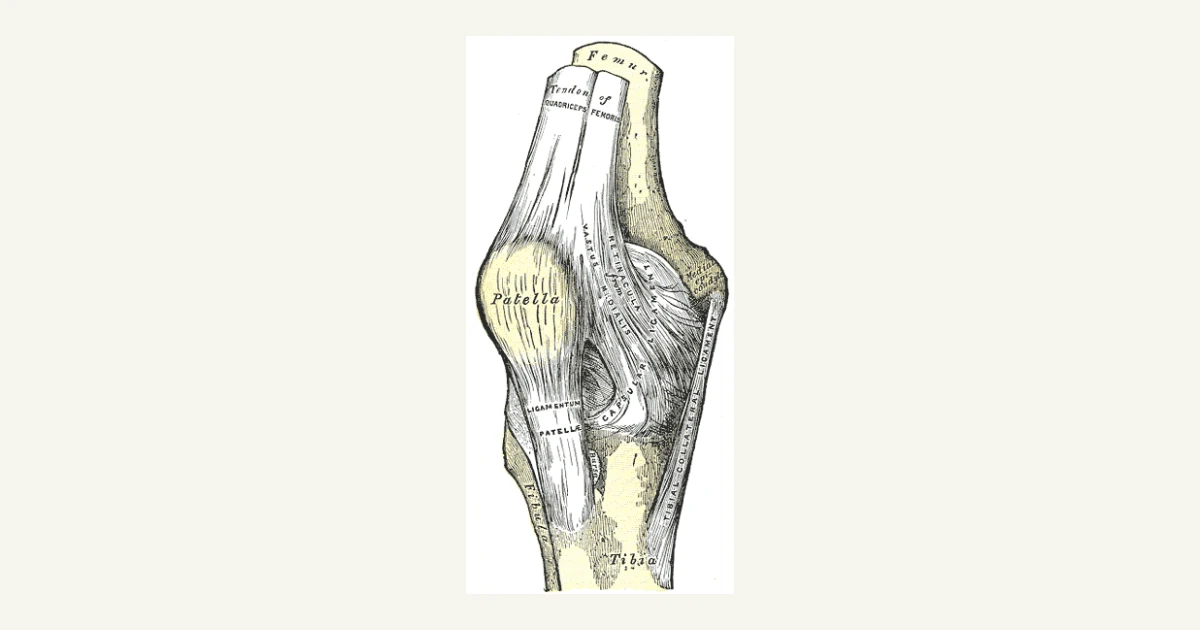
Written by Zita Sham, Fairuuz Saleh and Shiv Mohan Banka, Principal Physiotherapists at Phoenix Rehab.Clinically reviewed by Louise Yow, Principal Physiotherapist & Director, AHPC A1300363H.Last reviewed 2 October 2026.
The stairs tell you first.
Coming down, not going up. Then the car, that small brace with a hand on the door frame before you swing the leg out. Then the first ten steps after a long meeting, where the knee feels rusted shut.
Most people searching for total knee replacement did not start there. They started with a knee that ached before the rain and a squat they quietly stopped doing.
The giving up is the part nobody warns you about. You stop using the overhead bridge and walk the long way round. You say no to the hike, then to badminton, then to the walk after dinner. Your world just gets smaller, one reasonable decision at a time.
This page is for three people. The one wondering if surgery is coming. The one with a date on the calendar. The one who had it done six weeks ago and is finding recovery harder than anyone let on. Our physios at Phoenix Rehab see all three.
Physiotherapy after surgery
Knee Replacement Recovery Program
The new joint goes in on day one. The bend, the strength and the stairs are trained back over the months after.
For total and partial knee replacement. A staged physiotherapy program run to your surgeon’s plan, at five Singapore clinics, from the week you come home.
No referral needed to start. Bring your operation note, discharge summary or scan report.
Start here
Where are you right now?
A replaced knee is a different problem depending on the week you are reading this. Pick the one that matches.
How the program runs
4-Stage Structured Recovery
You move up a stage when you meet the criteria for it, not when a number of weeks has passed. That is Criteria Before Clearance, and it is why the last appointment is a graduation rather than a discharge.
The shape of it
What happens, week by week
The weeks below are the usual shape after a total knee replacement. Partial replacements often move faster. Your surgeon’s protocol takes precedence over anything on this page, every time.
- Weeks 0 to 2Stage 1 · Calm & ProtectHome with a walking aid. Swelling and pain controlled. The knee straight and the quadriceps working. Bending as far as is comfortable, every day.
- Weeks 2 to 6Stage 2 · Move & MobilizeBend past 90 degrees and on toward 110 or more. The walking aid comes down to a stick, then away. Range measured every visit.
- Weeks 6 to 12Stage 3 · Rebuild & StrengthenStrength, balance and stairs. Standing from a low chair without using your hands. Walking further each week.
- Month 3 onwardStage 4 · Return & PerformDistance, uneven ground, travel and the activities you named at the start. Many knees keep improving for a year.
After the operation
Is this normal?
Usually expected
- Warmth and swelling around the knee for several months.
- Clicking from the implant.
- Numbness on the outer side of the scar.
- Broken sleep in the early weeks.
- Stiffness after sitting that eases once you move.
- Kneeling that feels strange or uncomfortable.
Contact your doctor
- Call 995 or go to the emergency department now: sudden shortness of breath, chest pain, or coughing up blood. After leg surgery these can mean a clot that has traveled to the lungs.
- Doctor the same day: a calf that becomes painful, swollen, warm or tender, which can mean a clot in the leg.
- Doctor the same day: fever, or a wound that is red, hot, opening or leaking.
- Surgeon soon: a knee that suddenly cannot take weight, or a fall onto the new knee.
- Surgeon soon: bend that is stuck below about 90 degrees at six weeks. Some stiff knees are offered a manipulation under anesthesia, and that is your surgeon’s decision to make while the option is open.
- Review soon: no change in bend over 2 to 3 weeks of therapy.
We would rather send you back to your surgeon early than be the reason you went late.
What does not reverse on its own
How much bend daily life needs
Climbing stairs and getting up from a standard chair each need roughly 90 to 110 degrees of knee bend (Rowe and colleagues, Gait and Posture, 2000). That is the reason the bend gets measured every visit. The difference between 85 degrees and 105 is the difference between stairs one at a time and stairs like you used to take them.
If it is not going to plan
Three months on, and the bend has stopped improving
The wound healed well. The X-ray is fine. And you still go down the stairs one at a time, sideways, holding the rail with both hands.
You choose the high stool at the kopitiam. You get into the taxi bottom first and swing the leg in. Getting up from the sofa takes two hands and a push.
A replaced knee that has stopped improving is usually a range problem that was left to settle on its own. Tissue shortens in the range you stop using, and the bend you do not work is the bend you keep losing.
The Stalled Recovery Review is three appointments, one a week for three weeks, with the same physiotherapist. The first finds what is holding you back. The next two measure how it responds, because what a joint does under load cannot be read in one visit. $690, nett, no GST.
More on what the three appointments cover: the Stalled Recovery Review.
Logistics
When can I…
Your surgeon decides, based on healing and what your job demands. These are typical points, not permissions.
| Activity | Typical point | What has to be true first |
|---|---|---|
| Walking without an aid | 2 to 6 weeks | A steady walk without a limp, and your physiotherapist and surgeon agree. |
| Driving | 4 to 6 weeks | Off strong painkillers and able to do an emergency stop. Your surgeon agrees, and check your insurer. |
| Desk work | 4 to 6 weeks | You can sit for an hour and get to work safely. |
| Flying | Ask your surgeon | Long flights raise clot risk in the early months. Your surgeon advises on timing and precautions. |
| Golf, long walks, swimming | 3 months or later | Stage 4 criteria met, and the wound fully healed for swimming. |
| Kneeling | Varies | Many people can, with a cushion, once it is comfortable. It is safe for the implant when your surgeon says so. |
| Medical certificate | Your doctor issues it | Physiotherapists do not issue MCs. We can write a report on your functional limits for your doctor or employer. |
Questions
Questions people ask after a knee replacement
How long is recovery after a knee replacement?
After a total knee replacement, walking without an aid usually comes at 2 to 6 weeks, driving and desk work at 4 to 6 weeks, and golf, long walks or swimming from 3 months. Many knees keep improving for a year. Partial replacements often move faster, and your surgeon’s protocol comes first.
What can I expect 3 weeks after a knee replacement?
Around week 3 most people are in Stage 2, Move & Mobilize: working the bend past 90 degrees toward 110 or more, and bringing the walking aid down to a stick. Warmth and swelling around the knee are usual. A calf that becomes painful, swollen, warm or tender needs a doctor the same day.
How long does swelling last after a knee replacement?
Warmth and swelling around the knee are usual for several months after the operation. Stiffness after sitting that eases once you move is common too. A fever, or a wound that becomes red or hot, needs a doctor the same day.
When can I drive after a knee replacement?
Usually at 4 to 6 weeks, once you are off strong painkillers and can do an emergency stop. Your surgeon has to agree, and check with your insurer before you drive.
The program
What it costs and what is in it
Knee Replacement Recovery Program, Stages 1 to 4
Per 45-minute appointment, nett, no GST. The Knee Replacement Recovery Program is 12 appointments, $2,760 in all. You pay for each appointment as you attend it. If you need more, your physiotherapist shows you which stage criteria are still open, and each extra appointment is $230.
- An Assessment & Treatment first, at $230: which stage you are in, what is limiting you, and a written plan you walk out holding
- Swelling and scar care
- Staged range and strength work, progressed on criteria
- Knee bend in degrees and a timed stand-up test measured every few visits
- A home program, written down
- A one-page report to your surgeon at weeks 2, 6 and 12 if you were referred
- Your next stage review dated into the diary, with the same physiotherapist
Graduation, Not Discharge. The program ends when you meet the Stage 4 criteria for the walking, stairs and activities you named at the start.
Who you will see
Managed by our physiotherapy team
Knee replacements sit with the physiotherapy team. You stay with the same physiotherapist through the program, and every appointment is one to one for the whole 45 minutes.
Ching Yee
Principal Physiotherapist at Tanjong Pagar, and at Jurong East from 25 October 2026. Recovery after total knee and hip replacement, and knee and spine degenerative conditions.
This program runs Stages 1 to 4 of the Phoenix Recovery Protocol. It sits under physiotherapy after surgery, alongside the other recovery programs.
Sources
Where the numbers on this page come from
- Rowe PJ, Myles CM, Walker C, Nutton R. Knee joint kinematics in gait and other functional activities measured using flexible electrogoniometry: how much knee motion is sufficient for normal daily life? Gait and Posture, 2000.
Timings on this page are typical ranges, not predictions for any individual recovery, and your surgeon’s protocol takes precedence. Physiotherapists assess, treat, exercise, educate and refer; doctors diagnose, inject, prescribe and order imaging. If we find something that needs medical review we refer you back to your doctor.
What knee osteoarthritis actually is
Osteoarthritis gets called wear and tear, and that phrase does more damage than anything else a person hears about their knee. It suggests the joint is being used up, like brake pads, and that rest is the cure. Neither is true.
Osteoarthritis in the knee joint is a change across the whole joint, not one worn part. The cartilage, the smooth slippery cap on the ends of the bones that lets them glide, gets thinner and less springy. The bone underneath thickens and reshapes. Small bony ridges called osteophytes can form at the edges, and the joint lining can become irritated and make extra fluid, which is the puffiness you notice after a long day.
Then the part that gets ignored. The muscles around the knee weaken, especially the quadriceps at the front of the thigh. Those muscles are the joint’s shock absorber. Strong, they soak up load before it reaches the cartilage. Faded, they let more of every step land inside the joint. Sore joint, less movement, weaker muscle, sorer joint. That loop is the engine of the whole thing, and the part you control.
How bad a knee looks on an x-ray and how much it hurts do not line up well. Plenty of people have big changes on a scan and walk comfortably. Plenty have modest changes and hurt badly.
That does not make a scan wrong or unnecessary. Imaging tells a doctor what the joint structure looks like, which matters enormously when surgery is on the table. It does not tell you what your life will look like. A bad x-ray does not sentence anyone.
How to tell if this is what you have
The pattern is consistent once you know it.
- Pain that builds with load and settles with rest, not constant from the start.
- Stiffness after sitting that loosens within minutes of walking, and morning stiffness easing in well under half an hour.
- Stairs down worse than stairs up, because descending loads the knee harder.
- Squatting, kneeling and rising from a low seat go first.
- Swelling that comes and goes. Puffy after a long walk, better by morning.
- Grinding or crunching when the knee bends. That noise alone is not damage.
- Later on, pain at night or at rest, a different signal worth a doctor’s look.
Three things get mistaken for it.
Kneecap pain. Sharp pain at the front, worst after sitting or descending stairs, often in a younger knee, points towards chondromalacia patella and patellofemoral pain.
A meniscus tear. The meniscus is the rubbery cushion between the bones. Tears often start with a twist and bring catching, or a knee that locks and will not straighten. Osteoarthritis rarely locks a knee.
Hip trouble pretending to be knee trouble. An arthritic hip sends pain down to the thigh and knee. If your groin is tight, socks are a struggle and the knee is not tender to touch, read about hip pain and what it can feel like first.
What causes it
There is no single cause, which is why blame is not useful here. Age, genetics and alignment all matter, though plenty of people reach eighty with comfortable knees. Previous injury matters most, particularly a torn cruciate ligament or a knee that had part of the meniscus removed years ago.
Body weight is part of this, and it deserves honesty with no shaming attached. Walking multiplies body weight through the knee with every step, so a change in weight is amplified at the joint rather than matched one for one. That is mechanics, not a character judgement.
Singapore adds its own loading pattern. Older HDB blocks where the lift skips floors make stairs compulsory, and overhead bridges do the same. MRT interchanges ask for real distance, and Dhoby Ghaut on a bad knee day is a long way. Squat toilets still exist in older premises.
Kneeling for prayer or floor housework puts the knee into deep bend under load, for years. Then the weekend pattern, five days at a desk followed by a hard game of badminton. None of it causes osteoarthritis alone, but it shapes how much a knee is asked to tolerate and how ready it is.
When you need to get this looked at
Osteoarthritis is rarely an emergency. Some knee problems are. See a doctor promptly for:
- A knee that is hot, red and swollen, especially with fever. Same-day review.
- A knee that suddenly locks and will not straighten fully.
- Giving way that makes you fall or nearly fall.
- Severe pain after a fall or twist, or being unable to weight bear.
- Calf pain, calf swelling or breathlessness, especially after surgery.
- Night pain that wakes you regularly, or pain present at complete rest.
- After a knee operation: spreading redness, wound discharge, a wound that opens, or fever.
For everything else, use the trajectory rule. Pain being present is not the signal. Pain that is not improving is. Give a knee six weeks of genuine management, meaning you modified what you do and actually strengthened. If it is no better, get it assessed. Waiting another six months rarely produces new information.
What happens if you leave it
Osteoarthritis is not a conveyor belt to a replacement. Worth saying plainly, because many people hear the diagnosis and mentally book the surgery for five years away.
Many people with osteoarthritis in the knee joint stay stable for years. Some get better, not because cartilage grows back, but because the leg gets stronger and the joint stops doing work that muscle should do.
What reliably worsens with waiting is everything around the cartilage. Quadriceps muscle disappears fast when you avoid a leg and returns slowly. Range narrows quietly. The other knee, the hip and the back start compensating.
One consequence matters more than the rest. If a replacement does turn out to be right for you, the strength you walk into theatre with shapes your first six weeks afterwards. A year spent avoiding the knee is a year spent making that recovery harder.
How it gets treated
Strengthening and exercise therapy
This is the most effective non-surgical treatment for knee osteoarthritis, and most people are never told so properly. Not stretching. Not a heat pack. Loaded strengthening of the quadriceps, glutes and calf, built up over weeks.
Why it works is not mysterious. Stronger muscle absorbs load before the joint has to, and better control means fewer jolts through the cartilage. A body asked to do slightly more each week also turns its pain alarm down, because the alarm calibrates to what you do.
The catch is dose and time. Most people need around twelve weeks of consistent work before the change feels solid, and the first fortnight feels like nothing is happening. That is where most people quit.
Weight, activity and walking aids
If carrying less weight is realistic for you it helps, and even a modest change counts because of that multiplier at the joint. If it is not realistic right now, strength work improves knee pain whether or not the scale moves.
On activity, the instinct is to stop whatever hurts. The better move is to change the dose. Shorter walks more often instead of one long one. The bike or the pool on bad weeks. A higher chair so the knee is not loaded from deep bend all day.
A stick in the hand opposite the sore knee takes real load off that joint. People resist it because of how it looks. Three months of a stick that keeps you walking daily beats a proud, painful year of getting weaker.
Medication and injections
A doctor’s decision, described here rather than recommended. Pain relief and anti-inflammatory medication, by mouth or on the skin, is often used to make movement possible. Pain relief that lets you strengthen is doing useful work.
Corticosteroid injections can settle an angry, swollen knee. Relief usually runs from weeks to a few months, and it calms inflammation rather than repairing anything, which is why doctors limit how often they repeat them.
Hyaluronic acid injections, sometimes described as lubricating the joint, have genuinely mixed evidence. Some people report real relief, many do not. PRP injections sit in a similar space. They do not replace strengthening. They buy a window for it.
The myth that exercise wears the knee out faster
This belief stops more people getting better than any other. Cartilage has no blood supply. It is fed by fluid inside the joint, pushed in and out of it by movement, like squeezing and releasing a sponge. A knee that moves regularly gets fed. A knee that sits still is not resting. It is being starved of the thing that keeps it healthy.
Meanwhile the muscles protecting the joint only stay strong if you load them. Stop, and every step lands harder inside than before. Avoidance is far closer to the thing you fear than exercise is.
When a total knee replacement becomes the right conversation
There is a point where a replacement stops being a last resort and becomes the sensible option. Reaching it is no failure of you or your rehabilitation.
The conversation fits when pain is no longer controlled by what you are doing, when night pain regularly disturbs sleep, when function has shrunk past what you are willing to accept, and when non-surgical options have been properly tried, not mentioned in passing.
That is a quality of life decision, and it belongs to you and your orthopedic surgeon. The surgeon decides whether to operate, when, and which implant fits your knee. Where only one side of the joint is affected, a surgeon may consider a partial knee replacement that resurfaces just that compartment. Our work starts before the operation and continues long after it.
Prehabilitation: going in stronger than you are now
Almost nobody does this, and it is one of the highest-value windows in the process.
Prehabilitation means using the weeks before surgery to build the leg up instead of letting it fade. The stronger your quadriceps going into a total knee replacement, the better your early function afterwards tends to be. The muscle that gets you out of a chair on day three is the muscle you built beforehand.
A block usually runs around six weeks where the date allows. It covers four things. Strength, mainly quadriceps, glutes and calf. Range, so the knee arrives with as much bend and straightening as it can manage. Practice, rehearsing crutches, chair transfers and stairs before you are in post-operative pain. And planning: whether your sofa is too low, who is around for the first fortnight.
People who do this arrive at week two ahead, and tend to stay ahead.
Exercises and what to do at home
General starting points for an arthritic knee and the weeks before surgery. They do not replace an assessment, and anyone recovering from surgery follows the protocol their surgeon and physiotherapist set.
Quadriceps setting. Sit with the leg straight. Press the back of the knee down and tighten the thigh so the kneecap pulls upward. Hold five seconds. 10 repetitions, 3 times daily. The foundation for the rest.
Straight leg raise. Lying down, one knee bent, the other straight. Tighten the thigh, lift the straight leg 30 centimeters, lower with control. 10 to 15 repetitions, 2 to 3 sets. If the knee bends, go back to setting.
Heel slides. Lying down, slide the heel towards your bottom as far as is comfortable, then straighten fully. 10 to 15 repetitions, 2 to 3 sets. Straightening matters as much as bending.
Sit to stand. From a firm chair, stand and sit with control, arms folded if you can. 8 to 12 repetitions, 2 to 3 sets. Start high, lower the chair as you improve.
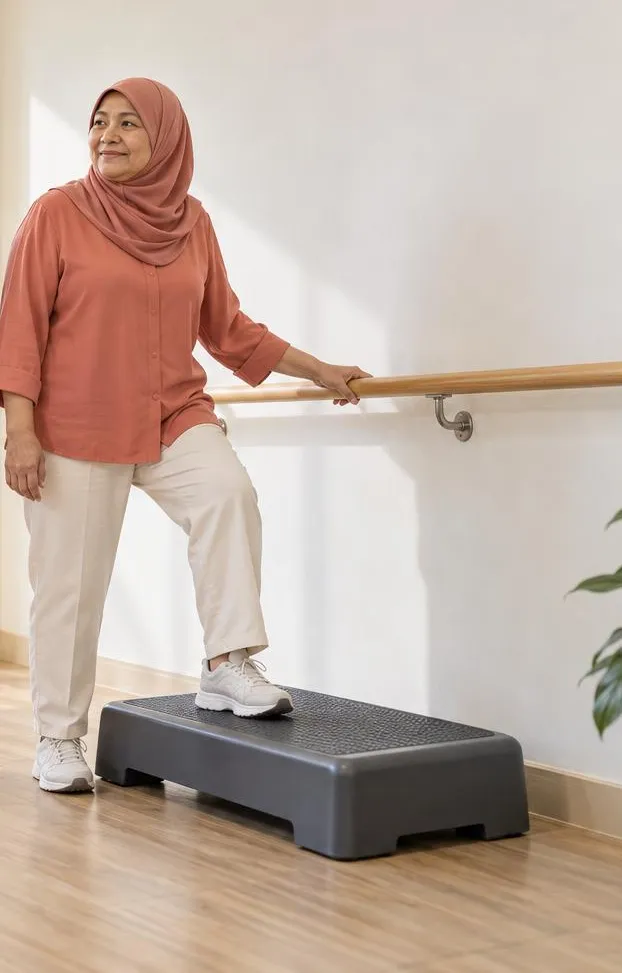
Step ups. A low step, up leading with the sore leg, down with control. 8 to 12 repetitions each side, 2 to 3 sets. Hold a rail. The way down is the point.

Hip abduction. Side lying, top leg straight, lift towards the ceiling without rolling back. 12 to 15 repetitions, 2 to 3 sets. Strong hips stop the knee falling inwards.
Calf raises. Standing with support, rise onto the toes and lower slowly. 12 to 15 repetitions, 2 to 3 sets. Shock absorption, nearly always neglected.
Stationary cycling. Seat high enough that the knee is not forced into deep bend. Start at 5 to 10 minutes, light resistance, and build. Kind to the joint.
The pain rule. Up to about five out of ten during the exercise is fine for an arthritic knee. Sharp, stabbing or unfamiliar pain is not. Stop there.
The 24 hour flare rule. Soreness afterwards should settle back to your baseline within 24 hours. If it does, the dose was right and you can progress in a week. If it is still worse the next day, drop the load by about a third and build again.
If you want someone to check your form and set the dose for your knee, WhatsApp 8336 6009 and our team will arrange an assessment.
What recovery actually looks like
Without surgery, expect the first fortnight to feel like nothing is shifting. Most people notice a real difference around eight to twelve weeks of consistent strengthening, and gains keep coming as long as the work does. A flare is not a relapse. It means load jumped faster than the knee was ready for.
After a total knee replacement
Harder work than most people expect, and being told so honestly helps more than reassurance.
The first two weeks. Swelling, real pain, and a leg that feels like it belongs to someone else. You will walk with a frame or crutches from day one or close to it. The priority is range of movement, both directions. Getting the knee fully straight matters as much as getting it to bend, and people forget the straightening because bending is what everyone talks about. Early targets are often around 90 degrees of bend by the end of week two.
The early window matters for a reason. Scar tissue forms and matures around the joint in these first weeks, and it sets to whatever range you move through. Range you use is range you keep. Range you skip is much harder to reclaim, and a stiff knee occasionally needs a further procedure to free it up.
Around six weeks. Many people are off the walking aid or down to a stick outdoors. Bend is often around 110 to 120 degrees.
Around three months. Most daily function is back. Stairs, normal walking distance, household tasks. Driving and return to work vary with which leg and what your job asks. That timing is your surgeon’s call.
Out to twelve months. The knee keeps improving for a full year, sometimes longer. That is not a consolation prize, it is how these knees behave. People who assume they are finished at three months feel disappointed when they are doing well.
What slows recovery down
Four things, all avoidable. Avoiding the knee, guarding it, resting it bent on a pillow. Poor pain control, because pain that stops you exercising has moved from uncomfortable to actively slowing recovery, and your surgeon needs to hear that. Skipping the early range work, which there is no catching up on later.
And the biggest by a distance, stopping rehabilitation as soon as walking gets easy. Walking comfortably at eight weeks feels like the finish line. The leg is still much weaker than the other side, and the strength work between three and twelve months decides whether you get a knee you can live with or one you can genuinely use.
Getting assessed at Phoenix Rehab
A first appointment is mostly conversation and testing. Our physios will want to know what the knee stops you doing now, what it stopped you doing two years ago, and what you want back. Those three answers set the plan. Then we measure. Range, quadriceps and glute strength, how you rise from a chair, how you walk.
If surgery is coming, we build the leg up beforehand. If you have already had it, we work inside your surgeon’s protocol, chase the range while the window is open, then stay through the strength stage most people abandon early. If surgery is not on the table, we treat the loop driving your pain. See the full physiotherapy service or our clinic locations, with Jurong East opening on 25 October 2026.
Frequently asked questions
Can physiotherapy help me avoid a total knee replacement? Sometimes, and sometimes not. Strengthening reduces pain and improves function for a great many people with knee osteoarthritis, and some never need surgery. But a knee that has reached uncontrolled pain and severely limited function needs the operation. Whether you need one is your surgeon’s judgement, not ours.
Is osteoarthritis in the knee joint just wear and tear from getting old? No. It involves the cartilage, the bone underneath, the joint lining and the muscles around the knee, all changing together. Age is a factor, and so are old injuries, load history and muscle strength. Plenty of older knees are comfortable and plenty of younger ones are not.
My x-ray looks terrible. Does that mean surgery is inevitable? No. How a knee looks on imaging and how much it hurts do not track closely. Imaging matters for surgical planning, but it does not predict your function. What you can do, how strong your leg is, and how much pain limits your life carry more weight than the picture does.
Will walking and exercise wear my knee out faster? Closer to the opposite. Cartilage is fed by joint fluid that only moves when the knee moves, and the muscles protecting the joint only stay strong if you load them. Progressive exercise keeps both working. Avoiding movement weakens the leg and means every step lands harder inside the joint.
How long does recovery from a total knee replacement really take? Most people walk with an aid immediately, come off it around six weeks, and manage normal daily life by three months. The knee keeps improving for a full year and sometimes longer. It is harder work than people expect, and the range of movement work in the first fortnight matters more than anything else you do.
Should I do physiotherapy before my knee replacement or just wait? Before, if you have the weeks. Going into surgery with a stronger quadriceps generally means better early function afterwards, and the first two weeks are easier with something in the bank. Prehabilitation also lets you practise crutches, chair transfers and stairs while you are not in pain.
What is the difference between a partial and a total knee replacement? A total knee replacement resurfaces the whole joint. A partial replaces only the affected compartment and suits some knees where damage is confined to one side. Which one fits depends on your scans, alignment and ligaments, and that decision belongs to your orthopedic surgeon.
Get the leg strong again
You are not trying to get through the week. You are trying to still be the person who takes the stairs at sixty-five, who kneels to play with a grandchild and gets back up without a plan, who says yes to the walk after dinner because saying yes costs nothing.
Whether your knee needs surgery or never does, the leg has to be strong, and someone has to help you build it and stay long enough for it to hold.
WhatsApp 8336 6009 and we will get you assessed. Bring your scans if you have them, your surgeon’s plan if there is one, and the list of things you have stopped doing. That list is where we start.
Had an injection?
The knee injection bought you some weeks. What are you building with them?
Steroid or hyaluronic acid injections can ease knee arthritis pain for weeks to months. They do not strengthen the thigh muscle that takes load off the joint on every stair, and they do not change how you get up from a low chair.
Quadriceps and hip strength, measured against the other leg, is the work that is still there when the injection fades.
Where are you with this right now?
1. It is settling on its own
Most knee pain that started with a specific moment settles over six to twelve weeks. Swelling that comes and goes with activity, and an ache after a long day, are usual in that window. If it is improving month on month and you can walk, take stairs and sleep, it is behaving normally. You do not need us for this, and we would rather say so.
2. It has stopped improving
You go down stairs one leg at a time. You have stopped squatting to pick things up. You test it before you trust it.
Pain settling is the first thing that happens, not the last. Quadriceps strength is the last thing to come back, and it does not come back on its own. That is the gap worth measuring, and it is not measured by how you feel on the day.
The Stalled Recovery Review is three appointments over three weeks with the same therapist, because what a joint does under load cannot be read in one visit. The first finds what is limiting it. The next two measure how it responds. $690, nett, no GST, which is three appointments at $230.
3. You have had surgery, or you have a date
Recovery after an operation has a shape, and knowing which stage you are in tells you whether you are on it. See the ACL Reconstruction Recovery Program, or knee physiotherapy if you are not sure which applies to you.
All of it runs on the same four stages. The Phoenix Recovery Protocol explains what each stage works on and what you have to meet to move up. No referral needed to start.
Next step
Find out which stage you are in
Pain is the first thing to leave. Movement and strength are the last things trained back, and most people stop before that part is done. One Assessment and Treatment is a single 45-minute appointment at $230, nett, no GST. Your therapist finds what is actually limiting you, treats it in the same appointment, and you leave with your current stage and a written plan.
Prefer to phone? Each of our five clinics has its own number on the clinics page. No referral needed to book.
Related reading
- physiotherapy after surgery
- knee physiotherapy
- Knee Pain When Climbing Stairs: Causes and What Helps
- Sharp Knee Pain: Common Causes and When to Seek Help
- Could You Have Knee Patellofemoral Syndrome? How to Find Out
- The Phoenix Recovery Protocol, and the four stages
- All recovery programs, hand and physio
- Sarcopenia: muscle loss with age
Where we are
Clinics across Singapore
ORCHARD
400 Orchard Road #12-12
Orchard Towers, S238875
NS22 Orchard MRT
Physiotherapy and hand therapy in Orchard →
WhatsApp 8800 1830TAMPINES
9 Tampines Grande #01-20
Asia Green, S528735
EW2DT32 Tampines MRT
Physiotherapy and hand therapy in Tampines →
WhatsApp 8780 9608SERANGOON
265 Serangoon Central Drive #04-269
S550265 · Lift C only
NE12CC13 Serangoon MRT
Physiotherapy and hand therapy in Serangoon →
WhatsApp 8892 4121TANJONG PAGAR
10 Anson Road #02-77A
International Plaza, S079903
EW15 Tanjong Pagar MRT
Physiotherapy and hand therapy in Tanjong Pagar →
WhatsApp 8227 7074JURONG EAST
2 Venture Drive #02-02
Vision Exchange, S608526
NS1EW24 Jurong East MRT
Opening 25 October 2026
Physiotherapy and hand therapy in Jurong East →
WhatsApp 8242 7340What our patients say
Google reviews from our clinics in Singapore.



