
Written by Fairuuz Saleh, Principal Physiotherapist at Phoenix Rehab, AHPC A1301092H.Clinically reviewed by Louise Yow, Principal Physiotherapist & Director, AHPC A1300363H.Last reviewed 8 October 2026.
Physiotherapy for osteoarthritis of the hip means exercise, education and hands-on treatment, and clinical guidelines put exercise first. A physiotherapist measures your hip range, strength and walking, then sets and progresses a strengthening and walking plan. Medication and injections are a decision for your doctor. A fall, fever or sudden severe pain needs a doctor first.
Key takeaways
- Hip osteoarthritis usually shows up as an ache in the groin or the front of the thigh, stiffness first thing and after sitting, and trouble with socks, shoes and getting out of a car.
- Exercise and education are the first-line treatment in the NICE, OARSI and American College of Rheumatology guidelines. Weight loss is added where weight is above the healthy range, and a walking stick where walking is limited.
- In trials, exercise lowered hip osteoarthritis pain on average by less than most people would notice. An average says little about your own hip, which is why we measure it.
- Sit to stand, bridges, hip abduction, step-ups, a hip flexor stretch, standing on one leg and a walking plan make a reasonable home start when nothing in the doctor list applies.
- A hip replacement is your surgeon’s decision, usually considered when the hip substantially affects your quality of life and non-surgical care has not helped.
- A fall onto the hip with a leg that looks shorter or turned outward needs the emergency department now. A hot, swollen hip with a fever needs a doctor the same day.
What hip osteoarthritis is, and how it usually shows up
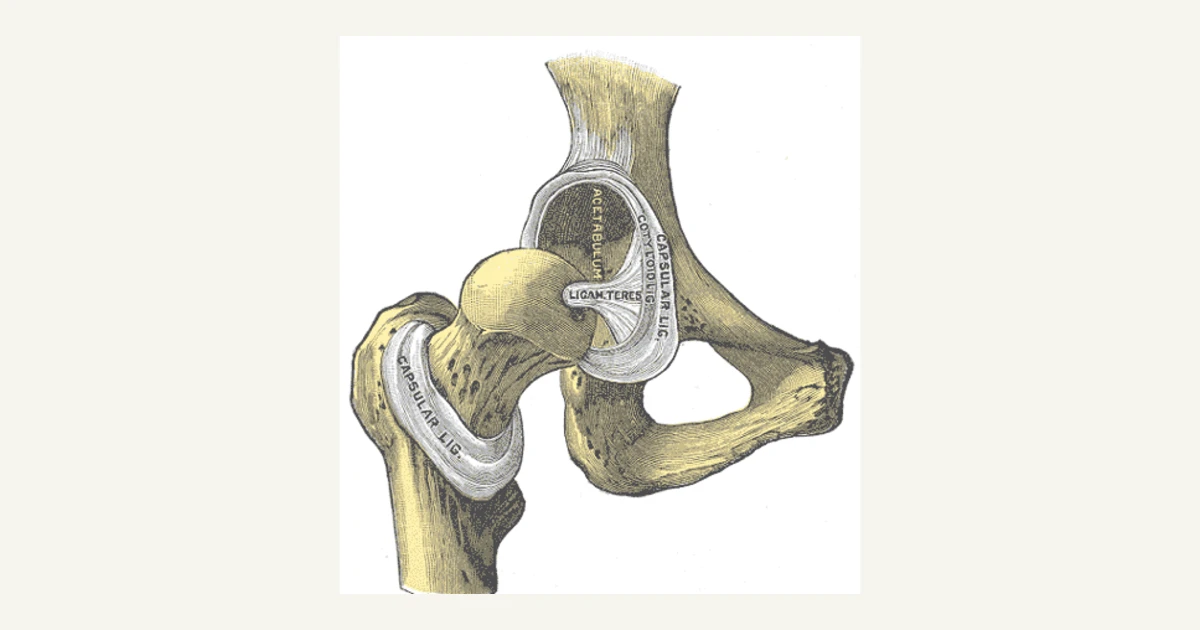
The hip is a ball and socket. In osteoarthritis the cartilage lining the joint thins, the bone at its edges changes shape, and the joint lining becomes irritated. In most people it is not bone grinding on bone. The chances of developing hip osteoarthritis increase as you age.
The most common symptom of hip osteoarthritis is pain in the hip or groin. In the words people use when they search for it:
- An ache in the groin or the front of the thigh, sometimes running down toward the knee. Some people feel it in the knee first.
- Stiffness in the hip, especially in the morning, that eases within about 30 minutes of moving, and comes back after a long meeting or a long MRT ride.
- The sock and the shoe. You put your socks on sitting down, or hook the sock over your toes from the floor. Cutting your toenails becomes a job for someone else.
- Getting out of a car. Both legs swung out together, a hand on the door frame, a push.
- The stairs. One at a time, the good leg first going up, a hand on the rail.
- A walk that shrinks. The ache arrives sooner on the same route, and it is still there the next morning.
Clicking or grinding sounds in your hip joint are also common. Also on this site: the page on a snapping hip covers which kind it is and when a click needs attention.
Socks and car doors go early because they need the hip to bend and turn inward at the same time. Hip pain with a reduced inward turn is one of the signs doctors use to classify hip osteoarthritis.1
How it is diagnosed
A doctor usually diagnoses hip osteoarthritis from your symptoms, your history and an examination of hip range, strength and tenderness. UK guidance says a doctor can make the diagnosis without an X-ray if you are over 45, the pain comes with activity, and morning stiffness lasts 30 minutes or less.2 Whether you need an X-ray or a scan is your doctor’s decision, usually when something does not fit. What an X-ray shows and how the hip feels do not always line up.
What raises the risk
- Obesity: Excess weight puts extra stress on the hip joint.
- Previous hip injury or hip dysplasia: A fracture, dislocation, or other injury to the hip can increase your risk of developing osteoarthritis.
- Family history: Having a family history of osteoarthritis increases your risk.
- Certain occupations: Jobs that require repetitive hip movements or heavy lifting can increase your risk.
Is it the hip joint, or something else?
Point with one finger at the spot that hurts most.
| Where you point | How it behaves | What it usually is | What it needs first |
|---|---|---|---|
| The groin or the front of the thigh | Stiff in the morning, socks and the car are hard, an ache after a long walk | Hip osteoarthritis. In younger, active people, impingement or a labral tear | The plan on this page, and a physiotherapist if it is not settling |
| The outside of the hip, over the bony point | Sore to lie on, sore on stairs, tender to press | Gluteal tendinopathy | Load and strength work rather than stretching. See hip pain: where it hurts |
| The buttock, or down the back of the thigh | Changes with sitting and with your back, not with socks | Pain referred from the lower back | A physiotherapist or a doctor to check the back |
| After a fall | You cannot stand or take weight, or the leg looks shorter or turned outward | A possible hip fracture | The emergency department now |
| A hot, swollen hip with a fever | Pain at rest, feeling unwell | A possible joint infection | A doctor the same day |
The page on hip pain physiotherapy covers the other causes of hip pain and how we treat them. Pain in the groin crease itself, including hernias, is on the page on groin pain.
What actually helps hip osteoarthritis
Exercise and education come first
Three sets of guidelines agree on where to start. NICE in the UK recommends tailored therapeutic exercise, with information and support, for everyone with osteoarthritis.2 OARSI names structured land-based exercise and arthritis education as the core treatments for the hip.3 The American College of Rheumatology and the Arthritis Foundation strongly recommend exercise, tai chi, self-management programs, a walking stick, and weight loss for people with hip or knee osteoarthritis who are overweight.4
The average benefit is modest. A 2026 Cochrane review of 18 trials and 1,368 people found exercise lowered hip osteoarthritis pain and improved function compared with usual care or no treatment, by about 7 points on a 100-point scale. Researchers usually treat about 12 points as the change a person notices.5 The authors still recommend exercise as a primary treatment. An average across all those people says little about your own hip. That is why the plan starts with measures, and why we repeat them.
Weight, where it applies
Excess weight puts extra stress on the hip joint. If your weight is above the healthy range, losing some is part of the guideline plan.2,4 Your doctor or a dietitian helps you set the target. Keep the strength work going while the weight comes down.
A walking stick, and tai chi
A stick takes load off a painful hip on a long walk. It goes in the hand opposite the sore hip and moves forward with the sore leg. A physiotherapist sets the height, usually level with the crease of your wrist when your arm hangs by your side.
Tai chi, a mind-body exercise of gentle movements that train balance, flexibility and range of motion, is among the treatments the American guideline strongly recommends.4
What physiotherapy adds
- Measured strength. The hip abductors and extensors tested with a handheld gauge against the other side, so the plan trains the weak muscles and not the sore spot.
- Your walk. How your pelvis moves when you stand on that leg, your step length, any lean to one side, and the stick if you need one.
- Hands-on treatment. Joint mobilizations and soft tissue work to ease stiffness and pain, alongside the exercise and never in place of it.
- A progressed plan. The load goes up when the numbers move, and comes down for a flare. Your physiotherapist will educate you about hip osteoarthritis, proper body mechanics, and pain management strategies.
Pain relief and anti-inflammatory medication are a decision for your doctor or pharmacist. Injections into the hip are a decision for your doctor.
A home plan for hip osteoarthritis
These are general starting points when nothing in the doctor list below applies. If you have had a hip replacement, follow the plan your surgeon and physiotherapist gave you instead.
How much discomfort is fine. Up to about 4 out of 10 during the exercise, settling within half an hour. Judge it the next morning. Worse than the day before means the dose was too much, so drop the sets or the range by about a third. Stop for sharp groin pain, the hip giving way, or pain that wakes you that night.
1. Sit to stand
From a firm dining chair, stand up without using your hands, then sit down slowly. 3 sets of 8 to 10, most days. Use a higher chair or a cushion if it is not smooth, and come down in height as it gets easier. It is the same movement as the toilet, the taxi and the low sofa.
2. Bridges
On your back, knees bent, feet flat and hip-width apart. Squeeze your buttocks and lift your hips until your body is straight from knee to shoulder. Hold 2 seconds and lower slowly. 2 to 3 sets of 10 to 15. If it pinches in the groin, lift less high.
3. Hip abduction, standing or side lying
The muscles on the outside of the hip hold your pelvis level when you stand on one leg. Standing: hold the kitchen counter and take the sore leg out to the side without leaning away, toes pointing forward, small and slow. Side lying, once standing is easy: lie on the other side, top leg in line with your body or a little behind it, and lift it about 30 centimeters. 2 to 3 sets of 10 to 12 each side. Stop if pain on the outside of the hip lasts into the evening.
4. Step-ups
Start on a low step, around 15 centimeters, with a hand on the rail. Step up with the sore leg first and lower yourself down with control. 2 to 3 sets of 8 to 10 each leg. Raise the step over weeks, not days. Stop for sharp groin pain or a giving-way feeling.
5. Hip flexor stretch, within comfort
A stiff hip often loses the stretch at the front that lets the leg go behind you as you walk. Stand side-on to the kitchen counter, one foot forward and the sore leg back, back heel up. Tuck your tailbone under and bend the front knee until you feel a gentle stretch at the front of the back hip. Hold 20 to 30 seconds, 3 times, once or twice a day. Keep it gentle, and stop if it pinches deep in the groin.
6. Standing on one leg
At the kitchen counter, fingertips on the top, stand on the sore leg with your pelvis level and count the seconds. Work up toward 30 seconds, 3 times on each leg. Stop if the hip gives way.
7. A walking plan
Find the walk that leaves the next morning no worse than usual, often 10 to 15 minutes on the flat to start, and do it on most days. Add about 5 minutes a week while the mornings hold. Flat park connectors come before hills and stairs. On a bad day, two short walks suit the hip better than one long one. Cycling and walking in the pool count too.
Will I need a hip replacement?
Not everyone with hip osteoarthritis does, and the decision belongs to you and your orthopedic surgeon. UK guidance suggests a referral to a surgeon is considered when pain, stiffness and reduced function substantially affect your quality of life and non-surgical care has not helped or does not suit you.2 An X-ray alone does not decide it.
The conversation usually starts when the hip wakes you most nights, when the walk has shrunk to the bus stop, and when the things that made up your week have dropped out of it. Your surgeon makes that call with you, after examining you and your imaging.
What prehab does
If you have a date, the weeks before it count. A prehab block covers three things. Strength in the buttock and thigh on both sides, because the other leg carries you while the new hip cannot. Practice with the stick or crutches, the bed, the chair and a step. And the home set-up, from the toilet seat to the shower. What you build before the operation is what the first weeks after it draw on.
For the weeks after the operation, the precautions and the week-by-week, see the Hip Replacement Recovery Program. Your surgeon’s protocol takes precedence.
Is this normal?
Usually expected: stiffness on getting up that eases as you move. An ache after a long walk or a day of stairs that settles overnight. A flare after a busy weekend that settles back to your usual within a few days to two weeks. Mild muscle soreness the day after the exercises.
Worth getting checked: a walking distance that shrinks month by month. A limp that has crept in. Pain that now wakes you most nights. A flare that has not settled in two weeks.
When to see a doctor first
- Call 995 for chest pain or tightness, sudden breathlessness or coughing up blood. Also after a fall if you cannot get up, or you have hit your head.
- Go to the emergency department now after a fall onto the hip if you cannot stand or take weight on the leg, or the leg looks shorter or turned outward, even if the pain seems mild. Also if you cannot take any weight on the leg at all, fall or no fall. Also for hip or buttock pain with numbness between the legs, or new trouble passing urine or controlling your bowels.
- See a doctor the same day for a hip that is hot, swollen or red, with a fever or feeling unwell, which can be an infection in the joint. Also for sudden severe groin pain with no fall, when you can still take some weight. Also for new hip or thigh pain if you have had cancer.
- See a doctor soon for night pain that wakes you and does not ease when you change position, hip pain past 6 weeks with no change on the plan, or weight loss you cannot explain.
What we measure
Your X-ray describes the joint. These describe what the hip can do. We take them at the first visit and at each stage review, the sore side against the other.
- Hip range. Bending, the inward and outward turn, and the leg going behind you, in degrees, side to side.
- Hip abductor and extensor strength. The muscles on the outside and the back of the hip, measured with a handheld gauge against the other side.
- Five-times sit to stand. How many seconds five stands from a chair take, arms folded.
- Walking speed. Timed over a set distance, and how the walk looks from behind.
- Single-leg stance. How many seconds you hold on each leg with the pelvis level.
- The HOOS-12 or the Oxford Hip Score. Twelve questions on how the hip affects your day, scored at the start and at each review.6,7
Tested, not dated. The plan moves up when the numbers do.
Hip osteoarthritis: who does what
- A doctor (your GP or a polyclinic doctor) diagnoses hip osteoarthritis, rules out the other causes, decides whether you need an X-ray, decides about medication and injections, and refers you to an orthopedic surgeon when needed.
- An orthopedic surgeon decides with you whether and when to operate, and which operation.
- A physiotherapist assesses and measures the hip, treats the stiffness with hands-on joint mobilization and soft tissue work, sets and progresses the exercise and walking plan, advises on a walking stick and on the load through your day, and refers you back to a doctor when a finding needs one.
The four stages, applied to hip osteoarthritis
In the Phoenix Recovery Protocol the work starts at Calm & Protect: settling a flare, taking out the loads that set it off, and the walking stick if you need one. Move & Mobilize takes the bend, the inward turn and the leg-behind-you stretch toward the other side. Rebuild & Strengthen loads the buttock and thigh muscles, from sit to stand and bridges to step-ups and single-leg work, measured against the other side. Return & Perform tests the tasks themselves: the MRT stairs, the walk round the reservoir, the taxi, the golf round, the grandchild lifted from the floor. None of the four is passive. The measures set the pace.
Where are you with this right now?
1. It is settling on its own
The flare after the weekend has gone back to your usual ache. Your walking distance is holding or growing. Socks are no harder than last month, and the morning stiffness has eased by the time the kettle boils. That is hip osteoarthritis behaving as expected. Keep the home plan going. You do not need us for this, and we would rather say so.
2. It has been months, and the hip keeps taking more of your day
You put your socks on sitting down. You get out of the taxi both legs together, a hand on the door frame. At the MRT you look for the lift before you look for the exit.
What our patients say
Google reviews from our clinics in Singapore.



The evening walk round the park is now the void deck and back. You stand in the hawker queue shifting from leg to leg. You told your kaki you would be back for Saturday golf after the new year, and you said the same the year before.
It is wear and tear at your age, so you rested it. You gave it two weeks off. The stiffness at 7am was the same, and the walk got shorter.
Your X-ray has been read. Has anyone measured the muscles that move the hip?
The orthopedic review is in three months. You could walk into it with your hip range, your strength and your sit to stand written down in numbers.
If anything in the doctor list applies, see a doctor first. If a doctor has ruled those out, or you never needed one, one Assessment & Treatment with a physiotherapist measures the hip in degrees, times five sit to stands, tests the hip muscles against the other side, treats what is limiting you in the same visit, and tells you which stage you are in.
3. You have a surgery date, or you have had surgery
If you have a date for a hip replacement, the weeks before it are the prehab above, and the weeks after it are the Hip Replacement Recovery Program. If you are younger and active and had a hip arthroscopy for impingement or a labral tear, see the Hip Arthroscopy and FAI Recovery Program. Your surgeon’s protocol takes precedence.
If you have been treated and it stopped improving, before or after an operation, the Stalled Recovery Review is three weeks with the same physiotherapist. The first visit measures the hip, the muscles around it and your walk. The next two measure how they respond.
All of it runs on the same four stages. The Phoenix Recovery Protocol explains what each stage works on and what you have to meet to move up. No referral needed to start.
Next step
Find out which stage you are in
Pain is the first thing to leave. Movement and strength are the last things trained back, and most people stop before that part is done. One Assessment and Treatment is a single 45-minute appointment at $230, nett, no GST. Your therapist finds what is actually limiting you, treats it in the same appointment, and you leave with your current stage and a written plan.
Prefer to phone? Each of our five clinics has its own number on the clinics page. No referral needed to book.
Related reading
Sources: 1. Altman R, Alarcón G, Appelrouth D, et al. The American College of Rheumatology criteria for the classification and reporting of osteoarthritis of the hip. Arthritis Rheum. 1991;34(5):505-514. 2. National Institute for Health and Care Excellence. Osteoarthritis in over 16s: diagnosis and management. NICE guideline NG226. London: NICE; 2022. 3. Bannuru RR, Osani MC, Vaysbrot EE, et al. OARSI guidelines for the non-surgical management of knee, hip, and polyarticular osteoarthritis. Osteoarthritis Cartilage. 2019;27(11):1578-1589. 4. Kolasinski SL, Neogi T, Hochberg MC, et al. 2019 American College of Rheumatology/Arthritis Foundation guideline for the management of osteoarthritis of the hand, hip, and knee. Arthritis Care Res (Hoboken). 2020;72(2):149-162. 5. Hall M, Lawford BJ, Hinman RS, Dobson F, Spiers L, Kimp A, French HP, Reichenbach S, Hernandez-Molina G, Bennell KL. Exercise for osteoarthritis of the hip. Cochrane Database Syst Rev. 2026;(7):CD007912. 6. Dawson J, Fitzpatrick R, Carr A, Murray D. Questionnaire on the perceptions of patients about total hip replacement. J Bone Joint Surg Br. 1996;78(2):185-190. 7. Gandek B, Roos EM, Franklin PD, Ware JE Jr. A 12-item short form of the Hip disability and Osteoarthritis Outcome Score (HOOS-12): tests of reliability, validity and responsiveness. Osteoarthritis Cartilage. 2019;27(5):754-761.
Where we are
Clinics across Singapore
ORCHARD
400 Orchard Road #12-12
Orchard Towers, S238875
NS22 Orchard MRT
Physiotherapy and hand therapy in Orchard →
WhatsApp 8800 1830TAMPINES
9 Tampines Grande #01-20
Asia Green, S528735
EW2DT32 Tampines MRT
Physiotherapy and hand therapy in Tampines →
WhatsApp 8780 9608SERANGOON
265 Serangoon Central Drive #04-269
S550265 · Lift C only
NE12CC13 Serangoon MRT
Physiotherapy and hand therapy in Serangoon →
WhatsApp 8892 4121TANJONG PAGAR
10 Anson Road #02-77A
International Plaza, S079903
EW15 Tanjong Pagar MRT
Physiotherapy and hand therapy in Tanjong Pagar →
WhatsApp 8227 7074JURONG EAST
2 Venture Drive #02-02
Vision Exchange, S608526
NS1EW24 Jurong East MRT
Opening 25 October 2026
Physiotherapy and hand therapy in Jurong East →
WhatsApp 8242 7340