
Written by Zita Sham, Fairuuz Saleh and Shiv Mohan Banka, Principal Physiotherapists at Phoenix Rehab.Clinically reviewed by Louise Yow, Principal Physiotherapist & Director, AHPC A1300363H.Last reviewed 2 November 2026.
It hurts at the end of the collarbone, right where it meets the shoulder, every time you reach across to the passenger seat. Nothing happened. Or something happened on the bike six weeks ago, the X-ray was clear, and it still catches when you pull a T-shirt over your head.
Where the collarbone hurts tells you most of what it is. This page covers the four places it hurts and what each usually means, the signs that need a doctor or an X-ray first, collarbone pain with no injury, why the bone healing is not the end of it after a break, and what to do when the sling has been off for weeks and the shoulder is still not yours.
What causes collarbone pain?
Collarbone pain is most often one of three things: a break after a fall, a sprain or wear in the small joint where the collarbone meets the shoulder (the AC joint), or strain in the neck and chest muscles that attach along it. Less often it is the joint at the breastbone end, a nerve pinched under the collarbone, or, rarely, infection or a tumor.1,3
Key takeaways
- Pain at the shoulder end of the collarbone that is worst reaching across the body usually points to the AC joint. Pain in the middle after a fall is a break until an X-ray says otherwise.
- Collarbone pain with no injury is usually the muscles that attach to it, the trapezius, pec and neck muscles, or pain referred from the neck. It is tested, not scanned first.
- After a broken collarbone, the bone usually heals in six to twelve weeks. The stiff shoulder and the weak shoulder blade are what take longest.
- A collarbone that is deformed, a wound over it, a cold or numb arm, or pain under the left collarbone with chest pressure or breathlessness, is an emergency.
- Six weeks out of the sling with a shoulder that still will not reach overhead is a strength and movement problem, not a bone problem, and it is measured.
First, the signs that mean a doctor, not this page
- Call 995 for pain under the left collarbone or behind the breastbone with chest pressure, breathlessness, sweating or pain into the jaw or arm; for difficulty breathing after a blow to the collarbone; or if the arm below is cold, white or blue.
- Go to the emergency department now if the collarbone is visibly out of shape after a fall, the skin over it is broken or stretched tight and white, or the arm or hand is numb or weak after the injury. A lump at the breastbone end of the collarbone after a hard blow, with trouble swallowing or breathing, is also an emergency.
- See a doctor the same day for a fall onto the shoulder or outstretched arm with pain and swelling over the collarbone, which needs an X-ray; or for a hot, red, swollen collarbone with a fever.
- See a doctor soon for a lump on the collarbone that is growing or was not there before, pain that wakes you at night and does not change with position, unexplained weight loss, a history of cancer, or numbness and tingling down the arm that keeps returning.
None of these? Then the rest of this page is for you.
Where it hurts tells you what it is
| Where | What it usually is | Who checks it first |
|---|---|---|
| The outer end, on top of the shoulder. Worst reaching across the body, pushing up from a chair, sleeping on it | The AC joint: a sprain after a fall, or wear in the joint over years of overhead work and lifting | A physiotherapist tests it. An X-ray if there was a fall |
| The middle of the bone, after a fall or a crash. Swelling, a bump, pain on any arm movement | A fracture until proven otherwise | A doctor and an X-ray first |
| The inner end, at the breastbone. A lump, pain lifting the arm overhead or lying on that side | The sternoclavicular joint: a sprain, wear, or in young adults a joint that has slipped | A doctor if there was a blow or a new lump |
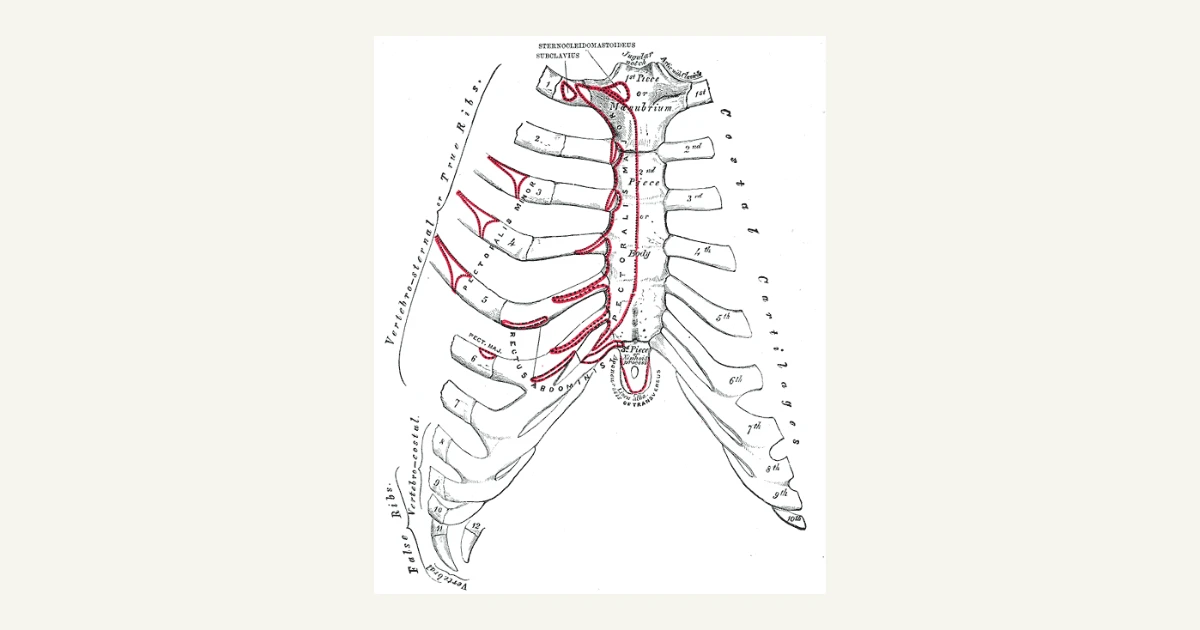
| Along or just above the bone, no injury, worse at the end of a desk day or carrying a bag | The muscles that attach to the collarbone (trapezius, sternocleidomastoid, pectoralis major) or pain referred from the neck | A physiotherapist tests the neck and the muscles |
| Under the collarbone, with aching or tingling down the arm, worse with the arm overhead | Thoracic outlet syndrome: a nerve or vessel pinched between the collarbone and the first rib | A physiotherapist tests it; a doctor if the hand changes color or swells |
Broken collarbone
A broken collarbone (clavicle fracture) usually comes from a fall onto the shoulder or an outstretched arm. Most breaks in the middle of the bone are treated in a sling, and the bone typically heals in six to twelve weeks in adults. Some, where the ends are badly out of line or the bone is shortened, are fixed with a plate.
Often, the bone is not what slows people down. The shoulder stiffens in the sling, and the muscles that hold the shoulder blade weaken. Reaching overhead, sleeping on that side and lifting are what take longest to come back.
- In the sling: elbow, wrist and hand kept moving, and gentle shoulder movement only as your doctor allows.
- Out of the sling: shoulder range in all directions, then shoulder blade and rotator cuff strength once your doctor confirms healing.
- Lifting and sport: heavy lifting and contact sport usually wait until healing is confirmed on X-ray, commonly three months or later.
Call 995 for difficulty breathing after the injury. Go to the emergency department now if the skin over the break is broken, or looks stretched tight and white over the bone, or if the arm or hand is numb, weak, pale or cold.
If the break itself is still painful, or you can feel it move, at three months, ask your doctor whether the bone has joined. If the bone has joined and the shoulder is still stiff or weak, see the Stalled Recovery Review.
The AC joint: the sprain, the wear and the weightlifter’s version
The acromioclavicular joint is where the outer end of the collarbone meets the shoulder blade. It is small, sits right under the skin, and takes load every time the arm goes overhead or across the body.
- AC joint sprain or separation. A fall onto the point of the shoulder stretches or tears the ligaments holding the joint. Mild sprains settle in a sling for a week or two and then physiotherapy over four to eight weeks. A bigger separation leaves a visible step at the end of the collarbone, and whether that needs surgery is a surgeon’s decision, often made on how much the arm is needed overhead.1
- AC joint wear. Over years of lifting, overhead work and bench pressing the joint space narrows and the ends roughen. It aches at the top of the shoulder, hurts most reaching across the chest, and is common on scans in people over forty, including people with no pain. Physiotherapy works on the shoulder blade and the load through the joint. Injections and surgery are a doctor’s decision.
- Weightlifter’s shoulder. Repeated heavy bench press and dips can break down the outer end of the collarbone itself, a condition called distal clavicular osteolysis. It aches over the joint, hurts on bench press and dips, and settles only when those loads are changed for months, not weeks.2 The page on bench press shoulder pain covers the lifts in detail.
Collarbone pain with no injury
Most people who search this have not fallen on anything. The pain came on over weeks, sits along or just above the collarbone, and is worse at the end of a desk day or after carrying a bag on that shoulder. Three muscles attach along the collarbone: the trapezius from behind, the sternocleidomastoid from the neck, and the pectoralis major from the chest. All three tighten with hours at a screen or a one-sided bag, and they ache along the bone they attach to. A stiff lower neck also refers pain to the collarbone and the top of the shoulder without anything being wrong with the bone.
The organ worries are the rarest, and they announce themselves differently: a growing lump, fever, night pain that position does not change, or chest pressure and breathlessness with pain under the left collarbone. Those are in the doctor list above. Pain that the neck, the shoulder blade or pressing on the muscle can change is coming from the neck and the muscles.
Left side or right side
Side matters less than people fear. Right-sided collarbone pain follows the side you carry, mouse and lift with. Left-sided pain is the same muscles on the other side, with one exception: pain under the left collarbone or behind the breastbone that comes with pressure, breathlessness, sweating or pain into the jaw or arm is treated as the heart until proven otherwise. That is a 995 call, not a search.
Six weeks out of the sling, and the shoulder is still not yours
The thinking goes: the bone has healed, so the injury is over.
The X-ray at eight weeks said so. The sling went in a drawer. Six weeks on, you still cannot lie on that side. The T-shirt goes on with the other arm first. You have not been back to the pool, the bag goes on the other shoulder, and the overhead rack at the gym is somebody else’s problem. The clinic letter said the bone had healed. The shoulder did not get the letter.
There is a reason for that. The bone healed because bone heals on its own in a sling. The shoulder blade muscles that hold the arm up did nothing for eight weeks, and the joint capsule tightened while they rested. Neither of those recovers by waiting, because waiting is what caused them. They come back when the shoulder is moved to its end of range and loaded, a little more each week, with the strength measured against the other side. Six weeks of hoping has told you what six weeks of hoping does. The company dinner where you cannot raise a glass without thinking about it is next month.
Has anyone measured how far that arm goes overhead against the other one? Tested the strength of the muscles that hold the shoulder blade, side to side? Checked whether the AC joint at the end of the healed bone is now the thing that hurts? If not, nobody yet knows whether this is a stiff joint, a weak shoulder blade or a sore AC joint, and they need different plans.
What a physiotherapist does with it
Finding the real problem is half the battle. Treating it is the other half.
At the Assessment & Treatment, a physiotherapist asks where it is and what sets it off, in your words, then tests what a clear X-ray does not: the AC joint, by pressing it and by taking the arm across the body; the joint at the breastbone end; how far the arm goes overhead and behind the back, measured against the other side; the strength of the shoulder blade and rotator cuff muscles, side to side; the neck, because it refers here; and, if the arm tingles overhead, the space under the collarbone. If the pattern points to a fracture that has not joined, a lump, or anything in the doctor list, we say so and write to your doctor. X-rays, scans, injections and surgery are a doctor’s decision.
If it is the joint, the muscles or the stiff post-fracture shoulder, most of the 45 minutes is treatment: hands-on work for the joint and the muscles along the bone, movement to the end of range, then the shoulder blade and rotator cuff loading the sling took away, measured up at each review. You leave knowing which stage you are in, what is limiting the shoulder, and a written plan. The page on physiotherapy for shoulder pain covers the full program, and a proximal humerus fracture covers the break at the top of the arm bone, which is often mistaken for the collarbone.
Every appointment is one to one with your physiotherapist for the full 45 minutes, at five clinics: Orchard, Tampines, Serangoon, Tanjong Pagar and Jurong East. Bring your X-ray report and the surgeon’s letter if you have them.
Questions about collarbone pain
Why does my collarbone hurt without any injury?
Usually because of the muscles that attach to it, the trapezius, sternocleidomastoid and pectoralis major, which tighten with long hours at a screen or a bag on one shoulder, or because a stiff lower neck is referring pain there. A lump that is growing, fever, or pain that position does not change is a doctor’s question.
Why does my collarbone hurt when I lift my arm?
Pain at the outer end of the collarbone when the arm goes overhead or across the body usually points to the AC joint, either sprained after a fall or worn over years of lifting. Pain at the inner end on lifting points to the joint at the breastbone. A physiotherapist tests both; an X-ray comes first if there was a fall.
Why does my collarbone hurt when I bench press?
Bench press and dips load the AC joint at the outer end of the collarbone. Pain there during the lift, worse on the lowering phase and when reaching across the chest, usually points to the AC joint or, in heavy lifters, to the end of the collarbone itself (weightlifter’s shoulder). Both need the load changed and the shoulder blade strength tested, not a heavier belt.
How long does a broken collarbone take to heal?
In adults the bone usually heals in six to twelve weeks, with heavy lifting and contact sport waiting until healing is confirmed on X-ray, commonly three months or later. The shoulder stiffness and shoulder blade weakness from the sling often take longer than the bone, and are what physiotherapy works on.
What is the hard lump on my collarbone near my sternum?
A firm, non-tender bump at the breastbone end of the collarbone is often the sternoclavicular joint itself, which is more prominent in some people and after old sprains. A new lump, a tender one, one that is growing, or one after a hard blow needs a doctor to look at it, not a physiotherapist.
Is pain under the left collarbone serious?
On its own, with no chest symptoms, pain under or along the left collarbone is usually the same muscle or joint problem as on the right. Pain under the left collarbone with chest pressure, breathlessness, sweating or pain into the jaw or arm is treated as the heart until proven otherwise. Call 995.
X-ray clear, sling off for six weeks, and the arm still goes into the T-shirt second? Get Assessed & Treated, and leave knowing whether it is the joint, the muscles or the shoulder the sling left behind, what it can take today, and what the next stage asks of it.
Sources: 1. Mazzocca AD, Arciero RA, Bicos J. Evaluation and treatment of acromioclavicular joint injuries. Am J Sports Med. 2007;35(2):316-329. 2. Cahill BR. Osteolysis of the distal part of the clavicle in male athletes. J Bone Joint Surg Am. 1982;64(7):1053-1058. 3. Robinson CM. Fractures of the clavicle in the adult: epidemiology and classification. J Bone Joint Surg Br. 1998;80(3):476-484.
Also on this site: the page on a proximal humerus fracture covers the break at the top of the arm bone, and the page on easing shoulder pain covers what helps and what does not.
What our patients say
Google reviews from our clinics in Singapore.


Where are you with this right now?
1. It is settling on its own
Most injuries and most flare-ups settle over weeks with sensible load management and a return to normal movement. Improvement is judged over a month, not over a day, and good days and bad days inside that are usual. If you are doing more this month than last, and sleeping better, it is behaving the way it should. You do not need us for this, and we would rather say so.
2. It has stopped improving
You still put the T-shirt on with the other arm first. You have not been back to the pool. The bag lives on the other shoulder now.
Pain is the first thing to leave. Movement and strength are the last things trained back, and most people stop before that part is done. That is the gap worth measuring, and it is not measured by how you feel on the day.
The Stalled Recovery Review is three appointments over three weeks with the same therapist, because what a joint does under load cannot be read in one visit. The first finds what is limiting it. The next two measure how it responds. $690, nett, no GST, which is three appointments at $230.
3. You have had surgery, or you have a date
Recovery after an operation has a shape, and knowing which stage you are in tells you whether you are on it. See the recovery programs, hand and physiotherapy, or the four stages and what each one works on if you are not sure which applies to you.
All of it runs on the same four stages. The Phoenix Recovery Protocol explains what each stage works on and what you have to meet to move up. No referral needed to start.
Next step
Find out which stage you are in
Pain is the first thing to leave. Movement and strength are the last things trained back, and most people stop before that part is done. One Assessment and Treatment is a single 45-minute appointment at $230, nett, no GST. Your therapist finds what is actually limiting you, treats it in the same appointment, and you leave with your current stage and a written plan.
Prefer to phone? Each of our five clinics has its own number on the clinics page. No referral needed to book.
Related reading
Where we are
Clinics across Singapore
ORCHARD
400 Orchard Road #12-12
Orchard Towers, S238875
NS22 Orchard MRT
Physiotherapy and hand therapy in Orchard →
WhatsApp 8800 1830TAMPINES
9 Tampines Grande #01-20
Asia Green, S528735
EW2DT32 Tampines MRT
Physiotherapy and hand therapy in Tampines →
WhatsApp 8780 9608SERANGOON
265 Serangoon Central Drive #04-269
S550265 · Lift C only
NE12CC13 Serangoon MRT
Physiotherapy and hand therapy in Serangoon →
WhatsApp 8892 4121TANJONG PAGAR
10 Anson Road #02-77A
International Plaza, S079903
EW15 Tanjong Pagar MRT
Physiotherapy and hand therapy in Tanjong Pagar →
WhatsApp 8227 7074JURONG EAST
2 Venture Drive #02-02
Vision Exchange, S608526
NS1EW24 Jurong East MRT
Physiotherapy and hand therapy in Jurong East →
WhatsApp 8242 7340