

Written by Zita Sham, Fairuuz Saleh and Shiv Mohan Banka, Principal Physiotherapists at Phoenix Rehab.Clinically reviewed by Louise Yow, Principal Physiotherapist & Director, AHPC A1300363H.Last reviewed 28 September 2026.
A Bankart lesion (medically termed as a glenoid labrum tear) typically happens when the shoulder dislocates anteriorly (forwards), and this damages the lower part of the cartilage that lines the shoulder socket.
Most of the time, it affects mainly young athletes.
Damage to the labrum makes the shoulder at more risk of instability, and there is a high risk of further shoulder dislocation without appropriate treatment.
Bankart lesions are named after English orthopedic surgeon Dr Arthur Sydney Blundell Bankart, who lived between 1879-1951, who first described the injury and the surgical repair process.
In this article we will look at common causes, associated injuries, symptoms and the treatment options (both surgical and non surgical) for a typical Bankart lesion labrum tear.
Had a dislocation, or a Bankart repair booked? The Shoulder Dislocation and Labral Repair Recovery Program sets out the four stages week by week, what is normal, and when sport is safe again.
WHAT CAUSES A BANKART LESION?
To fully understand Bankart lesions, we need to first understand the structure of the human shoulder.
Our shoulder is a ball and socket joint, similar to our hip joint. The top of the arm bone (head of the humerus) forms the “ball” part of the shoulder joint, and the front part of the shoulder blade (glenoid fossa) forms the “socket” part of the joint.
To allow for the large range of mobility that the shoulder needs to move the arm in multiple directions, the socket part of the shoulder joint is very shallow.
To visualize this, make a fist with your left hand, and place your right hand over the fist. You’ll see that the joint is fairly shallow and can be easily dislocated or damaged.
Around the rim of the socket is a special band of cartilage known as the glenoid labrum. This labrum is made of fibrocartilaginous material. It deepens the shoulder socket to improve the connection of the joint and improve stability, without compromising or restricting mobility.
A Bankart lesion happens typically when there is damage to the lower portion of the glenoid labrum, causing it to break and tear away from the bony socket.
Usually this happens when the shoulder dislocates forwards, meaning the head of the humerus is forced forwards and is pushed out of the glenoid socket.
As it is forced forwards, it may damage the labrum, causing it to tear.
The vast majority of shoulder dislocations (over 95%) are anterior dislocations and are usually caused by:
1) Trauma
A fall onto an outstretched arm, particularly if the arm is
- abducted (stretched or extended out to the side)
- externally rotated (turned outwards away from the body)
- extended (behind).
This is the most common cause of anterior shoulder dislocations in older patients. Road traffic accidents (RTAs) are another cause of traumatic shoulder dislocations.
2) Sports and Sporting Injuries
These types of injuries can occur during contact sports such as football, soccer, water polo or rugby, particularly when the arm is above the head and the elbow is pushed backwards.
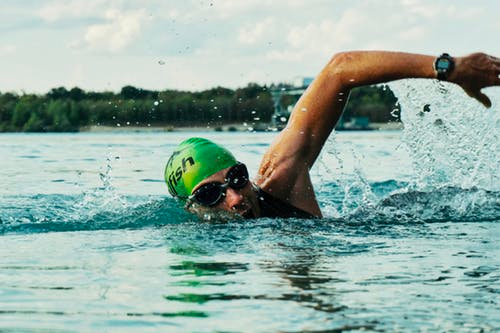
Repetitive movements above the head can also cause this injury, such as in cricket, baseball, tennis, badminton and swimming.
This is the most common cause of a glenoid labrum tear in younger and more active patients.
ASSOCIATED AND RELATED SHOULDER INJURIES
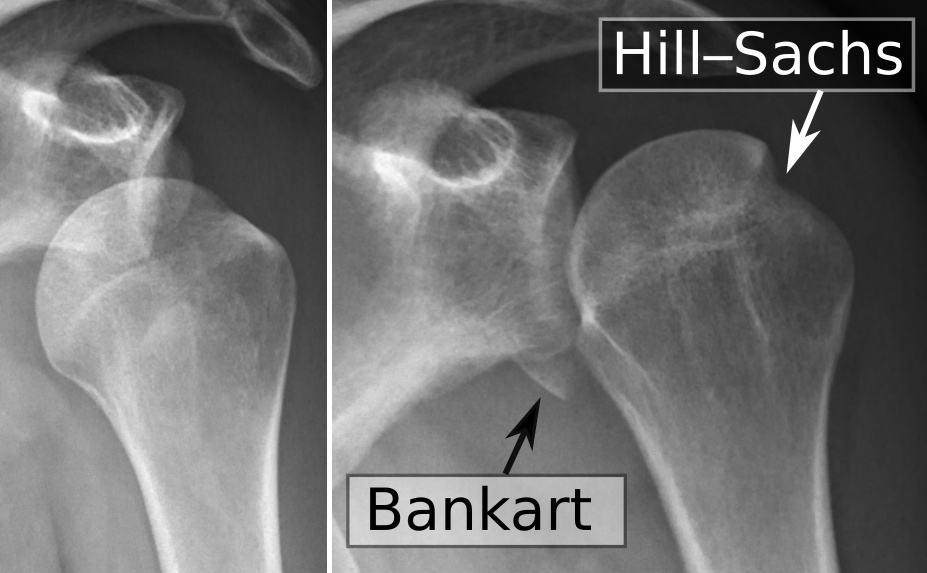
With forward anterior shoulder dislocations, some patients may also experience damage to one of the shoulder bones.
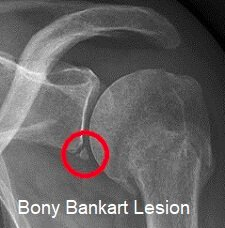
- Damage to the glenoid (the socket part) is known as a Bony Bankart. Bony Bankarts happen when there is a fracture (break) in the antero-inferior (lower front) part of the glenoid cavity, including the glenoid labrum tear.
- Bankart lesions may also be associated with fractures of the head of humerus (the ball), such as a Hill-Sachs lesion, where there is a compression fracture on the posterolateral (outer back) part of the humeral head.
- The joint capsule, a special sac that surrounds the glenohumeral joint, may be damaged. Damage may also occur to the surrounding ligaments, most commonly the inferior glenohumeral ligament.
These all increase the risk of further shoulder instability.
SYMPTOMS OF A GLENOID LABRUM TEAR
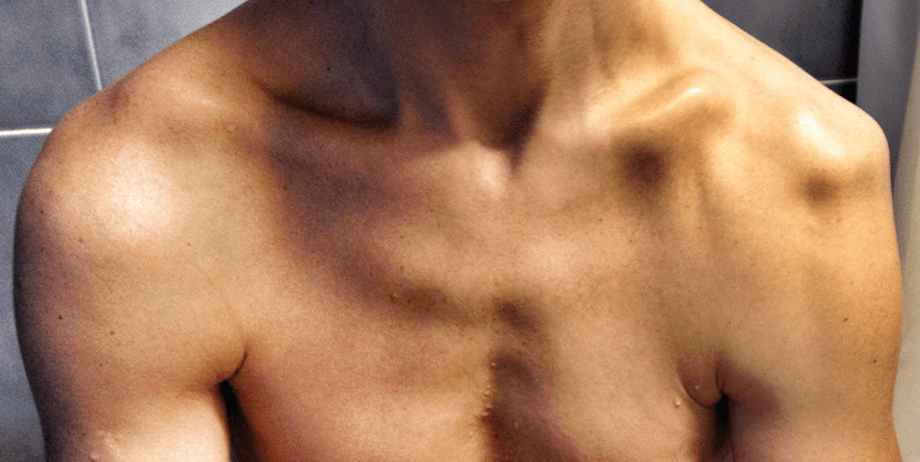
Common symptoms of a Bankart lesion include:
1) Recurrent Dislocations
Repeated episodes of shoulder dislocation are fairly common with a Bankart lesion, particularly in younger patients. This can affect up to 80% of people under the age of 30.
This frequency reduces with age to around 30% over time.
2) A Feeling of Looseness and/or Instability
Patients may report that their shoulder feels weak and as if it is going to dislocate again, with actions such as throwing, lifting and moving. A common complaint is that the shoulder feels loose and as though it can “pop out” at any time, especially at certain angles.
3) Pain
Shoulder patients with a glenoid labrum tear often complain of an aching pain which tends to be diffuse (generalized pain over a location) rather than in one spot.
4) Catching/Locking Sensations
Patients may experience unusual sensations when moving the arm, such as tingling pain or burning sensations.
BANKART TREATMENT OPTIONS
There are two treatment options for Bankart lesions, surgical and non-surgical. The right treatment will depend on factors such as severity, age, activity levels and levels of instability.
1) Surgical Treatment
Surgery tends to be the treatment of choice for younger patients with a Bankart lesion, especially with patients who play sports, as there is a high risk of the shoulder dislocating again.
This is because the glenoid labrum tear often fails to heal properly. The labrum has a poor blood supply and tends to heal slowly, and being a highly mobile area is susceptible to reinjury.
When the glenoid labrum doesn’t provide the extra depth to the socket that is needed, it reduces the stability and increases the risk of further (recurrent) shoulder dislocation.
A Bankart lesion repair is usually carried out arthroscopically (key hole surgery) under general anesthetic. The labral tear surgery aims to repair and tighten the overstretched and damaged ligaments, joint capsule and cartilage.
Suture anchors are placed in the bone, and the torn glenoid labrum is reattached to the glenoid fossa. Typically, patients can go home on the same day, or one day after this type of shoulder surgery.
You will need to wear a protective sling, even when you sleep, to protect the shoulder for the first few weeks and allow it to heal in the correct position.
Shoulder physical therapy with our senior physiotherapists in Phoenix Rehab Singapore will be started almost immediately, to regain
- strength
- stability
- movement.
You will be given a shoulder exercise and rehab program to follow, which gradually progresses to more challenging exercises over time.
What our patients say
Google reviews from our clinics in Singapore.



It usually takes around 4-6 months to recover completely and be able to return to contact sports.
Fortunately, Bankart shoulder repair surgery has an approximately 85-90% success rate, with most of our shoulder pain patients returning to their pre-injury activity levels.
Outcomes tend to be slightly better when surgery is carried out soon after the initial labrum tear, rather than further down the line.
2) Non-Surgical Treatment
For older patients, or those who are less active, conservative non-surgical treatment is recommended for a Bankart lesion.
The painful shoulder and arm is immobilized in a sling for a few weeks, usually with the arm resting across the front of the body in internal rotation (turned inwards) and a small pillow under the armpit to hold the arm slightly away from the body (slight abduction).
Patients are then referred to our senior physiotherapists for intensive shoulder physical therapy to regain
- strength
- stability
- mobility
of the affected shoulder.
One of the problems with this treatment method is that in this rest position, the glenoid labrum tends to heal in slightly the wrong place, so the socket depth is reduced, making the shoulder more prone to recurrent dislocations.
Except for young athletes, the advice is often to try non-surgical therapy first. If the shoulder does re-dislocate, then corrective shoulder surgery would be advised.
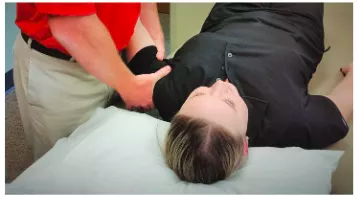
Physiotherapy interventions may include:
- cold therapy
- heat therapy
- moist heat paraffin wax therapy
- radio-frequency Indiba physiotherapy to accelerate soft tissue healing
- joint mobilization
- stretching exercises
- strengthening exercises
- scar management
- hands-on manipulation and mobilization (manual therapy)
- soft tissue management
- heat therapy, heat treatment and heat packs to relieve tight muscles and joints
- ultrasound therapy to accelerate soft tissue healing
- exercise therapy
- acupuncture and/or dry needling
- deep tissue release.
References
- https://www.shoulder-pain-explained.com/bankart-lesion.html
Where are you with this right now?
1. It is settling on its own
Most injuries and most flare-ups settle over weeks with sensible load management and a return to normal movement. Improvement is judged over a month, not over a day, and good days and bad days inside that are usual. If you are doing more this month than last, and sleeping better, it is behaving the way it should. You do not need us for this, and we would rather say so.
2. It has stopped improving
You have adapted without noticing. The other side takes the load, you plan movements you used to make without thinking, and you have quietly dropped things you used to do.
Pain is the first thing to leave. Movement and strength are the last things trained back, and most people stop before that part is done. That is the gap worth measuring, and it is not measured by how you feel on the day.
The Stalled Recovery Review is three appointments over three weeks with the same therapist, because what a joint does under load cannot be read in one visit. The first finds what is limiting it. The next two measure how it responds. $690, nett, no GST, which is three appointments at $230.
3. You have had surgery, or you have a date
Recovery after an operation has a shape, and knowing which stage you are in tells you whether you are on it. See the recovery programs, hand and physiotherapy, or the four stages and what each one works on if you are not sure which applies to you.
All of it runs on the same four stages. The Phoenix Recovery Protocol explains what each stage works on and what you have to meet to move up. No referral needed to start.
Next step
Find out which stage you are in
Pain is the first thing to leave. Movement and strength are the last things trained back, and most people stop before that part is done. One Assessment and Treatment is a single 45-minute appointment at $230, nett, no GST. Your therapist finds what is actually limiting you, treats it in the same appointment, and you leave with your current stage and a written plan.
Prefer to phone? Each of our five clinics has its own number on the clinics page. No referral needed to book.
Related reading
Where we are
Clinics across Singapore
ORCHARD
400 Orchard Road #12-12
Orchard Towers, S238875
NS22 Orchard MRT
Physiotherapy and hand therapy in Orchard →
WhatsApp 8800 1830TAMPINES
9 Tampines Grande #01-20
Asia Green, S528735
EW2DT32 Tampines MRT
Physiotherapy and hand therapy in Tampines →
WhatsApp 8780 9608SERANGOON
265 Serangoon Central Drive #04-269
S550265 · Lift C only
NE12CC13 Serangoon MRT
Physiotherapy and hand therapy in Serangoon →
WhatsApp 8892 4121TANJONG PAGAR
10 Anson Road #02-77A
International Plaza, S079903
EW15 Tanjong Pagar MRT
Physiotherapy and hand therapy in Tanjong Pagar →
WhatsApp 8227 7074JURONG EAST
2 Venture Drive #02-02
Vision Exchange, S608526
NS1EW24 Jurong East MRT
Opening 25 October 2026
Physiotherapy and hand therapy in Jurong East →
WhatsApp 8242 7340