
Written by Zita Sham, Fairuuz Saleh and Shiv Mohan Banka, Principal Physiotherapists at Phoenix Rehab.Clinically reviewed by Louise Yow, Principal Physiotherapist & Director, AHPC A1300363H.Last reviewed 28 September 2026.
A nerve stretch is not a stretch. You are not lengthening a nerve, you are asking it to slide through the tunnel of tissue it runs in. That is why the technique looks like a slow, small, repeated movement rather than a held position, and why holding it hard usually makes symptoms worse.
The proper name is neural mobilization, and the two useful versions are gliders and tensioners.
Why a nerve needs to slide
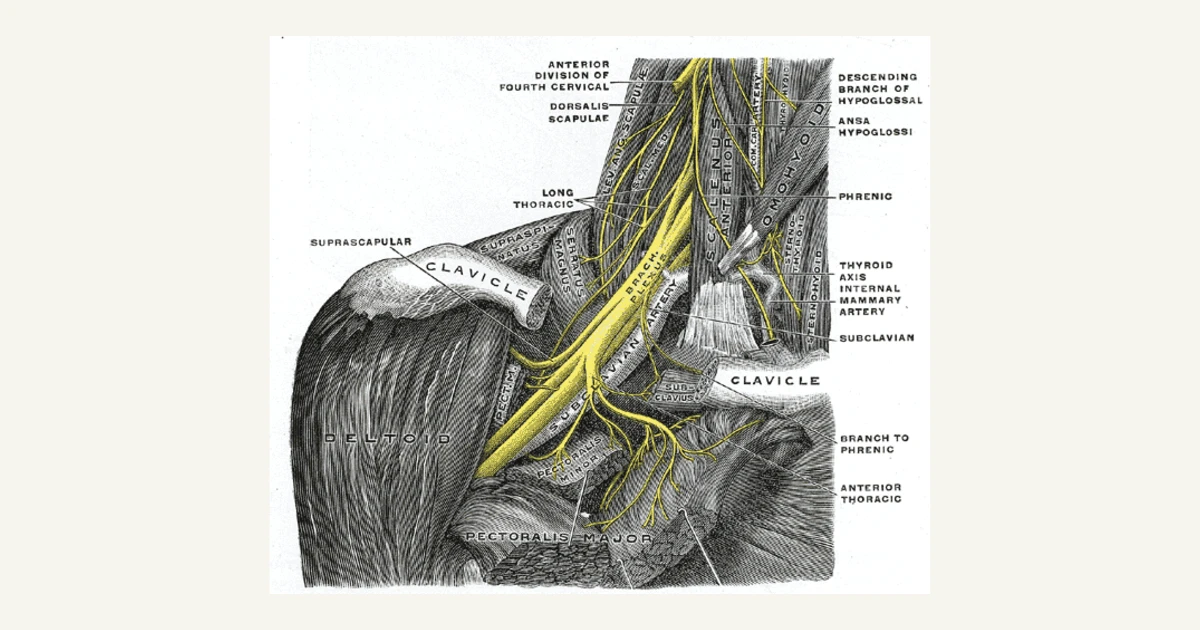
Nerves run from the spine to the fingers and toes through soft tissue that moves constantly. To let you reach overhead or straighten a leg, a nerve has to glide several millimeters through its bed and take up a little slack along its length. When scar, swelling, a disc, a tight tunnel or simply months of not moving restrict that, the nerve gets pulled rather than gliding, and it responds the way irritated nerves do. Tingling, burning, a line of pain that runs rather than sits, and a limb that feels tight in a way that stretching does not fix.
That last symptom is the tell. A hamstring that feels permanently tight and never responds to stretching is often a sciatic nerve that is not gliding, and it is treated in the opposite way from a tight muscle.
Gliders and tensioners
A glider slackens the nerve at one end while it tightens at the other, so the nerve slides back and forth without ever being put under real tension. That is the gentle version and it is where you start when symptoms are irritable.
A tensioner loads both ends at once, putting mild tension through the nerve. It is the progression, used when the nerve tolerates gliding and you want it to accept more length.
Both are done as small repeated movements, typically a handful at a time, several times a day, and both stop short of reproducing your symptoms strongly.
The rules that stop this backfiring
- Do not chase the symptom. A mild pull or a flicker of tingling at the end of the movement is acceptable. Reproducing your full symptom is too much.
- Small and often beats big and once. A nerve responds to repetition, not to duration.
- Judge it the next morning. Symptoms that are worse the following day mean the dose was too high, not that the nerve needs more.
- It is one part of the treatment. If the nerve is compressed by something structural, mobilizing it does not remove the compression.
When a nerve problem is not a stretching problem
Progressive weakness, a foot that drags, muscle wasting, or numbness that is constant rather than intermittent all mean the nerve is losing function rather than being irritated, and those belong with a doctor. So does numbness around the saddle area or any change in bladder or bowel control, which is an emergency department today.
Nerve conduction studies are the test that tells you how compressed a nerve actually is, and your GP can refer you for them. If you have numbness that wakes you at night, or you have noticed a hollow between your thumb and index finger, that test is the right next step regardless of who you see for therapy. See our cubital tunnel program and carpal tunnel page for what those two look like.
What we do with this
Work out which nerve, which point along it is restricted, and whether it is irritable or tolerant, because those three answers set the dose. Then the technique is taught and checked rather than handed over on a sheet, because the difference between a glider that helps and one that flares you is a few degrees at one end.
An Assessment and Treatment is one 45 minute appointment, $230 nett, no GST, and you leave with the movement, the dose and what to do if it flares.
Where are you with this right now?
1. It is settling on its own
Most injuries and most flare-ups settle over weeks with sensible load management and a return to normal movement. Improvement is judged over a month, not over a day, and good days and bad days inside that are usual. If you are doing more this month than last, and sleeping better, it is behaving the way it should. You do not need us for this, and we would rather say so.
2. It has stopped improving
You have adapted without noticing. The other side takes the load, you plan movements you used to make without thinking, and you have quietly dropped things you used to do.
Pain is the first thing to leave. Movement and strength are the last things trained back, and most people stop before that part is done. That is the gap worth measuring, and it is not measured by how you feel on the day.
The Stalled Recovery Review is three appointments over three weeks with the same therapist, because what a joint does under load cannot be read in one visit. The first finds what is limiting it. The next two measure how it responds. $690, nett, no GST, which is three appointments at $230.
3. You have had surgery, or you have a date
Recovery after an operation has a shape, and knowing which stage you are in tells you whether you are on it. See the recovery programs, hand and physiotherapy, or the four stages and what each one works on if you are not sure which applies to you.
All of it runs on the same four stages. The Phoenix Recovery Protocol explains what each stage works on and what you have to meet to move up. No referral needed to start.
Next step
Find out which stage you are in
Pain is the first thing to leave. Movement and strength are the last things trained back, and most people stop before that part is done. One Assessment and Treatment is a single 45-minute appointment at $230, nett, no GST. Your therapist finds what is actually limiting you, treats it in the same appointment, and you leave with your current stage and a written plan.
What our patients say
Google reviews from our clinics in Singapore.


Prefer to phone? Each of our five clinics has its own number on the clinics page. No referral needed to book.
Related reading
Where we are
Clinics across Singapore
ORCHARD
400 Orchard Road #12-12
Orchard Towers, S238875
NS22 Orchard MRT
Physiotherapy and hand therapy in Orchard →
WhatsApp 8800 1830TAMPINES
9 Tampines Grande #01-20
Asia Green, S528735
EW2DT32 Tampines MRT
Physiotherapy and hand therapy in Tampines →
WhatsApp 8780 9608SERANGOON
265 Serangoon Central Drive #04-269
S550265 · Lift C only
NE12CC13 Serangoon MRT
Physiotherapy and hand therapy in Serangoon →
WhatsApp 8892 4121TANJONG PAGAR
10 Anson Road #02-77A
International Plaza, S079903
EW15 Tanjong Pagar MRT
Physiotherapy and hand therapy in Tanjong Pagar →
WhatsApp 8227 7074JURONG EAST
2 Venture Drive #02-02
Vision Exchange, S608526
NS1EW24 Jurong East MRT
Opening 25 October 2026
Physiotherapy and hand therapy in Jurong East →
WhatsApp 8242 7340