
Written by Zita Sham, Fairuuz Saleh and Shiv Mohan Banka, Principal Physiotherapists at Phoenix Rehab.Clinically reviewed by Louise Yow, Principal Physiotherapist & Director, AHPC A1300363H.Last reviewed 2 November 2026.
The MRI report says “anterosuperior labral tear” and the surgeon said three months of physiotherapy first. You walked out with a torn piece of cartilage and no idea what a physiotherapist is supposed to do about it. Meanwhile the deep pinch at the front of the hip is there every time you get out of the car, an hour into a meeting, and at the bottom of every squat you no longer do.
A labral tear does not heal, and most people with one still do well without an operation. The difference is what those three months contain. This page covers what the labrum is and why the MRI is not the whole story, the signs that mean a doctor first, how a labral tear differs from the other causes of a pinch at the front of the hip, what “physio first” should involve and how it is measured, what the trial that compared physiotherapy with arthroscopy actually found, and where to go if you have already had the operation.
What is a hip labral tear?
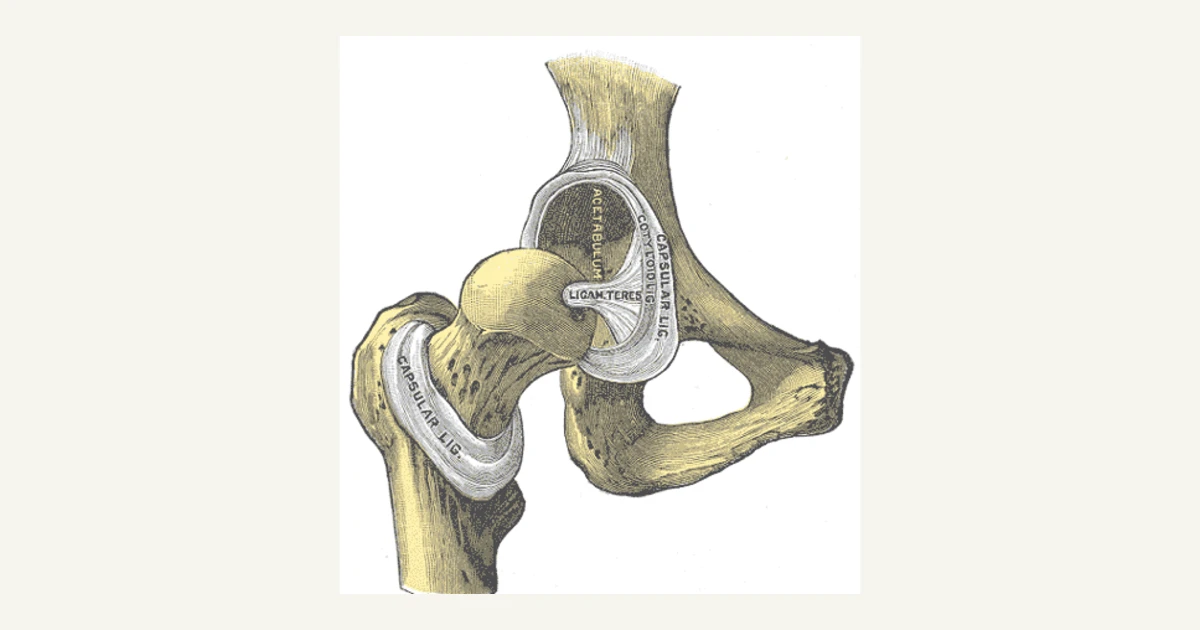
A hip labral tear is a tear in the ring of cartilage that rims the hip socket. Most come from the hip bone shape (femoroacetabular impingement) plus years of squatting, kicking or deep flexion, not one injury. The tear does not heal, but the pain depends on how the hip is loaded, which physiotherapy changes before any surgery decision.1,2
Key takeaways
- The pain is a deep pinch in the front of the hip or groin, often with catching or clicking, worst in deep flexion: squatting, sitting low, getting out of a car, pigeon pose.
- Labral tears show up on MRI in most adults who have no hip pain at all. The scan explains the pinch only when the examination agrees with it.
- “Physio first” means three months of changing how the hip is loaded and building the gluteal and deep hip muscles, with range and strength measured at the start and at each review, not heat and a clamshell sheet.
- In the largest trial, people treated with physiotherapy and people treated with arthroscopy both improved at one year; the arthroscopy group improved more on average. The decision is the surgeon’s and yours, made with the physiotherapy done.
- After an arthroscopy, the gluteal muscles that were switched off before the operation are the slow part. That recovery has its own program.
First, the signs that mean a doctor, not this page
- Call 995 if you cannot get up after a fall and the leg looks shorter or turned outward, or if hip pain came on with chest pain, breathlessness or a hot swollen calf.
- Go to the emergency department now if the hip is hot and you have a fever and cannot put weight on it, if the hip gave way or locked after an accident and will not move, or if groin or hip pain came with numbness around the buttocks or genitals or a change in bladder or bowel control.
- See a doctor the same day for a teenager with hip, thigh or knee pain and a limp; for a sudden inability to bear weight with no injury; or for groin pain with a new lump that gets bigger when you cough.
- See a doctor soon for night pain that no position changes; for weight loss, fever or a history of cancer; for deep groin pain if you have taken steroid medication for months or drink heavily, since the ball of the hip can lose its blood supply; for pain in both hips; for pain spreading into the abdomen or testicle; or if nothing has changed after six weeks of a proper plan.
None of these? Then the rest of this page is for you.
Is it the labrum, or something else at the front of the hip?
| What it feels like | What it usually is | Who checks it first |
|---|---|---|
| A deep pinch in the front of the hip or groin, often shown with a cupped hand around the hip (the C sign). Catching or clicking. Worst squatting, sitting low, getting out of a car, crossing the leg, pigeon pose. Builds with sitting | A labral tear, usually with femoroacetabular impingement: a cam bump on the ball, a deep socket, or both | A physiotherapist tests it. MRI and the decision on arthroscopy are a surgeon’s |
| Sharp pain at the crease of the hip with sprinting, kicking or lifting the knee, tender to press | A hip flexor strain | A physiotherapist |
| Pain on the outside of the hip, lying on that side, stairs, standing on one leg | Gluteal tendinopathy, sometimes with bursitis | A physiotherapist |
| Deep groin ache, over 50, stiff in the morning, losing the ability to turn the leg in, difficulty with socks | Osteoarthritis of the hip | A physiotherapist. An X-ray is a doctor’s |
| A click or clunk at the front or side of the hip with no pain | Snapping hip: a tendon flicking over bone. Usually needs nothing | A physiotherapist if it starts to hurt |
| Pain that starts in the back or buttock and runs down the leg, worse sitting or bending | A nerve root irritated in the lower back | A physiotherapist. A doctor if there is weakness |
Why the MRI is not the whole story
In a study that scanned the hips of 45 adults with no hip pain, average age 38, 69 percent had a labral tear on MRI.3 That number matters to you in two ways. The tear on your report may be twenty years old and have nothing to do with the pinch that started in March. And removing or repairing it is not the same as removing the pain, which is why surgeons ask for physiotherapy first and why the examination, not the scan, decides what the problem is. The tear is painful when the hip is repeatedly pushed into the positions where the ball and socket collide, with the muscles that should control that collision too weak or too late to stop it. Those two things, the positions and the muscles, are what three months of physiotherapy changes.
What “try physio first” should involve
It is a program, with measures, not a course of heat. At the start: pain and function scored on a questionnaire built for this hip problem (the iHOT-12 or HAGOS); hip flexion, internal rotation and abduction measured both sides; the impingement test (hip bent, pushed in and across) recorded as positive or negative; gluteal, deep rotator and hip flexor strength measured side to side; and a single-leg squat or step-down watched for the knee falling in and the pelvis dropping. Then the work, in three parts. The positions that pinch come out for now: deep squats, low chairs, pigeon pose, the leg crossed. The gluteal muscles, the deep rotators and the trunk are loaded, a little more each week, so the hip is held in the socket rather than driven into its rim. And the way you move is changed where it feeds the pinch: how you sit, stand up, squat, kick. The trial program that stands behind this ran six to ten appointments over three to six months.2 Every measure is retaken at each review, and at the three-month surgeon review you arrive with numbers, not an impression.
One correction while you are here: stretching the front of a hip that pinches in deep flexion usually makes the pinch worse, because the stretch drives the ball into the same corner of the socket. Hip flexor stretching helps a strained hip flexor. It is not the plan for an impinging hip.
Surgery or not: what the trial found
The largest trial to date, in the United Kingdom, randomized 348 people with femoroacetabular impingement, most with labral tears, to hip arthroscopy or to a structured physiotherapy program. At one year both groups had improved. The arthroscopy group had improved more on average, by about seven points on a 100-point hip score, and a proportion of the physiotherapy group had gone on to surgery.2 Read plainly: physiotherapy done properly gets a good share of people to a hip they can live with, surgery gets a further share, and neither is a failure of the other. What the trial cannot tell you is which group you are in, and the only way to find out is to do the physiotherapy part properly and measure it. If you then choose the operation, you go into it with stronger gluteals, which is the part of the recovery that takes longest afterward.
If you have had the arthroscopy
The labrum has been repaired or trimmed and the bone reshaped; what is left is the hip you brought into the operation, minus the pinch and plus the crutches. The gluteal muscles were switched down for months before the surgery and do not switch back on because the labrum was repaired. Week ten with the crutches gone and a hip that still cannot sit through a meeting is the common place to stall. That recovery runs as its own program, the Hip Arthroscopy and FAI Recovery Program, on the surgeon’s protocol, with the four stages and what moves you up set out on that page.
Three months since the surgeon said “physio first”, and the hip still pinches getting out of the car
The thinking goes: physio was the formality before the real fix.
So you did it as a formality. Heat, some ultrasound, a sheet of clamshells you did for a fortnight. The pinch is still there an hour into every meeting. You stand up out of the Grab in two stages. The barbell squat went in August, the yoga class in September, and you have started choosing the bar stool because the low sofa is a trap. The surgeon review is in four weeks and you are going to walk in with the same pinch and nothing to show for the twelve weeks, which means the only thing left on the table is the operation.
The three months did nothing because nothing in them loaded the muscles or changed the positions. Heat does not hold a femoral head in a socket. A clamshell for two weeks does not build a gluteal that has been off for a year. The hip that stops pinching is the one whose deep rotators and gluteals have been trained for twelve weeks, measured, and whose owner has stopped driving it into the corner twenty times a day. Twelve weeks of the formality has told you what the formality does.
Has anyone measured how far your hip turns in against the other side? Tested your gluteal strength with a number on it? Watched you squat on one leg? Asked which positions pinch and taken them out? Retested any of it at week six? If not, the three months the surgeon asked for have not happened yet, whatever the calendar says.
What a physiotherapist does with it
Finding the real problem is half the battle. Treating it is the other half.
At the Assessment & Treatment, a physiotherapist asks where it pinches and what brings it on, in your words, then tests what the MRI cannot: the impingement test and the other provocation tests; hip flexion, rotation and abduction measured both sides; gluteal, deep rotator and hip flexor strength, side to side; the single-leg squat and step-down; the lower back and the sacroiliac joint, because both refer here; and how you walk. If the pattern points to a stress fracture, a hip that has lost its blood supply, a hernia or anything in the doctor list, we say so and write to your doctor. Scans, injections and the decision on arthroscopy are a surgeon’s.
If it is an impinging hip with a labral tear, most of the 45 minutes is treatment: hands-on work for the stiff back of the hip capsule, the positions that pinch taken out and replaced, and the first week of the gluteal and deep rotator loading, measured so the next review has something to compare. You leave knowing which stage you are in, what is driving the pinch, a written plan, and, if you want it, a one-page summary of the measures for your surgeon review. The page on hip impingement covers the bone shape in more detail, hip pain, where it hurts sorts the other causes, and physiotherapy for hip pain covers the full program.
Every appointment is one to one with your physiotherapist for the full 45 minutes, at five clinics: Orchard, Tampines, Serangoon, Tanjong Pagar and Jurong East. Bring the MRI report and the surgeon’s letter.
Questions about hip labral tears
Can a hip labral tear heal without surgery?
The torn labral tissue itself does not heal, because it has almost no blood supply. The pain can settle without surgery, because it depends on how the hip is loaded rather than on the tear alone. A structured physiotherapy program that builds the gluteal and deep hip muscles and takes out the positions that pinch is the usual first treatment, with surgery considered if it does not do enough.
Do I need surgery for a hip labral tear?
Not necessarily. In the largest trial comparing hip arthroscopy with a structured physiotherapy program, both groups improved at one year, with the arthroscopy group improving more on average. Most surgeons ask for three months of physiotherapy first and decide on arthroscopy with those results in hand. The decision is the surgeon’s and yours.
What does a hip labral tear feel like?
A deep pinch or ache in the front of the hip or groin, sometimes shown with a cupped hand around the hip, often with catching, clicking or a feeling of the hip giving way. It is worst in deep bending: squatting, sitting in low chairs, getting out of a car, crossing the leg, and it tends to build the longer you sit.
What should I avoid with a hip labral tear?
For now, the positions that drive the ball of the hip into the torn rim: deep squats, low chairs, sitting with the leg crossed, pigeon pose and similar deep hip stretches, and kicking or pivoting on that leg. These are set aside while the muscles that control the hip are built, then reintroduced in stages, not banned for life.
How long is recovery after hip arthroscopy for a labral tear?
Typical ranges run from two to six weeks on crutches, three to four months to return to running, and four to six months or more for sport that involves cutting and kicking, with the surgeon’s protocol taking precedence. The slow part is usually gluteal strength, which was reduced before the operation. The Hip Arthroscopy and FAI Recovery Program sets out the stages.
Can I still exercise with a hip labral tear?
Yes, and you should. Cycling with the seat high, swimming without breaststroke kick, upper-body training and hip strengthening that stays out of deep flexion are usually fine from the start. Running, squatting and sport are brought back in stages as hip strength and control are measured and improve.
Four weeks to the surgeon review, and the hip still pinches getting out of the car? Get Assessed & Treated, and leave knowing whether the tear is the problem or the passenger, what the hip measures today, and what the next stage asks of it.
Sources: 1. Griffin DR, Dickenson EJ, O’Donnell J, et al. The Warwick Agreement on femoroacetabular impingement syndrome (FAI syndrome): an international consensus statement. Br J Sports Med. 2016;50(19):1169-1176. 2. Griffin DR, Dickenson EJ, Wall PDH, et al. Hip arthroscopy versus best conservative care for the treatment of femoroacetabular impingement syndrome (UK FASHIoN): a multicentre randomised controlled trial. Lancet. 2018;391(10136):2225-2235. 3. Register B, Pennock AT, Ho CP, Strickland CD, Lawand A, Philippon MJ. Prevalence of abnormal hip findings in asymptomatic participants: a prospective, blinded study. Am J Sports Med. 2012;40(12):2720-2724.
For impingement or a labral repair at the hip, the gluteal muscles were switched down long before the operation. See the Hip Arthroscopy and FAI Recovery Program, which sets out the four stages and what moves you up.
Where are you with this right now?
1. It is settling on its own
A hip that started pinching after one heavy week of squats or a long drive often settles over a few weeks once the deep positions are eased off. If you are sitting longer this month than last, and the catching is rarer, it is on the normal course. You do not need us for this, and we would rather say so.
2. It has stopped improving
You stand up out of the car in two stages. The low sofa is a trap. The squat rack and the yoga mat have been quiet since the summer.
Pain is the first thing to leave. Movement and strength are the last things trained back, and most people stop before that part is done. That is the gap worth measuring, and it is not measured by how you feel on the day.
The Stalled Recovery Review is three appointments over three weeks with the same therapist, because what a joint does under load cannot be read in one visit. The first finds what is limiting it. The next two measure how it responds. $690, nett, no GST, which is three appointments at $230.
3. You have had surgery, or you have a date
Recovery after an operation has a shape, and knowing which stage you are in tells you whether you are on it. If you have had a hip arthroscopy, see the Hip Arthroscopy and FAI Recovery Program. For any other operation, see all the recovery programs, hand and physiotherapy.
All of it runs on the same four stages. The Phoenix Recovery Protocol explains what each stage works on and what you have to meet to move up. No referral needed to start.
Next step
Find out which stage you are in
Pain is the first thing to leave. Movement and strength are the last things trained back, and most people stop before that part is done. One Assessment and Treatment is a single 45-minute appointment at $230, nett, no GST. Your therapist finds what is actually limiting you, treats it in the same appointment, and you leave with your current stage and a written plan.
Prefer to phone? Each of our five clinics has its own number on the clinics page. No referral needed to book.
Related reading
- Hip Pain in Singapore: Where It Hurts Tells You What Is Wrong
- Hip impingement (FAI) physiotherapy
- Hip Flexor Strain: Where It Hurts, What Else It Could Be, and What Helps
- Groin Pain: Strain, Hip, Hernia or Something Else, and What Helps
- Snapping Hip: Which Kind It Is, and When a Click Needs Attention
- Physiotherapy for Osteoarthritis of the Hip: What Helps, and a Home Plan
- Hip Arthroscopy and FAI Recovery Program
- Physiotherapy for Hip Pain
- The Stalled Recovery Review: three appointments, one a week
- The Phoenix Recovery Protocol, and the four stages
- All recovery programs, hand and physio
Where we are
Clinics across Singapore
ORCHARD
400 Orchard Road #12-12
Orchard Towers, S238875
NS22 Orchard MRT
Physiotherapy and hand therapy in Orchard →
WhatsApp 8800 1830TAMPINES
9 Tampines Grande #01-20
Asia Green, S528735
EW2DT32 Tampines MRT
Physiotherapy and hand therapy in Tampines →
WhatsApp 8780 9608SERANGOON
265 Serangoon Central Drive #04-269
S550265 · Lift C only
NE12CC13 Serangoon MRT
Physiotherapy and hand therapy in Serangoon →
WhatsApp 8892 4121TANJONG PAGAR
10 Anson Road #02-77A
International Plaza, S079903
EW15 Tanjong Pagar MRT
Physiotherapy and hand therapy in Tanjong Pagar →
WhatsApp 8227 7074JURONG EAST
2 Venture Drive #02-02
Vision Exchange, S608526
NS1EW24 Jurong East MRT
Physiotherapy and hand therapy in Jurong East →
WhatsApp 8242 7340What our patients say
Google reviews from our clinics in Singapore.


