

Written by Zita Sham, Fairuuz Saleh and Shiv Mohan Banka, Principal Physiotherapists at Phoenix Rehab.Clinically reviewed by Louise Yow, Principal Physiotherapist & Director, AHPC A1300363H.Last reviewed 28 September 2026.
Medically known as metatarsophalangeal (MTP) joint sprain, turf toe is an injury to the main joint of the big toe.
This injury occurs when the big toe is forced into an extreme position of hyperextension (where the toe moves back towards the top of the foot past its normal range of motion).
It happens moreso in sports and athletic environments, particularly in football, such as when an athlete pushes off to sprint or is tackled with the front of the foot fixed and jammed into the ground, causing the toe to get stuck or caught in a hyperextended position.
The good news is that in most cases, a turf toe injury does not require surgery and can be treated effectively by our senior physiotherapists.
WHAT IS TURF TOE?
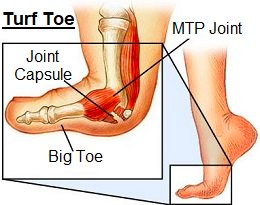
There are two joints in the big toe.
These joints allow the big toe to move in an upward motion and bend in a downward motion. Our big toe plays a significant role in our ability to walk and run; when the foot touches the ground and prepares to take another step, the big toe is the last joint through which the foot pushes off to move the body forwards.
The primary joint that this motion occurs through is the metatarsophalangeal joint, where the metatarsal, the first long, straight bone of the foot, attaches to the phalange, the first shorter bone of the toe.
If the big toe is forced into an extremely unnatural position, the MTP joint and surrounding structures may be injured. These structures may include:
- ligaments
- muscle tendons
- the small bones that sit under the big toe, called the sesamoid bones.
All of these structures play a role in maintaining the integrity and function of the MTP joint; they are often grouped together and termed the plantar complex. Sometimes, one of the soft-tissue structures is simply stretched when the toe is bent back towards the top of the foot.
However, a turf toe injury may involve
- a subluxation (where one bone of the joint slips out of place, but comes back to its normal position)
- or a dislocation (where the two bones of the joint are completely separated)
HOW DOES IT FEEL?
The most common symptoms associated with a turf toe injury are:
- Localized pain at the MTP joint
- Feeling a “pop” at or around the MTP joint at the time of the injury
- Swelling
- Bruising
- Tenderness to touch
- Cramping in the arch of the foot
- In more severe injuries, a disfiguring of the MTP joint (as in a dislocation)
HOW IS IT DIAGNOSED?
Turf toe injuries are typically classified into grades 1 to 3 to describe the severity of the injury and to guide treatment:
- Grade 1: stretching of the plantar complex
- Grade 2: partial tearing of the plantar complex
- Grade 3: complete tearing of the plantar complex.
Diagnosis of a turf toe injury starts with an interview to learn the mechanism of injury and your symptoms.
Our senior physiotherapists will perform a gentle clinical examination to assess the toe’s movement and muscle function as well as to note any swelling or tenderness in the area. We may ask you if you are able to walk on your foot and if so, will analyze your gait pattern.
If we suspect a fracture of one of the bones or a tearing of the muscle-tendon unit, then we may refer you to an orthopedic physician who specializes in foot and ankle injuries for diagnostic imaging (i.e., x-ray, MRI).
HOW OUR SENIOR PHYSIOTHERAPISTS CAN HELP YOU
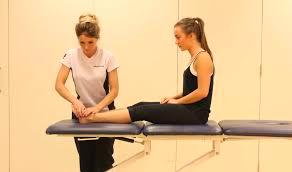
Immediately following a turf toe injury, the RICE protocol is recommended: Rest, Ice, Compression, and Elevation (Refer to our RICER article on immediate treatments post injuries).
The goal of the RICE protocol is to
- decrease pain
- decrease swelling
- protect the joint from further injury
until it can be more thoroughly assessed. Most turf toe injuries do not require surgery and are treated with physical therapy.
The physiotherapy treatments depends on the severity of the injury.
Grade 1
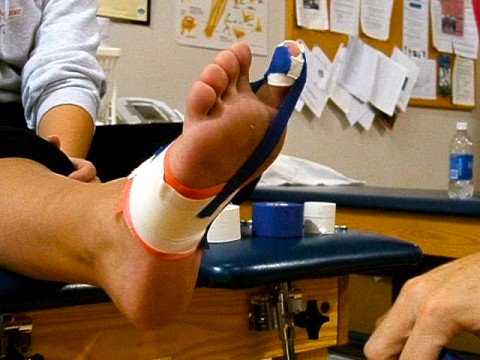
To treat a Grade 1 injury, we may use narrow athletic tape to immobilize your big toe with your second toe to restrict painful motion. We may also place a firm insert in your shoe to limit motion and promote healing.
In many cases, an athlete may be able to return to sport soon after a Grade 1 injury.
Grade 2
Treating Grade 2 injuries may require immobilizing the foot in a brace or walking boot, and allowing several weeks of rest.
Grade 3
Treatment of Grade 3 injuries is dependent on the severity of the damage to the structures of the foot. Surgery may be required if there is
- a fracture of a bone
- damage to the cartilage (the tissue that lines the bones of the joints)
- a complete tearing of the tendon
- excessive movement of the joint that causes repetitive instability (subluxation or dislocation).
In each case, our senior physiotherapists will work with you to design an individualized treatment program specific to the nature of your condition and your goals. Treatment may include:
Range of Motion Exercises
It is important to regain a full range of motion of your big toe. Your motion may be limited after a turf toe injury, particularly one that requires immobilization in a brace or boot.
We will teach you gentle stretching exercises to help regain motion.
Muscle Strengthening
It is common to lose strength in the muscles of your leg, particularly around your foot and ankle, after a turf toe injury due to the limited weight-bearing and activity that is required to allow the injury to heal.
We will determine which muscles are weak and teach you specific exercises to treat them, such as strengthening with
- resistance bands
- balance activities
- functional activities, like stair climbing.
Manual Therapy
Our senior physical therapists in Phoenix Rehab use manual (hands-on) therapy to gently move and manipulate muscles and joints to improve their motion and strength. These techniques can target areas that are difficult to treat on your own.
Manual therapy can be especially effective for joints that become stiff following immobilization. With a turf toe injury, we will use different techniques to mobilize your big toe as well as the other joints of your foot and ankle that may have become stiff during your recovery.
What our patients say
Google reviews from our clinics in Singapore.



Patient Education
We will educate you on the dos and don’ts following a turf toe injury to ensure that your recovery is a smooth one.
We will work with you to develop an individualized rehabilitation program, including expected timelines and goals to give you a roadmap for your return to full activity.
Pain Relief
We may use pain relief modalities such as
- ultrasound therapy
- radio-frequency Indiba physiotherapy
- cold therapy
- heat therapy
- customized splinting
Where are you with this right now?
1. It is settling on its own
Foot and ankle problems are slow but usually very treatable. Months rather than weeks is normal, and improvement is judged over a month, not a day. If the first steps in the morning are easier than they were four weeks ago, you are on the right road. You do not need us for this, and we would rather say so.
2. It has stopped improving
The first ten steps out of bed are still the worst part of the day. You choose shoes by how long you will be standing. You still look at the ground when you walk.
Symptoms settle well before the tissue has rebuilt its capacity, which is why stopping the loading work early is the most common reason this drags on for years. That is the gap worth measuring, and it is not measured by how you feel on the day.
The Stalled Recovery Review is three appointments over three weeks with the same therapist, because what a joint does under load cannot be read in one visit. The first finds what is limiting it. The next two measure how it responds. $690, nett, no GST, which is three appointments at $230.
3. You have had surgery, or you have a date
Recovery after an operation has a shape, and knowing which stage you are in tells you whether you are on it. See the recovery programs, or ankle physiotherapy if you are not sure which applies to you.
All of it runs on the same four stages. The Phoenix Recovery Protocol explains what each stage works on and what you have to meet to move up. No referral needed to start.
Next step
Find out which stage you are in
Pain is the first thing to leave. Movement and strength are the last things trained back, and most people stop before that part is done. One Assessment and Treatment is a single 45-minute appointment at $230, nett, no GST. Your therapist finds what is actually limiting you, treats it in the same appointment, and you leave with your current stage and a written plan.
Prefer to phone? Each of our five clinics has its own number on the clinics page. No referral needed to book.
Related reading
- physiotherapy after surgery
- ankle physiotherapy
- Lisfranc Injury: The Midfoot Injury That Gets Called a Sprain
- Heel Pain: When The First Few Steps Out Of Bed Are The Worst Part Of Your Day
- Your Ankle Stopped Hurting. That Is Not the Same as Healed.
- The Phoenix Recovery Protocol, and the four stages
- All recovery programs, hand and physio
- Peroneal Tendonitis Exercises to Relieve Your Pain
Where we are
Clinics across Singapore
ORCHARD
400 Orchard Road #12-12
Orchard Towers, S238875
NS22 Orchard MRT
Physiotherapy and hand therapy in Orchard →
WhatsApp 8800 1830TAMPINES
9 Tampines Grande #01-20
Asia Green, S528735
EW2DT32 Tampines MRT
Physiotherapy and hand therapy in Tampines →
WhatsApp 8780 9608SERANGOON
265 Serangoon Central Drive #04-269
S550265 · Lift C only
NE12CC13 Serangoon MRT
Physiotherapy and hand therapy in Serangoon →
WhatsApp 8892 4121TANJONG PAGAR
10 Anson Road #02-77A
International Plaza, S079903
EW15 Tanjong Pagar MRT
Physiotherapy and hand therapy in Tanjong Pagar →
WhatsApp 8227 7074JURONG EAST
2 Venture Drive #02-02
Vision Exchange, S608526
NS1EW24 Jurong East MRT
Opening 25 October 2026
Physiotherapy and hand therapy in Jurong East →
WhatsApp 8242 7340