
Written by Zita Sham, Principal Physiotherapist at Phoenix Rehab, AHPC A1302159H.Clinically reviewed by Louise Yow, Principal Physiotherapist & Director, AHPC A1300363H.Last reviewed 8 October 2026.
A pulled calf muscle, or calf strain, is muscle fibers in the calf stretched beyond their limit or torn, most often in the gastrocnemius, on a push-off. For the first two days, stop, ice it, wrap it and raise it. A pop at the back of the ankle and no tiptoe on that leg means the emergency department.
Key takeaways
- A pulled calf muscle, or calf strain, is muscle fibers in the calf stretched beyond their limit. It most often affects the gastrocnemius, and sometimes the soleus underneath it.
- Pain when the calf is tested with the knee straight points to the gastrocnemius. Pain only with the knee bent points to the soleus.
- For the first two days: ice for 15 to 20 minutes every few hours, an elastic bandage, the leg raised, and no heat.
- A grade I strain typically heals within 7 to 10 days, a grade II takes 2 to 6 weeks, and a grade III can take several months.
- A pop at the back of the ankle and no tiptoe on that leg alone needs the emergency department now. A swollen, warm, red calf with no strain moment needs a doctor the same day.
- Running comes back when calf raises and hops on that leg measure up against the other side, not on a date.
What is a pulled calf muscle?
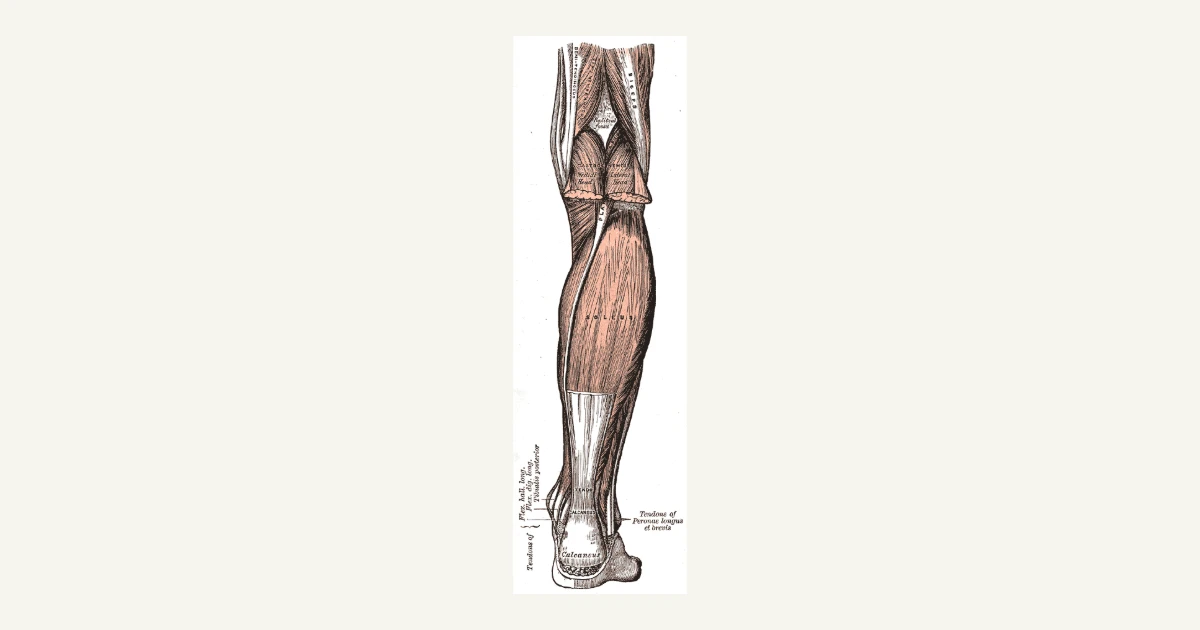
A pulled calf muscle, also referred to as a calf strain, happens when the muscle fibers in your calf are stretched beyond their limit, often due to a sudden or forceful movement. This kind of strain typically affects the gastrocnemius, the prominent muscle you can feel at the back of your lower leg. However, it may also involve the soleus, the broad, flat muscle that lies deeper in the calf.
Three muscles share the back of the lower leg. The gastrocnemius has two heads, inner and outer, and crosses both the knee and the ankle. The soleus lies underneath and crosses only the ankle. The plantaris is a small muscle with a long, thin tendon that runs between the two. All of them pull on the heel through the Achilles tendon.
The gastrocnemius muscle is particularly vulnerable due to its position crossing both the knee and the ankle, making it more susceptible to strains from rapid extension.
Tennis leg
Tennis leg is the common name for a tear of the inner (medial) head of the gastrocnemius, where the muscle joins its tendon in the middle of the calf. The inner head tears more often than the outer one.1 It shows up most in middle-aged players, on a lunge for a short ball with the back knee straight and the ankle bent up. People describe it as a ball hitting the calf, or a kick from behind, and they turn round to see who did it. A plantaris tear gives a similar story and is less common.
The grades
This type of injury can range from mild overstretching to severe muscle tears, depending on the severity. Calf muscle strain injuries are classified in grades:
- Grade I: Mild discomfort, minimal loss of strength or movement
- This involves minor damage to the muscle fibers, with the muscle stretched and pulled but not completely torn.
- Grade II: Moderate pain and swelling, reduced strength and range of motion
- This involves a partial tear, with some muscle fibers remaining intact.
- Grade III: Severe pain, possible muscle rupture, and significant loss of function
- This involves a complete tear or rupture of the muscle.
Straight knee or bent knee: which muscle is it?
A physiotherapist tests the calf twice: once with the knee straight, which works the gastrocnemius, and once with the knee bent, which works the soleus.1 Pain on the straight-knee test points to the gastrocnemius, in the middle or upper calf. Pain only on the bent-knee test points to the soleus, lower and deeper, toward the Achilles. Soleus strains in runners often build over the second half of a run rather than arriving with one sharp stab.
How can I tell if my calf is strained?
The symptoms of a pulled calf muscle can range from mild to severe, depending on how badly the muscle fibers are damaged. In a mild strain, you may feel tightness or a dull ache, while more serious cases can involve sharp pain and loss of function. Symptoms often come on suddenly during physical activity, but can also worsen over time if the muscle is repeatedly strained.
- Sudden pain in the back of the lower leg, usually during movement such as running, jumping, or pushing off the foot
- Swelling or bruising in the calf, especially around the injured area, as small blood vessels may rupture
- Difficulty walking or standing on tiptoe due to weakness or pain in the calf muscle
- A popping or snapping sensation at the time of injury, often reported in moderate to severe strains.
- Limited range of motion in the ankle or knee, the injury may restrict flexibility, particularly in movements that stretch the calf.
- Tightness or cramping in your calf, which may increase during or after activity and can persist at rest.
In some cases, a lump or knot may be felt where the muscle has torn, especially in grade 2 or 3 calf strains.
How it happens, in the order to check
1. A sprint or a push-off
A quick burst of power, such as sprinting from a standstill or taking off for a jump, can overload the calf muscle, especially if it’s not warmed up properly. Chasing a through ball. The green man starting to flash at the crossing. The bus pulling away from the stop.
2. The first run back after a break
Two weeks off for a work trip or a cold, then the usual Saturday route at the usual pace. Breathing feels fine. The calf has lost more over the break than the lungs have, and it goes on the push-off.
3. The lunge in padel, tennis, badminton or pickleball
A lunge forward for a drop shot or a short ball, the back knee straight and the ankle bent up, is the tennis leg position. Sports that require quick pivots (like football, rugby, basketball, or tennis) often put strain on the calf, especially when the foot plants firmly and the leg twists or turns sharply. This increases tension on the muscle fibers, making a strain more likely. See badminton injuries, tennis injuries and pickleball injuries. Padel loads the calf the same way on the split step and push-off, covered in the padel injuries guide.
4. Hills and stairs
Hill repeats, a steep trail, or the stairs of a block when the lift is down. Going up, the calf pushes your whole weight off the ball of the foot with the ankle bent, and it does it again on every step. Runners see this one most. See running injuries.
5. The curb step
A helpful way to think about it: your calf muscle works like a coiled spring. The more compressed or tense it is, without preparation, the more likely it is to snap under sudden force. That’s why even something as simple as pushing off the curb quickly, especially in older adults, can result in a calf strain.
Fatigue sits under all five. Tired muscles lose coordination and contractile efficiency, especially late in a long run or a long match. When your calf muscle is fatigued, it’s less able to absorb shock or adapt to unexpected loads, and a strain is more likely.
Who pulls a calf muscle?
In sports-related injuries, individuals with certain characteristics are more prone to calf muscle strains. Athletes, particularly those who perform activities involving stop-and-go movements and quick bursts of speed, like sprinters, football players, and soccer players, are at higher risk.
Pulled calf muscles are especially common among elite athletes aged 22 to 28, with men being more frequently affected.1 Calf strains also come back. A 2022 review put the recurrence rate at 19% to 31% of cases.1
Additionally, adults over 40, those with a history of previous calf strains, and those with tight or weak calf muscles are also more susceptible.
Should you walk on a pulled calf muscle?
Yes, a little, on the flat, once you know it is the muscle and not the Achilles tendon. Short walks keep the ankle moving and the calf working. Take shorter steps and let the heel land first. If you limp hard, a small heel lift in both shoes, or crutches for the first few days, takes the stretch off the tear. A walk that makes the pain climb, or a limp that grows through the day, means the walk was too long. Shorten it and keep walking.
Being able to walk does not rule out an Achilles rupture. If you felt a pop or a kick at the back of the ankle, try to rise onto your toes on that leg alone. If you cannot, do not walk it off. Go to the emergency department.
Calf strain, tennis leg, Achilles rupture, blood clot, cramp or your back?
Ask three things: was there one moment, where does it hurt, and can you rise onto your toes on that leg alone.
| Condition | How it started | What you notice | What it needs first |
|---|---|---|---|
| Calf strain (pulled calf muscle) | One moment: a sprint, a push-off, a hill, a curb step | A sudden pull or stab in the belly of the calf. A tender spot you can press. Pain rising onto the toes and on a stretch | Ice, compression and elevation, short walks, then physiotherapy |
| Tennis leg (medial gastrocnemius tear) | A lunge with the back knee straight, often in middle age | A feeling of being hit in the calf. Pain and swelling on the inner side of the calf, and bruising that tracks toward the ankle over the next days | A doctor if you cannot walk, then physiotherapy |
| Achilles tendon rupture | A pop or a kick at the back of the ankle, on a push-off or a landing | You cannot rise onto your toes on that leg alone. Sometimes a gap you can feel above the heel. You may still walk flat-footed. A clinician checks it with the Thompson squeeze test | The emergency department now |
| Achilles tendinopathy | No single moment. Builds over weeks of running or jumping | Stiff for the first steps in the morning and the first minutes of a run, in the tendon above the heel | Changes to the running load and calf loading |
| Blood clot in the calf (deep vein thrombosis) | No strain moment. Often after a long flight, an operation, a cast or boot, or days in bed | A calf that is swollen, warm, red or tender, often the whole calf, aching on its own | A doctor the same day. Call 995 with chest pain or breathlessness |
| Cramp | Late in exercise, or at night in bed | The muscle locks hard and the toes pull down. It lets go within minutes and leaves no tender spot the next day | Stretch it out. A doctor if cramps keep coming |
| Referred pain from the back (sciatica) | Back pain, long sitting, a lift | Burning, tingling or numbness running down the calf, and no tender spot in the muscle | A physiotherapist or doctor to check the back. The emergency department now with numbness between the legs or trouble passing urine |
| Acute compartment syndrome | Hours after a hard blow, a crush or a fracture | A calf that grows tighter and harder, with pain far out of proportion and worse when someone stretches your toes | The emergency department now |
Pain at the back of the knee rather than the calf has its own list. See back of knee pain.
What we measure
- Where it tore. The tender spot, its length in centimeters, and which muscle it sits in.
- Calf raises, straight knee. Single-leg calf raises to fatigue at a set pace, counted on each leg. This works the gastrocnemius.
- Calf raises, bent knee. The same with the knee bent, for the soleus.
- Ankle bend. The knee-to-wall lunge, in centimeters, against the other leg.
- Hops. Single-leg hops in place and forward, counted and measured on each leg, before running speed comes back.
- Run tolerance. How many minutes of walk-jog the calf takes, and how it feels the next morning.
Tested, not dated. Running comes back when the calf raises and hops on the injured side are within about 10% of the other side and the next morning is no worse than the one before.
What you can do this week
The first two days
The first step in calf strain treatment is RICE:
- Rest. Avoid activities that put pressure on the calf.
- Ice. Apply an ice pack to the injured area for 15 to 20 minutes every few hours.
- Compression. Use an elastic bandage to reduce swelling.
- Elevation. Keep your leg raised to minimize inflammation.
- Do not apply heat during the first two days. Heat may worsen inflammation early on. Use ice instead to reduce swelling.
- Walk short distances on the flat, with shorter steps. Use a heel lift or crutches if you limp hard.
- Pain relief and anti-inflammatory medication are a decision for your doctor or pharmacist.
After that
Once pain subsides, gentle stretching and strengthening exercises help improve flexibility in the calf muscles. Examples include towel stretches and standing calf raises. These exercises should be introduced gradually and with care.
- Walk a little further each day while the limp shrinks.
- Start calf raises on both legs, slow, one hand on the wall. Move to the injured leg alone when both legs together are easy.
- Hold the run until a brisk walk, stairs foot over foot and calf raises on that leg alone are comfortable.
How long does a pulled calf muscle take to heal?
Recovery time from a pulled calf muscle depends on the extent of the injury:
- Grade I (mild strain): Typically heals within 7 to 10 days. You may feel some tightness or discomfort, but you can usually walk with minimal pain.
- Grade II (moderate tear): Healing may take 2 to 6 weeks. Pain is more noticeable, and weight-bearing activities are likely limited during the early stages.
- Grade III (severe tear or rupture): Recovery can take several months and may require surgical repair followed by a structured rehabilitation plan.
These are typical ranges. The return to running is decided by tests, not days: calf raises, hops and a walk-jog, each measured against the other leg. The re-tear we see most comes on the first fast run or the first match back, when walking has felt normal for a while and nobody has counted the calf raises.
How can you prevent a pulled calf muscle?
- Warm up properly before exercise.
- Avoid sudden increases in training intensity.
- Come back from a break at a shorter distance and an easier pace than you left at.
- Keep the calf itself strong: single-leg calf raises with the knee straight and the knee bent, two or three times a week, through the season.
- Strengthen supporting muscles, including the hamstrings and glutes.
- Wear supportive footwear.
Is this normal?
Usually expected: bruising that shows a day or two later and slides down toward the ankle and the heel. Stiffness on the first steps out of bed and after sitting. A tender lump in the muscle where it tore. A calf that tires sooner than the other one for some weeks after the pain has gone.
Worth getting checked: a limp that has not changed in a week. A calf that pulls at the same spot each time you try to run. Pain at night or at rest that is growing. Calf pain that comes on after walking a set distance and eases when you stop, especially if you smoke or have diabetes.
When to see a doctor first
- Call 995 if your calf is swollen and painful and you have chest pain, sudden breathlessness, or you cough up blood.
- Go to the emergency department now if you felt a pop or a kick at the back of the ankle or low in the calf and now cannot rise onto your toes on that leg alone, or you can feel a gap above the heel, even if you can still walk. The Achilles tendon may have torn, and the decision on a boot or an operation is made early. Also go now for a calf that grows tighter and harder hour by hour after a blow, a crush or a fall, with pain far out of proportion to the injury, pain when the toes are stretched, or tingling or numbness in the foot. Also if you cannot take any weight on the leg after a fall or a blow, if the foot turns cold, pale or blue, or if back pain and leg pain come with numbness between the legs or new trouble passing urine.
- See a doctor the same day if the calf is swollen, warm, red or tender with no strain moment, especially after a long flight, an operation, a cast or boot, or days in bed. A blood clot needs ruling out. Also the same day for a pop in the middle of the calf with a large swelling, when you cannot walk without a heavy limp.
- See a doctor soon if the limp has not changed in a week, pain at rest is growing, the calf keeps tearing at the same spot, calf pain comes on after walking a set distance and eases when you stop, or tingling runs down the calf from the back.
Calf strain treatment: who does what
- A doctor (your GP, a polyclinic doctor, a sports doctor or the emergency department) examines the calf, rules out an Achilles rupture and a blood clot, decides whether you need an ultrasound, an MRI or a Doppler scan, and decides about medication.
- An orthopedic surgeon sees the rare complete tear and the Achilles rupture, and decides between a boot and an operation.
- A physiotherapist works out which muscle and which grade, measures the calf against the other leg, treats the stiffness and the swelling, and loads the calf back in stages to running and sport.
For moderate to severe calf muscle strains, your healthcare provider may recommend using a compression wrap or walking boot to immobilize the muscle during the initial recovery stage.
The four stages, applied to a calf
In the Phoenix Recovery Protocol the work starts at Calm & Protect: the ice, the bandage and the raised leg, short walks on the flat, and a heel lift or crutches if you limp. Move & Mobilize gets you walking without the limp, takes the ankle bend back toward the other side, and has you on the stairs foot over foot. Rebuild & Strengthen loads the calf from two legs to one, with the knee straight and the knee bent, then adds hops. Return & Perform tests the tasks themselves: the walk-jog, the hill, the sprint, the lunge on court, the push-off for the bus. The measures set the pace.
Where are you with this right now?
1. It is settling on its own
You walk to the MRT without the limp. The bruise has gone from purple to yellow. Stairs are foot over foot again, and the calf raises on that leg get easier each week. That is a calf strain behaving as expected. You do not need us for this, and we would rather say so.
2. It has been weeks, and the calf still is not right
Six weeks ago it went on the hill loop with the run club: a stab halfway up, as if someone had flicked a stone at your calf. You walked home.
What our patients say
Google reviews from our clinics in Singapore.


You still take the stairs at the MRT one at a time, and the escalator when there is one. The first step out of bed is stiff and careful. The run club route passes your block on Saturday mornings, and you have stopped answering the group chat. The 10 km you entered is next month.
It feels fine walking, so it must be healed. You tried a jog in week three, and it grabbed at the same spot inside a kilometer. Every jog since has stopped at that spot.
Walking does not hurt. Has anyone counted your calf raises against the other side?
If the calf is swollen, warm or red, or you felt a pop at the back of the ankle, see a doctor first. If a doctor has ruled those out, or you never needed one, one Assessment & Treatment with a physiotherapist tests the calf with the knee straight and bent, counts calf raises and hops against the other leg, treats what is limiting you in the same visit, and tells you which stage you are in.
3. A complete tear, an Achilles rupture, or an operation
Few calf strains need a surgeon. A complete tear of the muscle, or an Achilles rupture, goes to an orthopedic surgeon, who decides between a boot and an operation. After an Achilles rupture, see the Achilles Rupture Recovery Program and physiotherapy after surgery. Your surgeon’s protocol takes precedence.
If it is months on and you still cannot run, or the calf keeps tearing at the same spot, the Stalled Recovery Review is three weeks with the same physiotherapist. The first visit measures the calf, the ankle bend, the hops and your run. The next two measure how they respond. See all recovery programs, hand and physio.
All of it runs on the same four stages. The Phoenix Recovery Protocol explains what each stage works on and what you have to meet to move up. No referral needed to start.
Next step
Find out which stage you are in
Pain is the first thing to leave. Movement and strength are the last things trained back, and most people stop before that part is done. One Assessment and Treatment is a single 45-minute appointment at $230, nett, no GST. Your therapist finds what is actually limiting you, treats it in the same appointment, and you leave with your current stage and a written plan.
Prefer to phone? Each of our five clinics has its own number on the clinics page. No referral needed to book.
Related reading
Sources: 1. Meek WM, Kucharik MP, Eberlin CT, Naessig SA, Rudisill SS, Martin SD. Calf strain in athletes. JBJS Rev. 2022;10(3):e21.00183.
Where we are
Clinics across Singapore
ORCHARD
400 Orchard Road #12-12
Orchard Towers, S238875
NS22 Orchard MRT
Physiotherapy and hand therapy in Orchard →
WhatsApp 8800 1830TAMPINES
9 Tampines Grande #01-20
Asia Green, S528735
EW2DT32 Tampines MRT
Physiotherapy and hand therapy in Tampines →
WhatsApp 8780 9608SERANGOON
265 Serangoon Central Drive #04-269
S550265 · Lift C only
NE12CC13 Serangoon MRT
Physiotherapy and hand therapy in Serangoon →
WhatsApp 8892 4121TANJONG PAGAR
10 Anson Road #02-77A
International Plaza, S079903
EW15 Tanjong Pagar MRT
Physiotherapy and hand therapy in Tanjong Pagar →
WhatsApp 8227 7074JURONG EAST
2 Venture Drive #02-02
Vision Exchange, S608526
NS1EW24 Jurong East MRT
Opening 25 October 2026
Physiotherapy and hand therapy in Jurong East →
WhatsApp 8242 7340