
Written by the Phoenix Rehab physiotherapy team.Clinically reviewed by Louise Yow, Principal Physiotherapist & Director, AHPC A1300363H.Last reviewed 3 November 2026.
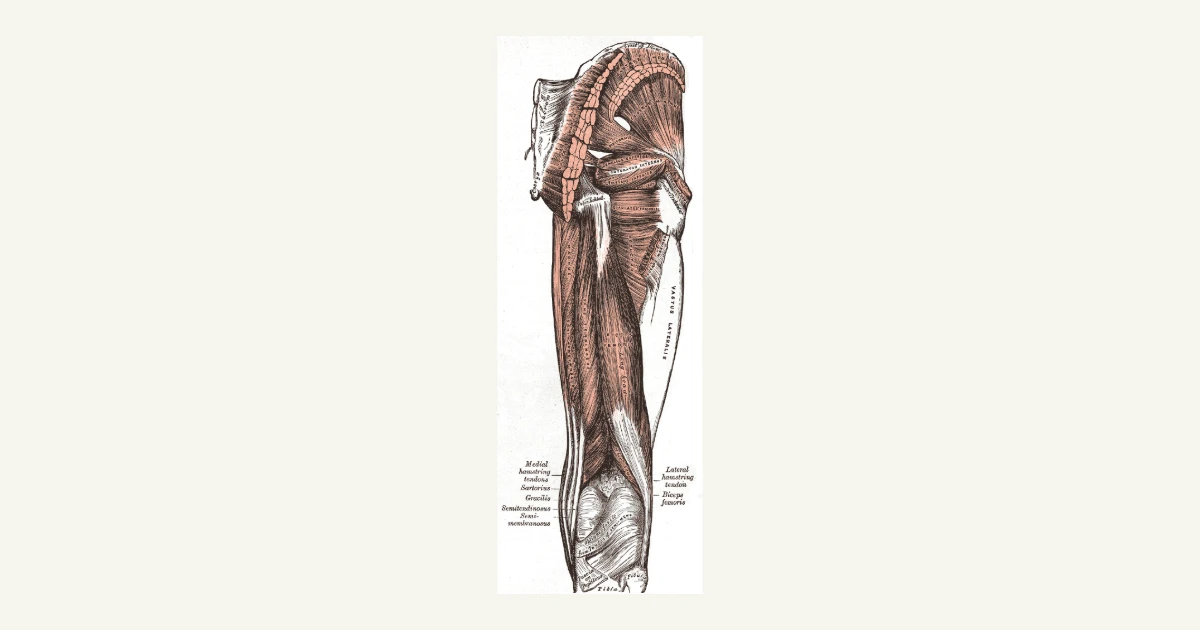
A pulled hamstring is a strain or tear in one of the three muscles at the back of the thigh, usually while sprinting, kicking or reaching into a split. Mild strains often settle in one to three weeks; partial tears take three to eight weeks or more. The pain usually goes first. The strength at full stretch, at speed, is the last thing to come back, and that is where most re-injuries happen.
How do I know if I pulled my hamstring?
A sudden sharp pain or a pop at the back of the thigh mid-sprint or mid-kick, then a limp. It hurts to bend the knee against resistance and to stretch the leg straight in front of you. Bruising can track down the back of the thigh over a few days. Where it hurts, and how it happened, changes the plan.
| How it happened | Where it usually is | What to know |
|---|---|---|
| Sprinting, in the last strides at top speed | The middle of the back of the thigh, usually the outer muscle (biceps femoris) | The most common type. Usually back running in weeks |
| A slow stretch into a split, a high kick or a slip | High up, close to the sit bone | Often feels milder than a sprint strain and often takes longer3, because the tendon is involved |
| A pop at the sit bone, bruising down the thigh, trouble walking | Where the tendon attaches to the sit bone | The tendon may have pulled off the bone. See a doctor the same day |
Pain at the back of the thigh with no single moment behind it is sorted in thigh pain.
How long does a pulled hamstring take to heal?
| Grade | What it means | Usually back to running |
|---|---|---|
| Grade 1 | Overstretched fibers, little loss of strength | About one to three weeks |
| Grade 2 | A partial tear, clear weakness, a limp | About three to eight weeks |
| Grade 3 | A complete tear, or the tendon off the bone | A surgeon decides. Often three months or more |
These are typical ranges. Your doctor’s plan comes first, and the measures decide each step, not the calendar.
Is it okay to walk on a pulled hamstring?
Yes, as comfort allows, with shorter steps for the first few days. Do not stretch it hard in the first week; a fresh tear does not need pulling apart. Gentle bending and straightening within comfort is fine. Walking normally without a limp is the first thing we look for.
What our patients say
Google reviews from our clinics in Singapore.


When the tendon comes off the sit bone
The most serious hamstring injury is not a torn muscle. It is the tendon pulled off the sit bone, called a proximal hamstring avulsion. It usually happens when the hip is forced deep into a bend with the knee straight: a slip into a split on a wet floor, waterskiing, or a fall forward while the foot stays planted.4 People describe a pop high at the back of the thigh, trouble walking, pain sitting, and over the next days a bruise that spreads from the buttock toward the back of the knee. Some feel tingling or numbness down the leg, because the sciatic nerve runs right beside the tendon. A doctor confirms it, usually with an MRI, and a surgeon decides whether to repair it.
The trap is calling it a pulled hamstring and giving it a fortnight. By week three you are sitting on one side at your desk, the bruise has reached the back of the knee, and the MRT stairs are taken one at a time. In a review of 300 of these injuries, tendons repaired within four weeks did better on strength, pain, satisfaction and return to sport than those repaired later, with fewer re-ruptures.4 Late repair is still possible, but by then the tendon has pulled back and scarred near the sciatic nerve, and results are weaker on average. So the order matters: a doctor and a scan first, in the same week as the injury. A physiotherapist’s part comes after that decision, on a nonsurgical plan for a partial tear or on your surgeon’s protocol after a repair.
Sit bone pain that will not settle
A different problem with the same muscle: an ache right on the sit bone, worse sitting on a hard chair, driving, running uphill or folding forward. That is usually proximal hamstring tendinopathy, an overloaded tendon, not a tear. Stretching it often makes it worse, because the stretch squeezes the tendon against the bone. It usually settles with load built up slowly, and it takes patience: often three months or more.
Why hamstrings tear again
Re-injury is common in the first weeks back. The leg feels normal walking, jogging and even stretching. Then the first full sprint, or the first hard kick, finds the strength that was never rebuilt at long length. Pain going down means the tissue has settled. It does not mean the muscle is ready for top speed. Strength work at long length, such as the Nordic hamstring exercise, has been shown to cut hamstring injuries in football players.1
What we measure before you sprint again
- Strength. Hamstring strength measured on both legs, in more than one knee angle, including near full stretch.2
- Range. How far the leg lifts straight compared with the other side.
- Running. Speed built up in steps: jog, stride, then sprint, with the measures deciding each step.
- Sport. Kicking, cutting and the split position last.
Tested, not dated. You sprint again when the measures say so. Pain is the first thing to leave. Strength is the last to train and recover.
When to see a doctor first
- Go to the emergency department now if the thigh is swelling fast and tight, or the calf is swollen, hot and painful.
- See a doctor the same day if the foot is numb or weak, or you cannot put weight on the leg.
- See a doctor the same day for a pop at the sit bone with bruising down the thigh and trouble walking. If the tendon has come off the bone, the surgeon will want to see it early.
Where are you with this right now?
1. It is settling on its own
If you are walking without a limp, the bruise is fading and each week you can do a little more, keep going. Build up gently and do not test it with a sprint. You are probably in Stage 2 of 4.
2. It has stopped improving
Six weeks since the match. You jog fine, but you pull up at three-quarter speed because you do not trust it, and the back of the thigh still feels tight every morning. You have stretched it every day. The muscle has calmed down. Its strength at long length, on that side, has not been measured, and that is the gap.
If you were my family, I wouldn't wait. Here's why.
Strength at full stretch, at speed, is the last thing to come back, and that is where most re-injuries happen.
I wouldn't want you guessing. I'd want it measured now and the work started.
WhatsApp us · Get Assessed & Treated · One 45-minute appointment, $230, nett, no GST.
3. You have had surgery, or you have a date
After a hamstring tendon repair, the stages are set with your surgeon. See physiotherapy after surgery. All of it runs on the four stages of the Phoenix Recovery Protocol.
Related reading
Sources: 1. van der Horst N, Smits DW, Petersen J, Goedhart EA, Backx FJ. The preventive effect of the Nordic hamstring exercise on hamstring injuries in amateur soccer players: a randomized controlled trial. Am J Sports Med. 2015;43(6):1316-1323. 2. Askling CM, Tengvar M, Thorstensson A. Acute hamstring injuries in Swedish elite football: a prospective randomised controlled clinical trial comparing two rehabilitation protocols. Br J Sports Med. 2013;47(15):953-959. 3. Askling CM, Tengvar M, Saartok T, Thorstensson A. Acute first-time hamstring strains during slow-speed stretching: clinical, magnetic resonance imaging, and recovery characteristics. Am J Sports Med. 2007;35(10):1716-1724. 4. Harris JD, Griesser MJ, Best TM, Ellis TJ. Treatment of proximal hamstring ruptures: a systematic review. Int J Sports Med. 2011;32(7):490-495.
Where we are
Clinics across Singapore
ORCHARD
400 Orchard Road #12-12
Orchard Towers, S238875
NS22 Orchard MRT
Physiotherapy and hand therapy in Orchard →
WhatsApp 8800 1830TAMPINES
9 Tampines Grande #01-20
Asia Green, S528735
EW2DT32 Tampines MRT
Physiotherapy and hand therapy in Tampines →
WhatsApp 8780 9608SERANGOON
265 Serangoon Central Drive #04-269
S550265 · Lift C only
NE12CC13 Serangoon MRT
Physiotherapy and hand therapy in Serangoon →
WhatsApp 8892 4121TANJONG PAGAR
10 Anson Road #02-77A
International Plaza, S079903
EW15 Tanjong Pagar MRT
Physiotherapy and hand therapy in Tanjong Pagar →
WhatsApp 8227 7074JURONG EAST
2 Venture Drive #02-02
Vision Exchange, S608526
NS1EW24 Jurong East MRT
Physiotherapy and hand therapy in Jurong East →
WhatsApp 8242 7340