
Written by Shiv Mohan Banka, Principal Physiotherapist at Phoenix Rehab, AHPC A1302278J.Clinically reviewed by Louise Yow, Principal Physiotherapist & Director, AHPC A1300363H.Last reviewed 8 October 2026.
A locked knee is a knee that gets stuck and cannot straighten fully, most often because a torn piece of meniscus or a loose fragment is caught inside the joint. A knee that catches and then frees is usually something else. A knee locked after a twist needs a doctor the same day. Do not force it straight.
Key takeaways
- A truly locked knee stops short of straight and will not go further, even when you press it down with your hand. A torn meniscus or a loose fragment is usually in the way.
- A knee that catches, clicks or sticks for a moment and then frees is usually pseudo-locking: pain, swelling, the kneecap or tight muscles, with nothing blocking the joint.
- A knee that is locked and will not straighten needs a doctor the same day. Do not force it straight, and do not let anyone pull it.
- A locked knee with severe pain after a fall or a twist, a knee that looks deformed, or a cold, pale or numb foot needs the emergency department now.
- A doctor decides on scans and whether an operation is needed. A physiotherapist measures the straightening in degrees, the swelling and the thigh strength against the other leg.
What is a locked knee?
A locked knee cannot straighten fully, whether you try with your own thigh muscle or someone helps it. It stops short with a firm, springy block, often somewhere between 10 and 30 degrees short of straight, and it can usually still bend. Something inside the joint is in the way. Doctors call it a block to extension, and the meniscus is the most frequent cause.1
True locking vs pseudo-locking
Two different problems both get called a locked knee, and the difference decides who you see first.1
- True locking. The knee is stuck and stays stuck. It will not go straight, and the block stays when the pain settles. The usual causes are a displaced meniscus tear, including a bucket-handle tear, where a long strip of the meniscus flips into the middle of the joint, or a loose body caught between the bones.
- Pseudo-locking, or catching. The knee sticks, catches or clicks, then frees, by itself or when you move it. Or it feels locked because it hurts and is swollen, and the hamstrings tighten to stop it moving. Nothing is blocking the joint. The kneecap, a plica and pain-related guarding are the usual reasons.
How to tell them apart at home
- Sit on the bed with both legs out in front of you and a rolled towel under each heel.
- Let both knees relax toward the bed. Look at the back of each knee: how far is it off the bed compared with the other side?
- Press the thigh just above the kneecap down with your hand. Do not push hard.
If the knee goes straight as it relaxes, or frees with a click, that is catching. If it stops at the same point each time with a firm block and stays there, treat it as locked. Test it once. Do not keep testing it, and do not let anyone force it.
| What you notice | True locking | Catching or pseudo-locking |
|---|---|---|
| Straightening | Stops short at the same point and stays there | Gets there as the muscles relax, or frees after a click |
| How long | Stays stuck. A loose body can free itself and lock again later | A moment, or until the pain and swelling settle |
| How it started | A twist on a bent knee, a pivot, a deep squat with a turn | Stairs, getting up from a low chair, or no single moment |
| Swelling | Often, within hours or by the next morning | Sometimes, after activity |
| What it needs first | A doctor the same day | A physiotherapist, or a doctor soon if it keeps happening |
Locking your knees when you stand
Search for knee locking and you also find the normal kind. As the knee straightens fully, the shin turns slightly outward on the thigh bone and the joint settles into its most stable position, so you can stand without the thigh muscle working. This is called the screw-home mechanism. A small muscle at the back of the knee, the popliteus, turns it back to unlock the knee as you start to bend. Standing with your knees pushed back into that position is a habit, and it is a different subject from this page.
What causes a locked knee?
In the order we would check them.
1. A meniscus tear
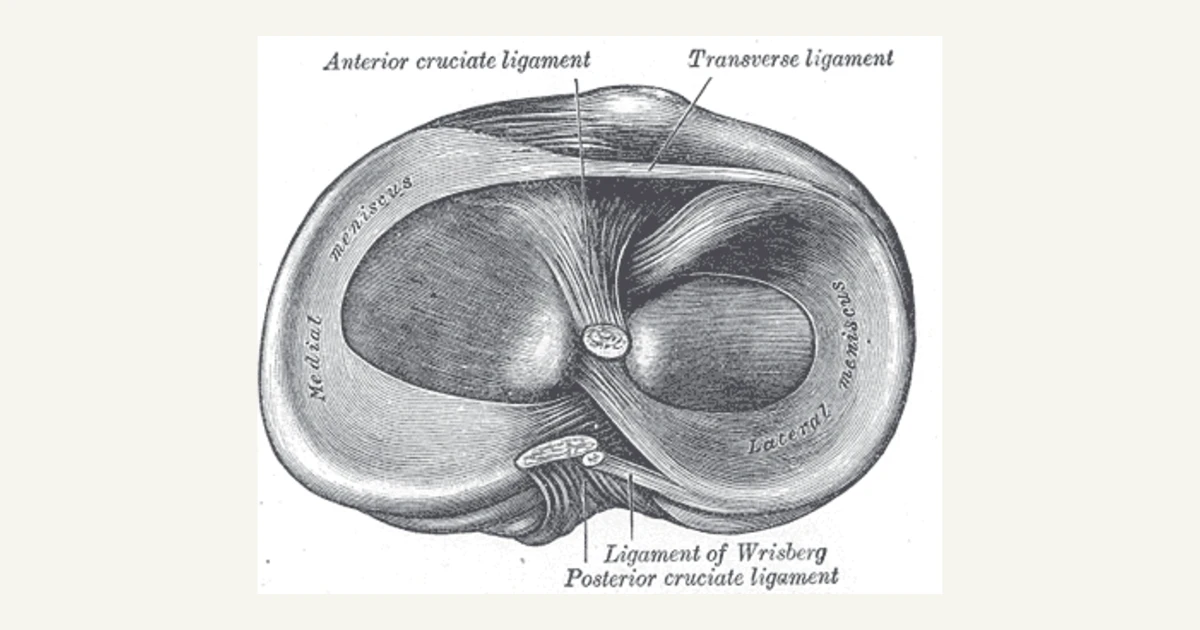
The meniscus is a crescent-shaped cartilage between the thigh bone and the shin bone, one on the inner side of the knee and one on the outer side. It cushions the load between them, and it handles up-and-down loads well. It tears when it is compressed and twisted at the same time: a pivot on a bent knee in basketball, netball, football or badminton, or a deep squat with a turn. The locking happens when the torn part of the meniscus blocks the movement of the knee.
Swelling often follows within hours. Sometimes it comes on later, or not at all, depending on the size and the place of the tear. Remember how it happened: the twist, where your foot was, whether it swelled that day. Your doctor and your physiotherapist will ask.
A bucket-handle tear runs a long way along the meniscus. Its inner strip flips into the middle of the joint, like the handle of a bucket, and the knee locks short of straight. It is the most common cause of a truly locked knee in younger, active people.
Over about 40, many tears are degenerative: the meniscus has frayed without a big injury. Catching is common with these, and true locking less so. In a trial of adults aged 35 to 65 with a degenerative tear, trimming the torn meniscus did not reduce catching or occasional locking any more than a placebo operation did.2 If you have a degenerative tear and the knee catches, ask your doctor what that trial means for your knee.
2. A loose body
A loose body is a piece of cartilage or bone floating inside the joint. It can come from an injury, from arthritis, or from osteochondritis dissecans, a condition of the bone under the cartilage seen most in teenagers and young adults. The knee locks at odd moments, often in one particular position, then frees when the piece moves. Some people feel a small lump that comes and goes. See knee cartilage injuries.
3. The kneecap
Pain around the kneecap can make the knee catch or give a sudden jolt on stairs and when you get up from a low chair. A kneecap that slips partly out of its groove and back feels like the knee giving way, with a shift at the front. Neither is a true lock. See kneecap and patellofemoral pain, and if the kneecap came fully out, dislocated kneecap.
4. An ACL injury with a meniscus tear
A pivot or a landing, a pop, swelling within hours, and a knee that has given way since points to the ACL. A torn ACL on its own rarely locks the knee. When a knee with a torn ACL also locks, a meniscus tear is usually caught in the joint, often a bucket-handle tear. See ACL injury and ACL surgery recovery.
5. A plica
A plica is a fold in the lining of the knee joint, most often on the inner side of the kneecap. When it thickens and gets irritated, it can snap or catch as the knee bends, with an ache after sitting. It catches without blocking the knee.
6. Arthritis
In a knee with osteoarthritis, rough joint surfaces and small fragments can make the knee catch or stick, and swelling can stop it straightening fully. Most of that is pseudo-locking. See knee osteoarthritis.
What to do now
If the knee is locked and will not straighten
- Do not force it straight. Do not let anyone pull or twist it to unlock it.
- Keep the weight off it. Use crutches if you have them, or someone to lean on, and rest the leg in the position that is most comfortable.
- An ice pack wrapped in a cloth for 15 to 20 minutes, for comfort.
- See a doctor the same day: your GP, a polyclinic or a sports doctor, or the emergency department if the pain is severe or you cannot take weight on the leg. A displaced bucket-handle tear is often repaired early, and that decision belongs to an orthopedic surgeon.
- Pain relief and anti-inflammatory medication are a decision for your doctor or pharmacist.
If the knee catches and then frees
- Keep it moving within comfort: walking on the flat, and an exercise bike on low resistance if it is comfortable.
- For two weeks, cut deep squats, kneeling, pivoting sport and long runs of stairs, instead of stopping exercise altogether.
- When it catches, sit down, take the weight off and bend and straighten it within comfort. Most catches free that way. If it does not free, treat it as locked.
- Tighten the thigh muscle with the leg straight and hold 5 seconds, 10 times, a few times a day.
- A cold pack for 10 to 15 minutes after activity, for comfort.
- Have it assessed if it catches more than once or twice, swells after activity, or gives way.
What treatment usually looks like
A doctor examines the knee, decides whether you need an X-ray or an MRI, and decides whether an arthroscopy, a keyhole operation, is needed. A knee that is truly locked by a displaced tear is an orthopedic surgeon’s decision. For a knee that catches without a block, physiotherapy is usually where treatment starts, and your doctor decides whether anything more is needed.
How it is examined
A physical examination will help to ensure a correct diagnosis. The examiner checks where the joint line is tender, whether the knee straightens fully and how it stops, and tests the ligaments. A medial meniscal tear can be mistaken for an MCL sprain, because the tear causes joint tenderness like the sprain. Tenderness from an MCL sprain usually settles over several weeks, while tenderness from a meniscal tear tends to persist. See inside knee pain.
Physiotherapy for catching and giving way
A knee that catches or gives way often has a thigh muscle that switched off with the first swelling and never came all the way back, and a last few degrees of straightening that went missing. The work is getting the knee fully straight, settling the swelling, rebuilding the thigh and the hip, and then training the pivot, the landing and the squat that set it off.
After meniscus or ACL surgery
A repaired meniscus and a trimmed one have different loading rules and different timelines, and the operation note tells your physiotherapist which you have. Your surgeon’s protocol takes precedence. See the Meniscus Surgery and Knee Arthroscopy Recovery Program, and after an ACL reconstruction, the ACL Reconstruction Recovery Program.
Is this normal?
Usually expected: a knee that clicks without pain. A catch on the first step after a long sit that frees by itself. Some swelling and stiffness for a few days after a twist, in a knee that still goes fully straight.
Worth getting checked: catching that comes more often each week. Swelling after every game. A knee you no longer trust on the stairs or on a turn.
When to see a doctor first
- Call 995 for chest pain or sudden breathlessness, especially with a painful, swollen calf after a knee injury, an operation or a long flight.
- Go to the emergency department now if the knee is locked with severe pain after a fall or a twist and you cannot take weight on it, if the knee looks deformed, or if the foot is cold, pale or numb. Also for a hot, red, swollen knee with a fever.
- See a doctor the same day if the knee is locked and will not straighten, even if you can walk on it. Also for calf pain and swelling, which can be a clot.
- See a doctor soon if the knee keeps catching or giving way, or swelling keeps coming back after activity.
What we measure
- Straightening and bending, in degrees. Lying down with the heel propped, against the other knee. If the knee goes straight when it is helped but not with your own thigh muscle, the difference is called a lag, and it is measured in degrees too.
- Swelling, graded. A stroke test over the knee grades the fluid in the joint from none to large, and a tape measures around the knee, week to week.
- Thigh strength. Quadriceps strength on each leg, or the number of single-leg sit-to-stands from a chair, against the other side.
- Single-leg balance. Seconds standing on each leg, eyes open, then eyes closed.
- The KOOS-12. Twelve questions on knee pain, function and quality of life, scored at the start and at each review.3
Tested, not dated. The load goes up when the numbers say so.
Locked knee: who does what
- A doctor (your GP, a polyclinic doctor, a sports doctor or the emergency department) examines the knee, makes the diagnosis, decides whether you need an X-ray or an MRI, decides about medication, and refers you to an orthopedic surgeon when a finding needs one.
- An orthopedic surgeon decides whether an arthroscopy is needed, and repairs or trims a torn meniscus or removes a loose body.
- A physiotherapist assesses and measures the knee, treats the stiffness and the swelling with hands-on work and exercise, rebuilds strength and control, explains what to load and when, and refers you back to a doctor when a finding needs one.
The four stages, applied to a locked or catching knee
In the Phoenix Recovery Protocol the work starts at Calm & Protect: settling the swelling, getting the thigh muscle switching on again, and protecting a repair if you had one. Move & Mobilize takes the knee fully straight first, then bending, measured against the other side. Rebuild & Strengthen loads the thigh and the hip from two legs to one. Return & Perform tests the tasks that set it off: the pivot, the landing, the deep squat, the lunge for a drop shot. None of the four is passive. The measures set the pace.
Where are you with this right now?
1. It is settling on its own
It caught once on the stairs last month and freed with a click. It has not happened since. The knee goes fully straight, there is no swelling, and you crouch to the bottom shelf at the supermarket without thinking about it. That is catching behaving as expected. You do not need us for this, and we would rather say so.
2. It keeps catching, and you have stopped trusting it
Two months ago you lunged for a drop shot and the knee stuck, bent, for a few seconds. It freed. Since then it has caught again getting out of a Grab, on the MRT stairs at Dhoby Ghaut, and getting up from a low stool at the kopitiam.
You stopped going to Thursday badminton. You take the lift at work. You get up from the sofa with a hand on the armrest, and you test the knee before you put weight on it. The futsal group still sends the Saturday booking, and you still say next week.
It always unlocks, so it cannot be serious. It has unlocked five times in eight weeks, and after each one you did a little less.
The knee straightens again. Has anyone measured the last few degrees, or your thigh strength against the other leg?
The club’s next season starts in January, and you have to tell the captain before then.
What our patients say
Google reviews from our clinics in Singapore.


If the knee is locked now and will not straighten, or anything in the doctor list applies, see a doctor first. If a doctor has ruled those out, or you never needed one, one Assessment & Treatment with a physiotherapist measures the straightening in degrees, grades the swelling, tests your thigh strength and balance against the other leg, treats what is limiting you in the same visit, and tells you which stage you are in.
3. You have had surgery, or you have a date
If a surgeon has repaired or trimmed your meniscus, or is about to, see the Meniscus Surgery and Knee Arthroscopy Recovery Program. If the locking came with a torn ACL, see the ACL Reconstruction Recovery Program. Your surgeon’s protocol takes precedence.
If you have been through rehabilitation and the knee still catches, swells or will not go fully straight, the Stalled Recovery Review is three weeks with the same physiotherapist. The first visit measures the straightening, the swelling, the thigh and your balance. The next two measure how they respond.
All of it runs on the same four stages. The Phoenix Recovery Protocol explains what each stage works on and what you have to meet to move up. No referral needed to start.
Next step
Find out which stage you are in
Pain is the first thing to leave. Movement and strength are the last things trained back, and most people stop before that part is done. One Assessment and Treatment is a single 45-minute appointment at $230, nett, no GST. Your therapist finds what is actually limiting you, treats it in the same appointment, and you leave with your current stage and a written plan.
Prefer to phone? Each of our five clinics has its own number on the clinics page. No referral needed to book.
Related reading
Sources: 1. Rhind JH, Khawar H, Webb M, Guthrie H. The locked knee. Br J Hosp Med (Lond). 2024;85(1):1-9. 2. Sihvonen R, Englund M, Turkiewicz A, Järvinen TL; FIDELITY Group. Mechanical symptoms and arthroscopic partial meniscectomy in patients with degenerative meniscus tear: a secondary analysis of a randomized trial. Ann Intern Med. 2016;164(7):449-455. 3. Gandek B, Roos EM, Franklin PD, Ware JE Jr. A 12-item short form of the Knee injury and Osteoarthritis Outcome Score (KOOS-12): tests of reliability, validity and responsiveness. Osteoarthritis Cartilage. 2019;27(5):762-770.
Where we are
Clinics across Singapore
ORCHARD
400 Orchard Road #12-12
Orchard Towers, S238875
NS22 Orchard MRT
Physiotherapy and hand therapy in Orchard →
WhatsApp 8800 1830TAMPINES
9 Tampines Grande #01-20
Asia Green, S528735
EW2DT32 Tampines MRT
Physiotherapy and hand therapy in Tampines →
WhatsApp 8780 9608SERANGOON
265 Serangoon Central Drive #04-269
S550265 · Lift C only
NE12CC13 Serangoon MRT
Physiotherapy and hand therapy in Serangoon →
WhatsApp 8892 4121TANJONG PAGAR
10 Anson Road #02-77A
International Plaza, S079903
EW15 Tanjong Pagar MRT
Physiotherapy and hand therapy in Tanjong Pagar →
WhatsApp 8227 7074JURONG EAST
2 Venture Drive #02-02
Vision Exchange, S608526
NS1EW24 Jurong East MRT
Opening 25 October 2026
Physiotherapy and hand therapy in Jurong East →
WhatsApp 8242 7340