
Written by Zita Sham, Fairuuz Saleh and Shiv Mohan Banka, Principal Physiotherapists at Phoenix Rehab.Clinically reviewed by Louise Yow, Principal Physiotherapist & Director, AHPC A1300363H.Last reviewed 6 October 2026.
Middle back pain on the left side is usually mechanical: an irritated rib joint beside the spine, a strained muscle, or a stiff thoracic joint. That kind changes when you twist, take a deep breath or press the spot. Pain that stays the same whatever you do, or comes with chest pain, fever or urinary symptoms, needs a doctor first.
Key takeaways
- Most middle back pain on the left side comes from a rib joint, a muscle or a thoracic joint, and it changes when you twist, take a deep breath or press the spot.
- Pain that no movement, breath or pressure changes is a question for a doctor before a physiotherapist.
- Chest pain, pressure or tightness spreading to the back, arm or jaw, or a sudden tearing pain in the back, means calling 995.
- Flank pain below the ribs with a fever, or with burning or blood when passing urine, needs a doctor the same day.
- A burning band around one side of the ribs, with or without a rash, can be shingles and needs a doctor the same day.
Where the middle back is, and what sits in front of the left side
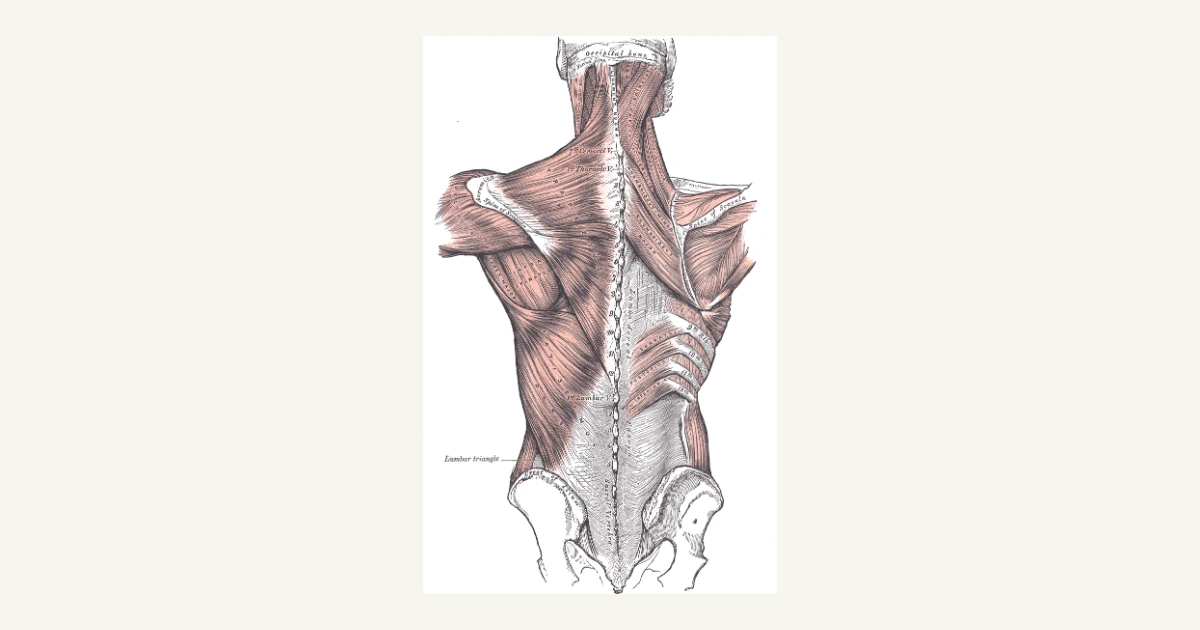
The middle back is the thoracic spine: roughly from the level between the shoulder blades down to the bottom of the ribs. Each rib meets the spine at two small joints. So the left side of the middle back holds a column of rib joints, the facet joints between the vertebrae, and layers of muscle: the rhomboids and middle trapezius higher up, the long erector spinae beside the spine, and latissimus dorsi wrapping round the lower ribs.
In front of all that, on the left, sit the heart, the aorta running down beside the spine, the left lung, the left kidney under the lowest ribs, the pancreas and the spleen. You can feel pain from any of them in your back. This page starts with a simple test for that reason, and puts the red flags before the exercises.
Is left side back pain a muscle, or something inside?
Three checks you can do sitting down.
- Turn. Cross your arms and turn slowly left, then right. Then lean back over the chair. Pain from a rib joint, a muscle or a facet joint usually changes with one of these: sharper one way, easier the other.
- Breathe. Take a slow, full breath in. An irritated rib joint or a strained muscle between the ribs often catches at the same point every time.
- Press. Ask someone to press gently with a thumb beside the spine, then a little further out over the ribs. A mechanical problem usually has a spot that reproduces your pain.
Pain that arrives with chest pain, breathlessness or sweating is a 995 call. Pain that none of this changes, that feels the same whether you lie, sit or walk, or that comes with fever, nausea or urinary symptoms, goes to a doctor first. A rib joint and the lung can both hurt on a deep breath. A catch on breathing with a fever or a cough points to the lung.
The common causes, in the order to check them
1. An irritated rib joint
The pattern we see most often on the left is a sharp spot one or two finger-widths out from the spine. It catches when you twist, reach back for the seatbelt, sneeze or breathe in deeply. It usually starts at a moment you can name: lifting a suitcase out of the car boot, a coughing fit during a cold, a night slumped on the sofa. The joint where the rib meets the spine is irritated, and the muscles around it tighten to guard it.
In studies of volunteers without back pain, irritating a single thoracic facet joint1 or a single rib joint2 produced a patch of pain on that side, close to the joint. A one-sided spot beside the spine fits that pattern, and the assessment tests it.
2. A strained muscle
The rhomboid runs between the spine and the inner edge of the shoulder blade, and aches after long hours at a laptop or a heavy rowing workout. See rhomboid pain. Lower down, the erector spinae run in a long band either side of the spine. A strain there follows a lift, a long drive or a jump in gym load, and feels like a ropey band you can press.
3. A stiff thoracic joint
The facet joints between the thoracic vertebrae stiffen with long sitting. This pain sits closer to the middle, catches when you lean back or turn, and eases once you have been moving for a while. Joints in the lower neck can also refer pain to the area between the shoulder blades3, so we check the neck as well.
4. Desk load and one-sided carrying
The left side often carries what the right hand does not. The laptop bag on the left shoulder. A toddler on the left hip. A handbag hooked over the left forearm for the whole MRT ride. A monitor set off to one side keeps the trunk turned for eight hours. One day of it injures nothing. Repeated daily for months, it loads the same muscles and joints on the same side.
5. Sport that turns the trunk
A golf swing, a badminton smash, a tennis serve, a rowing workout after weeks off. Each one turns the trunk hard and fast, and the rib joints and muscles on one side take the load. Pain that started with a swing and catches on the same movement is usually mechanical. A rib that aches with every rowing stroke and is tender at one point along its length needs a doctor to rule out a stress fracture. See stress fractures.
Woke up with it?
If the left middle back is worst in the first hour after waking and eases by mid-morning, the night is part of the problem: the mattress, the pillow, or lying on the left side with the arm tucked under you. That pattern has its own guide, upper back pain after waking up. Pain that wakes you every night whatever position you lie in is different, and it is in the red flags below.
How to tell them apart
| What you notice | Most likely | Who to see first |
|---|---|---|
| A sharp spot beside the spine that catches on twisting, a deep breath or a sneeze | Rib joint irritation | Physiotherapist |
| An ache along the inner edge of the shoulder blade, worse by late afternoon at the desk | Rhomboid or middle trapezius overload | Physiotherapist |
| A ropey band in the long muscle beside the spine after a lift, a drive or a gym workout | Erector spinae strain | Physiotherapist |
| Stiff and closer to the middle, catches when you lean back, eases once you are moving | Thoracic facet joint | Physiotherapist |
| Catches along one rib at the side after a cough or a twist | Intercostal muscle strain | Physiotherapist |
| A burning band wrapping round toward the front, skin sore to the touch of a shirt | Shingles, before or with the rash | Doctor, same day |
| Lower, below the ribs into the flank, with fever or burning when passing urine | Kidney | Doctor, same day |
| Pressure or tightness in the chest spreading to the back, arm or jaw | Heart | Call 995 |
What we measure
- Rotation, each way. Seated with the arms crossed, measured in degrees to the left and to the right. The difference between sides is often bigger than people expect.
- Rib movement. A tape around the lower chest, read at full breath out and full breath in.
- The level. Which segment, and which side, reproduces your pain when pressed, so treatment goes to the right joint.
- Shoulder blade endurance. How long you hold the shoulder blades set with the arms lifted, lying face down, and which side lets go first.
- The neck. Whether turning or tilting the head changes the pain.
Tested, not dated. The load goes up when the numbers say so.
What you can do this week
- Keep moving. Walk every day, and get up from the desk every 30 to 45 minutes.
- Open-book rotation. Lie on your right side, knees bent, both arms out in front. Open the top arm across to the floor behind you and follow it with your eyes. 10 slow repetitions, twice a day, then the other side.
- Breathe into the sore side. Sitting, rest a hand on your left lower ribs, breathe in slowly and let the ribs push into your hand. Five breaths, a few times a day. Shallow breathing to avoid the catch leaves the ribs stiffer.
- Split the load. Use both straps of the backpack, swap the bag between shoulders through the day, and carry the child on the other hip.
- If a sport set it off, drop the swing or smash that finds it for two weeks, and keep the rest of your game if the next morning is no worse.
- Heat for 15 minutes can ease the ache. Pain relief and anti-inflammatory medication are a decision for your doctor or pharmacist.
Is this normal? When to worry about left side back pain
A sharp catch on twisting a few days after a cough or a lift, an ache that comes and goes with the desk, stiffness after a long drive: in our experience these are common, and usually mechanical. Left-sided pain in the middle back also has causes outside the back that must not be missed: the heart, the aorta, the lung, the kidney, the pancreas, and shingles. This is where each one sits.
When to see a doctor first
- Call 995 if you have chest pain, pressure or tightness spreading to the back, left arm, neck or jaw, especially with breathlessness, sweating, nausea or lightheadedness. Women, people with diabetes and older adults can have a less typical version, with back or jaw pain and breathlessness but little chest pain. Also call 995 for a sudden, severe, tearing or ripping pain in the back or between the shoulder blades, or sudden breathlessness with a sharp pain on breathing in.
- Go to the emergency department now if you have back pain with a high fever, shivering and vomiting; severe pain in the upper abdomen that bores through to the back, with vomiting; waves of severe pain from the flank toward the groin that no position eases; lightheadedness or breathlessness after a fall or a blow to the left side of the back or ribs; or new numbness or weakness in the legs, numbness from the chest down, or trouble controlling your bladder or bowel.
- See a doctor the same day if you have flank pain below the ribs with a fever, or burning or blood when passing urine; a burning or tingling band around one side of the ribs, with or without a rash, which can be shingles before the blisters appear; pain on breathing in with a cough or fever; or sudden pain in the middle back after a minor fall, a lift or even a cough if you are over 50 or have osteoporosis. See spinal compression fracture.
- See a doctor soon if the pain wakes you every night whatever position you lie in, is there at rest and getting worse, comes with weight loss you cannot explain or a past history of cancer, does not change with any movement, breath or pressure, or has not improved after six weeks of sensible changes.
Where are you with this right now?
1. It is settling on its own
With a rib joint or a muscle strain on the left, the catch on breathing usually goes first, then the pain on twisting, and the tender spot last.
Most episodes of back pain settle substantially within six weeks, and staying active beats resting. Scans early on tend to find changes that are common in people with no pain at all. If it is easing week on week and you are moving more rather than less, that is the normal course. You do not need us for this, and we would rather say so.
2. It has stopped improving
The seatbelt gives it away. You reach across with your right hand now, so you never turn left. The laptop bag lives on the right shoulder. A sneeze at your desk stops you mid-sentence, one hand flat on the table.
It started six weeks ago. You have stretched over the back of the chair, leaned into a door frame and moved the monitor, and by three in the afternoon it is back: the same spot, the same side. The badminton racquet has been in the car boot for a month.
Waiting for it to loosen up has not loosened it. It goes quiet over a slow weekend and returns on Monday. Has anyone measured how far you turn to the left, against the right? That is the gap worth measuring, and it is not measured by how you feel on the day.
The Stalled Recovery Review is three appointments over three weeks with the same therapist, because what a joint does under load cannot be read in one visit. The first finds what is limiting it. The next two measure how it responds. $690, nett, no GST, which is three appointments at $230.
3. You have had surgery, or you have a date
Recovery after an operation has a shape, and knowing which stage you are in tells you whether you are on it. See the recovery programs, or upper back physiotherapy if you are not sure which applies to you.
If a doctor has diagnosed a thoracic compression fracture, in a brace or out of one, read spinal compression fracture. For recovery after spinal surgery, see physiotherapy after surgery.
All of it runs on the same four stages. The Phoenix Recovery Protocol explains what each stage works on and what you have to meet to move up. No referral needed to start.
Next step
Find out which stage you are in
Pain is the first thing to leave. Movement and strength are the last things trained back, and most people stop before that part is done. One Assessment and Treatment is a single 45-minute appointment at $230, nett, no GST. Your therapist finds what is actually limiting you, treats it in the same appointment, and you leave with your current stage and a written plan.
What our patients say
Google reviews from our clinics in Singapore.


Prefer to phone? Each of our five clinics has its own number on the clinics page. No referral needed to book.
Related reading
- Upper left back pain: causes and what to do
- Pain between the shoulder blades
- Rhomboid pain, between the spine and the shoulder blade
- Intercostal muscle strain: rib pain when you breathe, cough or twist
- Upper back pain after waking up
- Upper back physiotherapy
- The Phoenix Recovery Protocol, and the four stages
Sources: 1. Dreyfuss P, Tibiletti C, Dreyer SJ. Thoracic zygapophyseal joint pain patterns: a study in normal volunteers. Spine. 1994;19(7):807-811. 2. Young BA, Gill HE, Wainner RS, Flynn TW. Thoracic costotransverse joint pain patterns: a study in normal volunteers. BMC Musculoskelet Disord. 2008;9:140. 3. Dwyer A, Aprill C, Bogduk N. Cervical zygapophyseal joint pain patterns I: a study in normal volunteers. Spine. 1990;15(6):453-457.
Where we are
Clinics across Singapore
ORCHARD
400 Orchard Road #12-12
Orchard Towers, S238875
NS22 Orchard MRT
Physiotherapy and hand therapy in Orchard →
WhatsApp 8800 1830TAMPINES
9 Tampines Grande #01-20
Asia Green, S528735
EW2DT32 Tampines MRT
Physiotherapy and hand therapy in Tampines →
WhatsApp 8780 9608SERANGOON
265 Serangoon Central Drive #04-269
S550265 · Lift C only
NE12CC13 Serangoon MRT
Physiotherapy and hand therapy in Serangoon →
WhatsApp 8892 4121TANJONG PAGAR
10 Anson Road #02-77A
International Plaza, S079903
EW15 Tanjong Pagar MRT
Physiotherapy and hand therapy in Tanjong Pagar →
WhatsApp 8227 7074JURONG EAST
2 Venture Drive #02-02
Vision Exchange, S608526
NS1EW24 Jurong East MRT
Opening 25 October 2026
Physiotherapy and hand therapy in Jurong East →
WhatsApp 8242 7340Questions people ask
Is middle back pain on the left side usually a muscle?
Usually it is mechanical: an irritated rib joint beside the spine, a strained muscle such as the rhomboid or erector spinae, or a stiff thoracic joint. That kind of pain changes when you twist, take a deep breath or press the spot. Pain that stays the same whatever you do needs a doctor first.
When should I worry about left side back pain?
Call 995 for chest pain or pressure spreading to the back, arm or jaw, for a sudden tearing pain in the back, or for sudden breathlessness with sharp pain on breathing in. See a doctor the same day for flank pain with fever or burning urine, or a burning band around one side of the ribs.
Why does my left middle back hurt when I breathe in?
A deep breath moves every rib joint, so an irritated rib joint or a strained muscle between the ribs often catches at the same point on each breath. Pain on breathing in that comes with a cough or a fever points to the lung and needs a doctor the same day.
What does a physiotherapist measure for left middle back pain?
Rotation to each side in degrees, rib movement with a tape at full breath in and out, which segment and side reproduce the pain when pressed, how long the shoulder blades hold with the arms lifted lying face down, and whether neck movement changes the pain. The load goes up when the numbers say so.
Why does my middle back hurt when I wake up?
Stiffness that is worst in the first hour after waking and eases by mid-morning points to the night: the mattress, the pillow, or lying on the left side with the arm tucked under you. Pain that wakes you every night whatever position you lie in needs a doctor soon.