
Written by the Phoenix Rehab physiotherapy team.Clinically reviewed by Louise Yow, Principal Physiotherapist & Director, AHPC A1300363H.Last reviewed 4 October 2026.
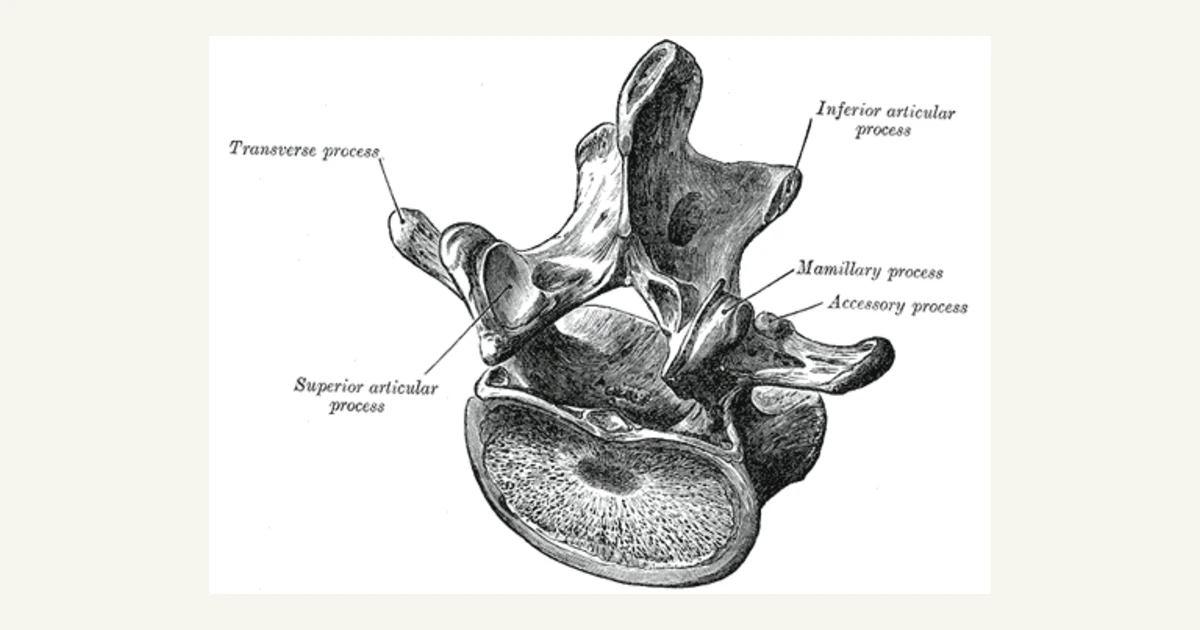
A spinal compression fracture is a vertebra that has collapsed at the front, usually because the bone is thinner than it should be. It often happens with something small: lifting a pail, a hard cough, a slip onto the bottom. Many happen at the junction of the mid and low back, the T12 and L1 vertebrae. The sharp pain usually settles over six to twelve weeks. The bone that broke is a signal about the bones that have not.
What does a compression fracture feel like?
- Sudden back pain, often in the middle or low back, after a small strain or for no clear reason.
- Worse standing, walking and turning in bed. Better lying still.
- Pain that can wrap around the ribs to the front.
- Over months, some people notice they have lost height or that their upper back has rounded.
Many spinal fractures are never diagnosed.1 If you are over 50, have osteoporosis, or take steroid tablets, sudden back pain after a small strain is worth a doctor’s look. Your doctor decides whether you need an X-ray or a scan.
Compression fracture or something else?
| What you notice | More likely | Who first |
|---|---|---|
| Sudden mid or low back pain after a small lift, cough or fall, age over 50 | Osteoporotic compression fracture | A doctor |
| Back pain after a car accident or a fall from a height | A fracture from force, which can be unstable | Emergency department now |
| Back pain that builds at night, with weight loss or a past cancer | A fracture or problem in the bone from another cause | A doctor the same day |
| Low back pain after bending, worse sitting, no fall, no bone history | A back strain or disc | Lower back pain: which kind you have |
How long does a compression fracture take to heal?
| Weeks | What usually happens |
|---|---|
| 0 to 2 | The worst pain. Short walks and changing position often, as comfort allows. Your doctor manages pain relief and decides about a brace. |
| 2 to 6 | Pain easing. Walking further, sitting longer, getting in and out of bed with less of a fight. |
| 6 to 12 | Most of the sharp pain has gone. The back muscles, balance and confidence have not come back by themselves. |
| 3 months on | The bone has usually healed. What is left is the strength, the posture and the fear of bending. |
These are typical ranges. Your doctor’s plan comes first. Vertebroplasty and kyphoplasty, where cement is injected into the vertebra, are a spine doctor’s decision.
The fracture is the warning
A first spinal fracture raises the chance of another. In one study of older women with osteoporosis who were not on treatment, about one in five who had a spinal fracture had another within a year.2 That is why your doctor will usually check your bone density and talk about bone treatment. That part is your doctor’s. The part that is ours is the back muscles, the balance and the way you bend and lift, because those can be measured and trained.
What to avoid, and what to do instead
| Instead of | Try |
|---|---|
| Bending from the waist to pick things up | Bending at the hips and knees, back long, the object close |
| Sit-ups, toe touches, twisting to the side under load | Back extensor work and standing balance, chosen and checked by your physiotherapist |
| Lifting the full pail or the grandchild out of the cot | Half-filled pails, waiting until the grandchild can climb up to you |
| Staying in bed until it stops hurting | Short walks several times a day, inside your pain |
The exercise advice for people with spinal fractures is consistent: balance training, back extensor strength and safe movement every day, and avoid loaded forward bending and twisting.3
What we measure
- Back extensor endurance. How long you can hold the upper back up, timed in seconds.
- Legs. Five chair stands, timed. See sarcopenia for why that number matters.
- Balance. Standing on one leg, and the timed up-and-go test.
- Posture. The gap between the back of the head and the wall, standing.
- Walking. How many minutes before the back asks you to stop.
Tested, not dated. You lift, carry and bend more when the measures say so. Pain is the first thing to leave. Strength is the last to train and recover.
When to see a doctor first
- Call 995 for sudden chest or upper back pain with breathlessness, sweating or feeling faint, or if the back pain followed a car accident or a fall from a height and you cannot move safely.
- Go to the emergency department now for numbness between the legs, new trouble passing urine or stool, leaking urine or stool you cannot control, or new weakness in both legs.
- See a doctor the same day for back pain with a fever, back pain with a past cancer or unexplained weight loss, or if one leg is going weak or numb.
- See a doctor soon for sudden back pain after a small strain if you are over 50, have osteoporosis or take steroid tablets, so the fracture can be confirmed and your bones checked.
Where are you with this right now?
1. It is settling on its own
If each week you walk a little further, get out of bed with less of a struggle, and your doctor has checked your bones, keep going. Keep walking. You are probably in Stage 1 or 2 of 4.
2. It has stopped improving
Ten weeks since your mother lifted the rice cooker and felt it go. The X-ray showed L1. The pain is much better now. But she no longer bends to the low cupboard, she holds the wall in the corridor, and she has stopped going to the market on her own. Everyone says it is healed. The bone has. Her back strength and her balance have not been measured.
WhatsApp us · Get Assessed & Treated · One 45-minute appointment, $230, nett, no GST.
3. You have had surgery, or you have a date
After vertebroplasty, kyphoplasty or spinal fixation, the stages are set with your surgeon. See physiotherapy after surgery. All of it runs on the four stages of the Phoenix Recovery Protocol.
Related reading
Sources: 1. Cooper C, Atkinson EJ, O’Fallon WM, Melton LJ 3rd. Incidence of clinically diagnosed vertebral fractures: a population-based study in Rochester, Minnesota, 1985-1989. J Bone Miner Res. 1992;7(2):221-227. 2. Lindsay R, Silverman SL, Cooper C, et al. Risk of new vertebral fracture in the year following a fracture. JAMA. 2001;285(3):320-323. 3. Giangregorio LM, Papaioannou A, Macintyre NJ, et al. Too Fit To Fracture: exercise recommendations for individuals with osteoporosis or osteoporotic vertebral fracture. Osteoporos Int. 2014;25(3):821-835.
Where we are
Clinics across Singapore
ORCHARD
400 Orchard Road #12-12
Orchard Towers, S238875
NS22 Orchard MRT
Physiotherapy and hand therapy in Orchard →
What our patients say
Google reviews from our clinics in Singapore.



TAMPINES
9 Tampines Grande #01-20
Asia Green, S528735
EW2DT32 Tampines MRT
Physiotherapy and hand therapy in Tampines →
WhatsApp 8780 9608SERANGOON
265 Serangoon Central Drive #04-269
S550265 · Lift C only
NE12CC13 Serangoon MRT
Physiotherapy and hand therapy in Serangoon →
WhatsApp 8892 4121TANJONG PAGAR
10 Anson Road #02-77A
International Plaza, S079903
EW15 Tanjong Pagar MRT
Physiotherapy and hand therapy in Tanjong Pagar →
WhatsApp 8227 7074JURONG EAST
2 Venture Drive #02-02
Vision Exchange, S608526
NS1EW24 Jurong East MRT
Opening 25 October 2026
Physiotherapy and hand therapy in Jurong East →
WhatsApp 8242 7340