
Written by the Phoenix Rehab physiotherapy team.Clinically reviewed by Louise Yow, Principal Physiotherapist & Director, AHPC A1300363H.Last reviewed 4 October 2026.
Tailbone pain (coccydynia) is pain right at the bottom of the spine, felt most when you sit, lean back in a chair or stand up from sitting. It usually starts after a fall onto the bottom, after childbirth, or after long hours on a hard seat or a bike. Most cases settle within weeks to a few months once the pressure on the coccyx is taken off. A few need a doctor.
What tailbone pain feels like
- A sharp or aching spot at the very bottom of the spine, just above the buttock crease.
- Worse sitting, especially on hard chairs or leaning back on a sofa.
- A jab of pain as you get up from sitting, which then eases standing.
- Sometimes pain on opening the bowels, or during sex.
It is more common in women, partly because of childbirth and the shape of the pelvis.1
What causes it
| Cause | What usually happened |
|---|---|
| A fall | Sitting down hard: a slip on a wet floor, a missed chair, a fall on the stairs, a snowboarding fall |
| Childbirth | The coccyx moves back during delivery and can be strained or, less often, dislocated |
| Sitting load | Long hours on a hard seat, slumped back onto the tailbone; long rides on a bike or on a rowing machine |
| Pelvic floor tension | The pelvic floor muscles attach to the coccyx; when they stay tight, the pull can keep it sore |
| No clear cause | Common. A doctor checks for the rare serious causes |
How to relieve tailbone pain
- Sit forward. Lean slightly forward so the weight goes through the sit bones, not the tailbone. Avoid slumping back into soft sofas.
- Use a cushion with a cut-out at the back. A wedge or U-shaped cushion takes pressure off the coccyx. A ring cushion is less helpful for some people.
- Break up sitting. Stand every 20 to 30 minutes.
- Keep the bowels soft. Straining hurts. Your doctor or pharmacist can advise if constipation is part of it.
- Pain medicine is your doctor’s or pharmacist’s decision.
What physiotherapy does for tailbone pain
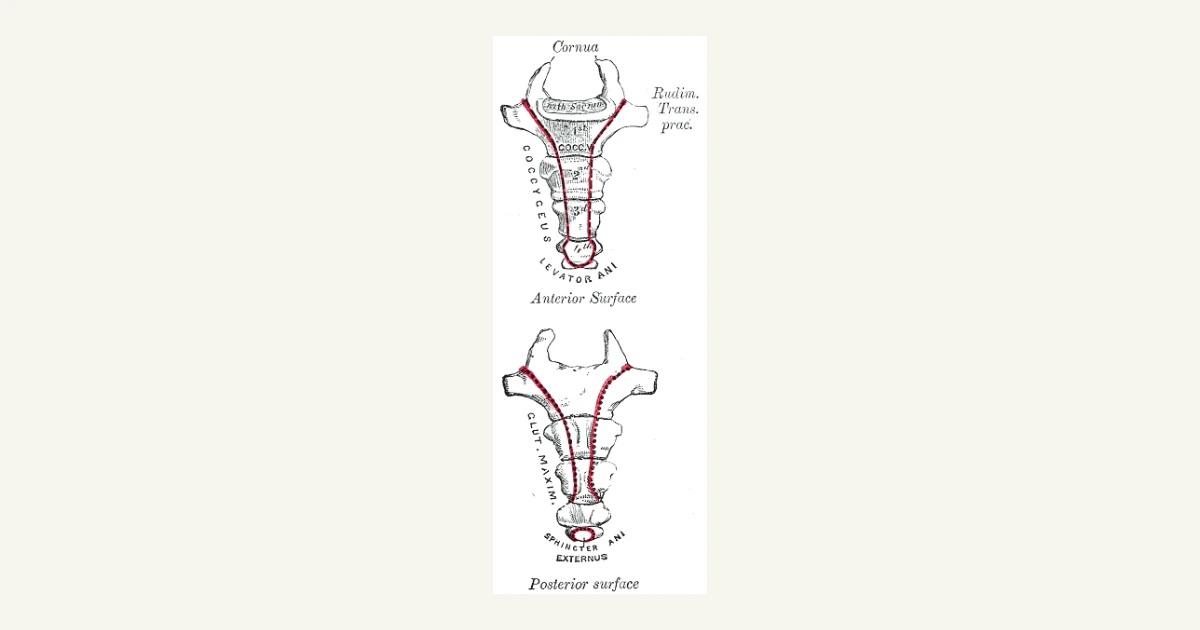
We assess how you sit, stand and move, the hips and low back, and the pelvic floor muscles that attach to the coccyx. Treatment can include posture and sitting changes, pelvic floor relaxation, stretching and strengthening of the hips and trunk, and hands-on treatment of the surrounding muscles. Where pain persists, your doctor may consider an injection; that is a doctor’s decision. See pelvic floor physiotherapy.
Tailbone pain and cancer: should you worry?
Almost all tailbone pain is mechanical: a fall, childbirth or sitting. Tumors at the coccyx are rare. The signs that need a doctor are pain with no injury behind it that keeps getting worse, pain at night that does not change with position, weight loss you cannot explain, or a lump. Those are reasons to see a doctor soon, not reasons to panic.
When to see a doctor first
- Go to the emergency department now for numbness between the legs or around the back passage, new trouble passing urine or stool, or weakness in the legs.
- See a doctor the same day for a red, swollen, painful lump near the top of the buttock crease, especially with fever or discharge, or after a fall if you cannot sit or walk.
- See a doctor soon for pain with no injury that keeps getting worse, night pain, weight loss you cannot explain, bleeding from the back passage, or pain that has not eased in two to three months.
Where are you with this right now?
1. It is settling on its own
If sitting is a little easier each week with the cushion and the forward lean, keep at it. You do not need us for this, and we would rather say so.
2. It has stopped improving
Four months since the baby, or since the fall in the bathroom. You still perch on the edge of every chair, carry the cushion to the office, and brace before you stand. You have been told it will go away by itself. Often it does. When it has not by now, the sitting habits, the hips and the pelvic floor around the coccyx are worth assessing properly.
WhatsApp us · Get Assessed & Treated · One 45-minute appointment, $230, nett, no GST.
3. After surgery
Removal of the coccyx is uncommon. After it, the stages are set with your surgeon. See physiotherapy after surgery. All of it runs on the four stages of the Phoenix Recovery Protocol.
Related reading
Sources: 1. Lirette LS, Chaiban G, Tolba R, Eissa H. Coccydynia: an overview of the anatomy, etiology, and treatment of coccyx pain. Ochsner J. 2014;14(1):84-87.
Where we are
Clinics across Singapore
ORCHARD
400 Orchard Road #12-12
Orchard Towers, S238875
NS22 Orchard MRT
Physiotherapy and hand therapy in Orchard →
What our patients say
Google reviews from our clinics in Singapore.


TAMPINES
9 Tampines Grande #01-20
Asia Green, S528735
EW2DT32 Tampines MRT
Physiotherapy and hand therapy in Tampines →
WhatsApp 8780 9608SERANGOON
265 Serangoon Central Drive #04-269
S550265 · Lift C only
NE12CC13 Serangoon MRT
Physiotherapy and hand therapy in Serangoon →
WhatsApp 8892 4121TANJONG PAGAR
10 Anson Road #02-77A
International Plaza, S079903
EW15 Tanjong Pagar MRT
Physiotherapy and hand therapy in Tanjong Pagar →
WhatsApp 8227 7074JURONG EAST
2 Venture Drive #02-02
Vision Exchange, S608526
NS1EW24 Jurong East MRT
Physiotherapy and hand therapy in Jurong East →
WhatsApp 8242 7340