
Written by the Phoenix Rehab physiotherapy team.Clinically reviewed by Louise Yow, Principal Physiotherapist & Director, AHPC A1300363H.Last reviewed 2 October 2026.
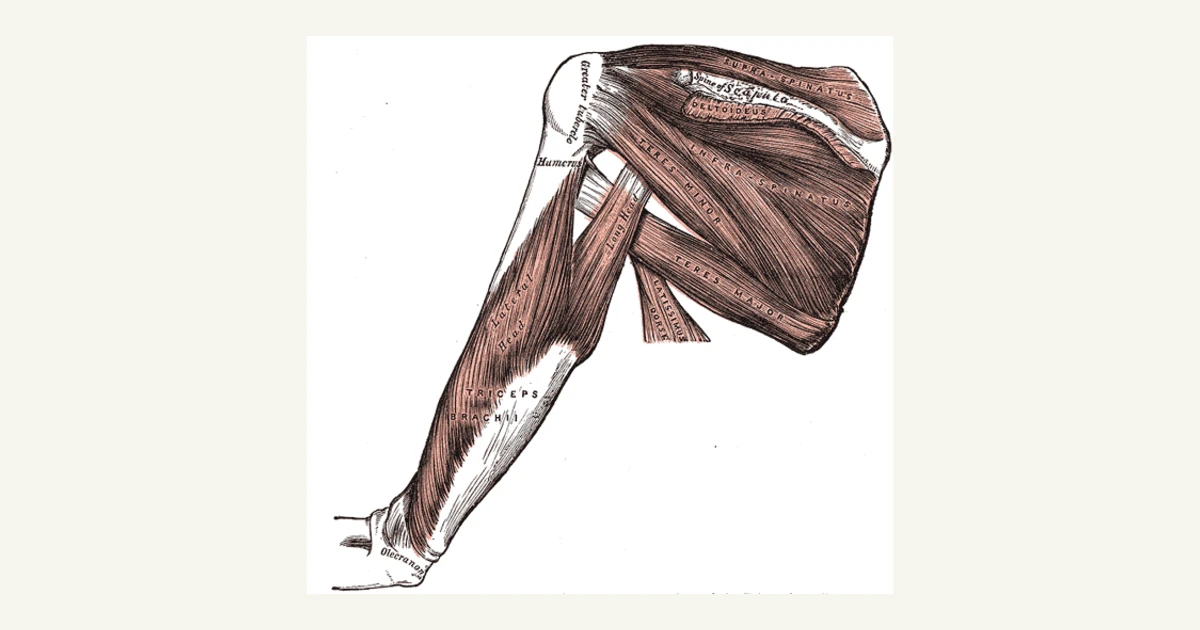
Teres minor is one of the four rotator cuff muscles: it turns the arm outward and holds the ball of the shoulder steady in its socket. Teres major is not part of the rotator cuff: it pulls the arm down and in and turns it inward, working with the latissimus dorsi (the lats). When either hurts, you feel it at the back of the shoulder or armpit.
What are teres major and teres minor?
Two small muscles running side by side from the outer edge of the shoulder blade to the upper arm, teres minor above, teres major below. They wrap the arm from opposite sides, so they turn it in opposite directions.
| Teres minor | Teres major | |
|---|---|---|
| Starts (origin) | Upper outer edge of the shoulder blade | Lower corner (inferior angle) of the shoulder blade |
| Attaches (insertion) | Greater tubercle, back of the upper arm | Bicipital groove, front of the upper arm |
| Nerve | Axillary nerve | Lower subscapular nerve |
| Main action | Turns the arm out; steadies the ball | Pulls the arm down and in; turns it in |
| Rotator cuff? | Yes | No |
Is teres major part of the rotator cuff?
No. The rotator cuff is supraspinatus, infraspinatus, teres minor and subscapularis, whose tendons blend into the joint capsule and keep the ball centered. Teres major attaches further down the arm and works as a smaller partner to the lats.
What does teres major or teres minor pain feel like?
A deep ache at the back of the shoulder or the back of the armpit, often with one tender spot on the edge of the shoulder blade. It is worse reaching overhead, throwing, pulling, swimming, climbing or rowing.
Teres minor tends to complain when you turn the arm out under load, or as it brakes the arm at the end of a throw. Teres major complains when you pull down hard: a pull-up, a climbing move, the catch of a freestyle stroke. The shoulder pain chart helps you place your pain.
Teres major strain and teres minor injury
A teres major strain usually happens in throwing and pulling sports: a hard pitch, a smash, a heavy pull-up set. You feel a sharp pull at the back of the armpit, then soreness when you pull or reach up.
Teres minor is rarely injured on its own. It usually suffers with the rest of the cuff, in tendinopathy or a tear, often working harder when infraspinatus is weak. Our rotator cuff guide covers that side.
What is quadrilateral space syndrome?
A rare condition in which the axillary nerve is squeezed in a small gap bordered by teres minor, teres major, the long head of triceps and the upper arm bone. It is mostly seen in overhead athletes and gives a vague ache at the back of the shoulder, sometimes with tingling down the outer arm, worse with the arm overhead and turned out. A doctor confirms it with imaging, so see your GP or a sports doctor.
How we test teres minor and teres major
We test strength turning the arm outward and inward, elbow at your side and again with the arm lifted to 90 degrees, and compare sides. We also check how far the shoulder turns.
The hornblower test is one a clinician uses. With the arm lifted to the side, you try to turn it outward. If you cannot, and you lift the elbow above the hand to bring the hand to your mouth, like blowing a horn, teres minor is likely not working. That usually goes with a large cuff tear, and we refer you to a doctor.
Teres major and teres minor stretches
- Sleeper-type stretch (teres minor): lie on the sore side, arm in front at shoulder height, elbow bent to 90 degrees. Use the other hand to ease the forearm toward the floor. Stop at a mild stretch.
- Overhead lat stretch (teres major): kneel facing a bench, hands on it, and sit your hips back until the back of the armpit lengthens.
Hold each for about 30 seconds, two or three times, once or twice a day.
Teres major exercises and teres minor strengthening
- Stage 1, Calm & Protect: move the arm below shoulder height; pause the pulling or throwing that sets it off.
- Stage 2, Move & Mobilize: side-lying external rotation, unweighted then with a light dumbbell; band external rotation, elbow at your side.
- Stage 3, Rebuild & Strengthen: band or cable rows, straight-arm pulldowns, then band external rotation with the arm at 90 degrees.
- Stage 4, Return & Perform: pull-ups, throwing, swimming or climbing, built back up over a few weeks.
Move up a level when you can do three sets of 15 with pain no higher than 3 out of 10 during the exercise, and it has settled by the next morning. If it is worse the next day, drop back a level for a week. Swimmers, see swimming injuries.
When to see a doctor first
- Go to the emergency department now if your shoulder has come out and not gone back in.
- See a doctor soon if, after a dislocation, the outer shoulder is numb or the arm is weak lifting out to the side. That can be the axillary nerve.
Where are you with this right now?
1. It is settling on its own
If it came on after a heavy pulling or throwing day and eases each week, keep moving, stretch, halve your pulling volume for two weeks, then build back. You do not need us for this, and we would rather say so.
2. It has stopped improving
You still feel it on the third pull-up. You swim breaststroke because freestyle catches at the armpit, and reach the top shelf with the other hand. Same ache as six weeks ago. Every first visit is one 45-minute Assessment & Treatment, $230, nett, no GST. If it has been months, the Stalled Recovery Review is three appointments over three weeks with the same therapist, $690.
3. You have had surgery, or you have a date
After a rotator cuff repair or shoulder stabilization, rehab follows your surgeon’s protocol. See physiotherapy after surgery. All of it runs on the four stages of the Phoenix Recovery Protocol.
Related reading
Sources: Walch G, Boulahia A, Calderone S, Robinson AH. The “dropping” and “hornblower’s” signs in evaluation of rotator-cuff tears. J Bone Joint Surg Br. 1998. Cahill BR, Palmer RE. Quadrilateral space syndrome. J Hand Surg Am. 1983.
Where we are
Clinics across Singapore
ORCHARD
400 Orchard Road #12-12
What our patients say
Google reviews from our clinics in Singapore.


Orchard Towers, S238875
NS22 Orchard MRT
Physiotherapy and hand therapy in Orchard →
WhatsApp 8800 1830TAMPINES
9 Tampines Grande #01-20
Asia Green, S528735
EW2DT32 Tampines MRT
Physiotherapy and hand therapy in Tampines →
WhatsApp 8780 9608SERANGOON
265 Serangoon Central Drive #04-269
S550265 · Lift C only
NE12CC13 Serangoon MRT
Physiotherapy and hand therapy in Serangoon →
WhatsApp 8892 4121TANJONG PAGAR
10 Anson Road #02-77A
International Plaza, S079903
EW15 Tanjong Pagar MRT
Physiotherapy and hand therapy in Tanjong Pagar →
WhatsApp 8227 7074JURONG EAST
2 Venture Drive #02-02
Vision Exchange, S608526
NS1EW24 Jurong East MRT
Opening 25 October 2026
Physiotherapy and hand therapy in Jurong East →
WhatsApp 8242 7340